You are browsing the archive for: October 2009
30 October 2009

FAA Approved?

I found this on an aviation forum and I just can’t stop staring at the photographs.

bear_attack_01

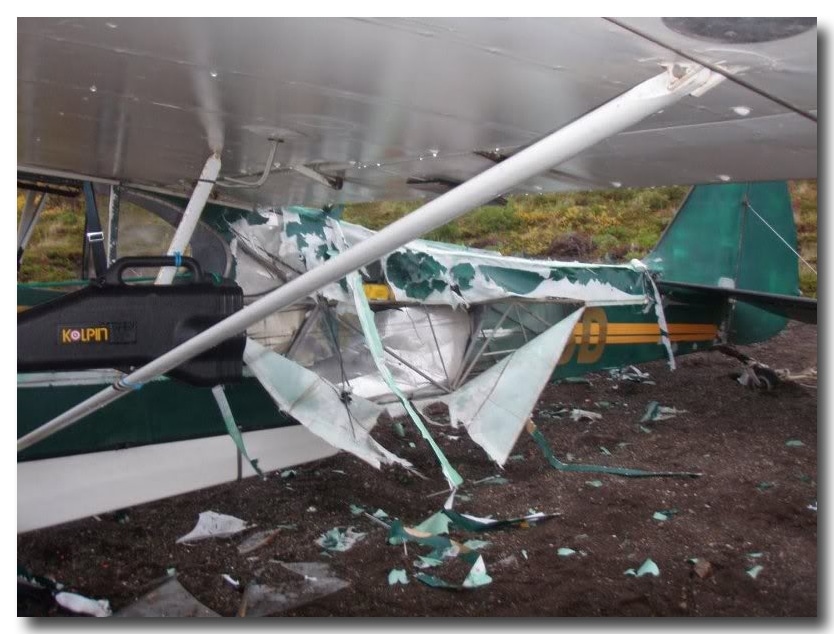
N9368D is a Piper Supercub registered in Anchorage.

Ouch

Apparently, the owner went on a fishing trip and left the catch in the plane.

Easier than a tin can

A bear smelled the food and tore the plane apart to get to it. I suppose a Piper is easier to open than a tin can…

Frontal Attack

Take a look at the horizontal stabilizer. Wow.

Ingenious

So, the story goes that the Alaskan pilot had 2 new tires, three cases of speed tape and several rolls of cellophane delivered to the site and promptly repaired his plane so that he could fly it home.

FAA Approved?

If you look closely, you can just about see that he wrote the registration on the side with a ball-point pen.

Would you get in?

Update: Alaska Dispatch say they got the whole story from the pilot’s father: An appetite for revenge

23 October 2009

Frequently Asked Questions

Not all of these questions are really all that frequent, if I’m honest with you. Most of them are more like occasionally asked questions. Or in the case of the last question: asked once, by my mother.

Nevertheless, I will endeavour to answer them all.

How many people can you fit into your plane?

The Saratoga seats six people. However, those six people should be fairly friendly as they will be bumping knees throughout the flight. The bigger issue is weight.

The Saratoga can carry up to 1,149 pounds or 521 kilos. Filling the fuel tanks uses up 614 of those pounds (278 kg), leaving us with 535 pounds or 278 kilos. You could fit 6 lightly dressed people into the plane but they’d have to weigh under 90 pounds each. That’s 6½ stone. 40 kilos. I haven’t weighed that little since I was 14 so among other things, you’d have to get a new pilot.

You can, however, take less fuel and more people, so having six seats can be useful for short flights.

How fast can your plane fly?

At 10,000 feet, the Saratoga has a cruise speed of 175 knots which is about 324 km/h (200 mph). We have a burn rate of about 18 US gallons an hour at this cruising speed.

Do you fly straight from Málaga to England?

No, we stop to refuel, usually in southern France as that makes for a comfortable break point. It’s about 6.5 hours in total, so it’s nice to split it after three and a half hours to have a lunch break.

How much fuel do you use?

This is very approximate, but:

At a cruising speed of 175 knots and a burn rate of 18 gph, that’s 11 miles per US gallon, 13 miles to the imperial gallon or 21 litres per 100 kilometres.

Do I have any antipodean readers? That’s 5 kilometres per litre to you.

How much does it cost to fill the plane full of fuel?

It depends on where we refuel. The tank takes 102 US gallons (386 litres) and prices are currently around €1.80/litre. So that’s around €700 or $1,000 or £640 for a full tank at today’s conversion rates.

Do you really always work out everything in all those different measurement systems?

Cliff does. I invariably mess it up. I watch the fuel gauges very closely to make up for my maths disability.

Could you fly direct from Málaga to England?

Yes, Cliff has done it once. However, it involves flying verrrrrrrry slowly in order to keep fuel consumption as low as possible, in order to make the journey without stopping to refuel. Even with a decent tailwind, it took him 7 hours to reach his destination in Essex.

Personally, I need to stretch my legs and a chance to “freshen up” so I have no interest in trying this.

Is it cheaper to fly from Spain to England with the Saratoga or with a commercial airline?

When we first started commuting using the Saratoga, we worked out that it was cheaper for the three of us (Cliff, Connor and me) to fly in the Saratoga than using British Airways. And the food was better.

Meanwhile, with rising fuel costs and the advent of low-cost airlines it’s now clearly much cheaper to fly commercial. However, in Faster than a Speeding Jet: Single Engine Travels I came to the conclusion that with the security checks and constant flight delays, it was more comfortable and just as time-efficient to use the Saratoga. Also, the food is definitely better.

Do you have a parachute?

No.

But in an emergency, shouldn’t you put on the autopilot and grab a parachute and jump out of the plane?

If I can get the plane controlled with the autopilot, then why on earth would I jump out of it?

Have you ever had to land in a field?

Thank goodness, no. Practised Forced Landings are a major part of pilot training. Part of pretty much every training flight and check out involves going through the motions so that your reactions to a real engine failure are instinctive. I’ve written about the experience in Falling Out of the Sky but I’ve never been in a situation where I thought I was going to have to land other than at my planned destination.

Do you always make sure you have clean underwear on in case you are in an accident?

Yes, Mom, I do. Not that I think it still would be once I got the plane on the ground!

19 October 2009

Security

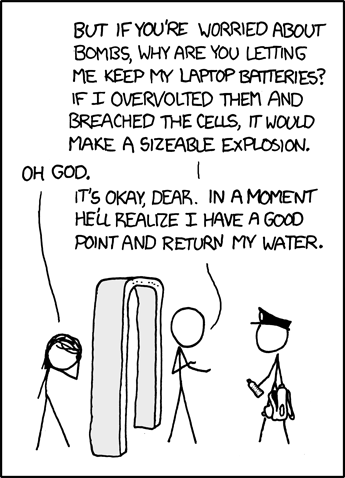
Today’s xkcd made me break out with a smile before I’d even finished my first coffee:

Bag Check

As with all of the xkcd comics, be sure to hover your mouse over the image for a further comment from the author.

For more intriguing views of the world we live in, visit xkcd.com.

16 October 2009

Short Circuit

It’s been a while since the day I missed the runway at Oxford Airport. I’ve done a lot more flying and I’m a lot more competent. But my first near-miss (no damage was done except the loss of a runway light) is not an incident I’m likely to forget in a hurry.

The Saratoga is fast in the circuit and if it’s busy, I spend half my time trying not to sneak up on the 152s pottering along downwind like a Sunday driver in a tweed cap.

On that fateful day, I was thrilled to see that Oxford circuit was nice and quiet: there was a touch of a crosswind which meant that most of the students were grounded for the day.

I spoke to a friendly instructor at PFT who confirmed that it was fine for circuits, just not optimal for new flyers who were still trying to get their confidence up. I’d done crosswind landings in much worse weather so I wasn’t very concerned.

It was a beautiful day, brilliant blue skies and clear views of the Cotswolds below me. I hummed to myself as I zipped around the circuit a few times. I knew there was a crosswind and I was taking it into account but I wasn’t particularly worried.

Except then I missed the runway.

I’m still not quite sure what happened. I called final as I bore down towards the threshold. The approach was a little bit messy but tolerable; I decided to carry on. I pulled up as I reached the transition point and noticed a slight float.

I considered full power and going round as I knew the plane would lose speed fast and she could be a pig to land. Then I felt her begin to sink back to the ground and I thought, “No, this is fine, I’ll land it.”

Nose up, wheels about to touch, everything seemed OK. Then I blinked. Where did the runway go?

I was lined up perfectly but 10 feet to the left of the numbers. There was no time left: I touched down with the left wheel on the grass and the right on the runway, the nose wheel bumping along the edge.

There must have been a slight gust of wind that shifted me sideways as the plane was low and slow. I steered back onto the runway and vacated at the first opportunity.

Once parked, I crawled under the plane to see if the tyres and connecting bits looked normal. It slowly began to dawn on me that, although I looked at the underside of this plane every flight, I didn’t actually feel that confident about how it all hung together and whether it still looked right.

Ben, an instructor who I’d flown with previously, happened to be in Oxford that day and walked out to the plane. “ATC just phoned. You took out a runway light. Are you OK?”

“I’m fine, I just don’t know about the plane.”

“Go to Operations and apologise. I don’t know if they will charge you or if it’s covered on their insurance or what. They want to talk to you. Take responsibility. Afterwards I can help you find someone to check it out.”

Luck was with me: while I was waiting to cower before a random air traffic controller, I saw Mark, the engineer who services the plane.

“Hey, good to see you flying, no time to chat, I’m on my way to Brittany,” he said as he rushed past me.

“I broke the Saratoga,” I said. He froze mid-step. I knew he would.

“Come on, show me.”

He looked it over, shook his head at a nick in the nose wheel, then pronounced the plane airworthy. “But watch that tyre, we need to get that fixed soon. Look at it after every landing, if you see any spreading or fraying, stay on the ground and call me.”

I was amazed he has that sort of faith in me; deep-down I felt that I had proven that I was still a student, not to be trusted with responsibility. I nodded seriously and he smiled at me. “It happens. You must have come down soft, those lights crack easy, they don’t want there to be any resistance. The nick happened after the light cracked and you rolled over it.”

A couple of pilots were standing around me now, I re-iterated what happened, no one seemed to think I deserved my licence ripped out of my hands. “It happens.”

“Plane’s in one piece, you’re in one piece, well done,” a man with a Scottish accent said with a pat on my shoulder.

I almost smiled.

I still had my apologies to do, though. I went to the man in Operations to tell him what happened.

“Where?”

“Just past the numbers. Left side.” It seemed important to me that he knew I was landing on the numbers, even if I was, well, off-set a bit.

“Just a second. ” He called ATC, nodded a few times and hung up.

“It’s OK,” he told me. “They’ve already cleared it up.”

I blinked at him. I wasn’t actually offering to dash out to the runway to clean it up with a bucket and a broom. “Oh. Good.” I wasn’t sure where to go from there.

“There might be a bill. Never had this happen before.” I winced as he tutted at me. “Anyway, we’ll let you know. Taking her up again for more circuits?”

I shook my head. I’d had enough for one day. What I really needed was a stiff drink. It wasn’t that I always landed perfectly but, if it looked questionable, I’d always gone around. This was my first truly bad landing.

“Plane’s in one piece, you’re in one piece.” I recited the words to myself as I walked away. At the end of the day, I knew I was lucky.

9 October 2009

Permission to Play

I totally lost control of my week! I had no idea it was Friday and now it’s the end of the day and I am out of time to write an interesting post for you.

So I am giving you permission to play a game. Spend the time you would have wasted reading my ramblings and see if you can get all the planes organised sensibly. I have to admit, I feel bad about all those passengers trapped in the planes while I made the pilots wait for taxi.

Choose to “Play Free Version” and then click on the planes to give them instructions. Read the rest of this entry »

2 October 2009

Have You Seen These?

This week: A selection of aviation articles and images that I found intriguing.

Bird strike! The moment 200 starlings were sucked into passenger jet engine on take-off | Mail Online

‘It was like a scene from the Hitchcock movie The Birds. One second all was clear, and the next thing you saw were these birds swarming over the plane,’ said an onlooker.

It is thought more than 200 starlings were sucked into the right engine as the Boeing jet approached 200mph.

Others dented the fuselage but thankfully did not pierce it. Their splattered remains could be seen on the plane later.

Houston News – Superthief – page 1

Dyson realized something was wrong driving back to his shop when he saw the Bonanza scream past him along the runway, taking off with the cockpit door still swinging open. He called Pearah, realized he’d been had and called the police.

Meanwhile, Calhoun flew the plane about two miles east, according to Dyson, then reversed course west for another three miles before crashing into a strand of trees. Uninjured, Calhoun could’ve simply escaped like he’d done for years, except his truck was still at the airport.

STOL Contest in Valdez, Alaska : Sulako’s Blog

Take a close look at the little yellow plane at 1:30 into the video for a gentle little prop strike right at the start of his takeoff roll. I’m amused / horrified that the pilot chose to continue the takeoff despite kissing the runway, but maybe I’m getting cowardly in my old age.

Above the Clouds. Sky-Viators in CG Illustrations. | Templates.com

This post is devoted for all those who are real fans of aviation, for those who find the point of life in it, for all those who are not afraid of the depth of the sky. The dream to fly above the clouds in the altitudes where the air is thin is not for everyone, only those who are strong in their spirit are able to perform it and they dare to do it.

HowStuffWorks “How Air Force One Works”

Air Force One is a prominent symbol of the United States in general and the office of the presidency in particular. Whenever the president travels overseas or across the country, he takes his high-tech deluxe jumbo jet with him. On September 11th, the president’s plane showed that it was much more than an executive jet — it became a mobile bunker when all ground positions seemed vulnerable to attack.

grande nef | aviation section | aeronautical salon | 1909 | 0004 | Flight Archive

Among other full-sized machines are the Delagrange and the Bleriot biplanes — the latter a 3-seater — the Bleriot, R.E.P., and Antoinette monoplanes, Kapferer’s double monoplane, and the Breguet aeroplane-helicopter. The Wright aeroplane is represented by a fullsized model, but the others above-mentioned are actual machines, and form a collection which is, it will be seen, quite as representative as could be expected under the circumstances, and remarkably interesting to boot.