Meowing on Guard (an attempt at an explanation)
Last week a video went viral and it’s been fun to see the mainstream media coverage try to cover two pilots who were heard making animal noises on the radio. There’s a lot of contextual knowledge and lore to understand what happened here, so although the actual event really isn’t worth a news headline, it is a good opportunity to get into what actually happened here.
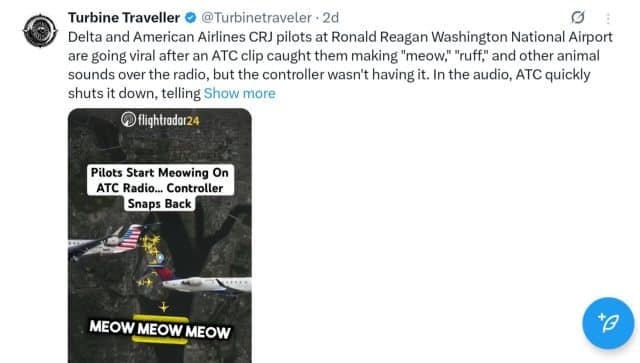
First of all, the audio has been posted in a few places with the implication that the two pilots were making these noises on Washington National Airport’s frequency and that a controller then told them off. In fact, they were speaking on “Guard”, the international aeronautical emergency frequency on 121.5 MHz. This channel is (theoretically) used for emergencies and lost contact: basically any situation where you don’t know what frequency the aircraft or local ATC are on.
The Guard frequency is monitored by ATC, search and rescue and other emergency services. Most aircraft (in the US, all aircraft who are capable) have the frequency dialled in to maintain a “listening watch”.
A common issue is that an aircraft is switching to a new frequency as they enter a new region and put it in wrong, or too early, and the new controller is unable to make contact. The controller will call for the aircraft on the emergency frequency to give the pilot the correct (or a different) frequency.
Similarly, an aircraft can inadvertently enter airspace where it shouldn’t be, for example a private pilot flying in southern England whose autopilot died accidentally wandering into the edge of Gatwick’s airspace without permission, not that you know anyone who accidentally did that. The point is that Guard is the fastest way to talk to the aircraft without knowing what frequency they are dialled into.
I think one of the reasons the video refers to DCA is that the Washington DC area has some of the most sensitive and tightly protected airspace in the US and is very fast to react to airspace incursions. Controllers will broadcast warnings on Guard to get the pilot’s attention before the situation escalates and fighter jets are scrambled.
Another use of Guard is to broadcast that someone has a stuck mic, that is, a pilot is unintentionally transmitting continuously on frequency, which blocks the frequency for everyone. The listening watch on Guard is on a second radio where they are not transmitting, thus they may hear the broadcast and realise that they need to try to unstick their mic by pressing the push-to-talk button. Similarly, it can alert other aircraft that a specific frequency is jammed and that they aren’t being heard.
A little bit harder to explain is why some pilots meow on that frequency.
There’s a theory that the whole thing started with the meow joke in Super Troopers. In the movie, Vermont state troopers try to slip the word meow into a traffic stop as many times without the driver noticing.
This was in response to a query on Airline Pilot Forums: Sorry, but I got to ask what is all the meowing on 121.5 all about
I’m pretty sure the genesis of the ‘meow’ thing was the movie ‘Super Troopers’. Watch the movie for full comprehension, it’s actually quite hilarious, especially in a North American cultural context. But doing it on guard is BS. It was funny the first two or three times, 20 years ago.
Twenty years ago puts it to 2004, which does match up with Super Troopers becoming a cult hit on DVD and would also explain why it was predominantly an issue in the US. But I can’t actually demonstrate that it was happening that early.
On PPRuNe there’s a 2007 thread on Abuse on 121.5. The multi-page thread complains about pilots swearing at controllers and other aircraft, asking for football scores and other inappropriate uses, and the guard police castigating anyone who uses the frequency inadvertently. There’s no mention of meow.
Now this is a UK forum and possibly meowing hadn’t yet crossed the pond; however there’s one reference that seems to be about US usage who is annoyed by “the chats on channel”. Another complains about “stupid cock crow noises at dawn wherever they are”. In nine pages of discussion, there is not a single mention of a meow.
The earliest reference I found on PPRuNe was in 2016, which includes two references to “animal noises”.
Another theory is that the meowing craze started in western Alaska. There’s a village called Atmautluak in the Yukon-Kuskokwim Delta. In 2019, an Alaskan bush pilot posted on a Pilots of America thread I had heard of it but never actually heard it…”Meow”.
I used to fly to a place called Atmautluak, but on the radio it was generally referred to as At-Mao (second part pronounced like Chairman Mao, because unless you can speak Yupik it’s impossible to actually pronounce) and at some point it further devolved into At-Meow, and eventually it just became Meow — ‘Downwind landing South Meow’ ‘Final landing South Meow’ ‘Departing North Meow’. Eventually standard radio protocol became that when one called it ‘Meow’ on the radio, everyone else on frequency was obligated to meow with the most obnoxious meows possible. This wasn’t one of two people either, this was 10-15 airplanes on the same frequency all meowing at each other. I even had a podium finish during the Meow contest at one of the crew houses on a Saturday night with my beautiful rendition of ‘Cat in heat Meow’, but I was beat out by the ‘Fat depressed cat meow’ and the ‘Sexy Meow’ performed with gusto by the only girl pilot who participated in our degenerate shenanigans.
This might explain how it expanded to the lower 48 and then became a joke on Guard, the one place where you aren’t positively identifying your aircraft when transmitting.
In the same thread, meowing and guard police (who get a mention in every thread about the misuse of Guard, going right back to the 2007 PPRuNe thread) are treated as equally annoying:
Now, guard is so messed up with meows and guard police it’s damn near useless. I even heard a plane with an actual emergency who made a benign-sounding radio call to ATC only to be jumped on by the guard police. Once everyone stopped saying ‘GUAAARRRRRRRRRRRRRD!’ he said ‘I’M ON FIRE!’
The point is that a single transmission on Guard reaches every aircraft within line-of-sight of any of thousands of monitoring stations and aircraft, with no callsign required. The meow meme works because other pilots chime in, just as described by the Alaskan bush pilot. This becomes rage bait to the “guard police”, who then complain on frequency about the misuse of the frequency, which seems to be hilarious to the meowers.
From 2019 onwards, pretty much every discussion of misuse of Guard includes a complaint about meowing. In October 2025, Airfacts Journal calls it a national embarrassment in an article blaming the problem on social media:
Then there are the pilots who play random sound effects and music into their microphones. Or the ones who make the same tired jokes about Delta pilots and turbulence PIREPs. Or, worst of all, the meowing. Make. It. Stop.
Now we have almost all of the context we need for the viral video of the week.
The audio comes from LiveATC.net, a streaming and archive service that covers over a thousand feeds from radios near airports around the world. The recording can be confirmed there as having taken place on Guard on the 12th of April 2026.
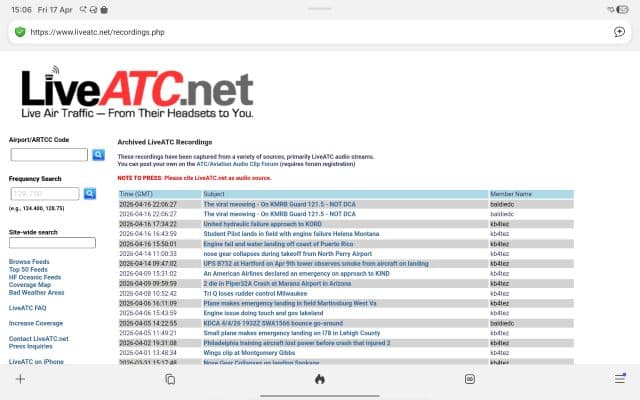
It’s not clear who originally isolated it or who added the video from FlightRadar implying that it took place at DCA, but the combo hit the mainstream after it was posted by Turbine Traveller, where it received over 1.4 million views.
In the video above, we hear some meows and then a voice breaks in, annoyed. “You guys, you need to be professional pilots.” He is answered with more meowing and barking.
What makes this funny is the cutting blow: “This is why you still fly an RJ”. RJ here refers to “regional jets”. The response is somewhat sadder and more subdued meowing, as if the jab landed.
This is a career-progression insult. It’s common for US commercial pilots to spend a few years flying a regional jet before moving to a major airline. There’s no way that the pilot could know who was meowing; it was purely an insult to their professionalism.
However, the insult may have hit home. Aviation a2z reports that two of the aircraft have been identified as CRJs flying for American Eagle and Delta Connection. The majors don’t operate CRJs and both of those airlines are regional subsidiaries.
The point that meowing is common with RJ pilots is expanded upon in a recent comment on One Mile at a Time Pilots “Meow” & “Ruff,” Anger Air Traffic Control: “This Is Why You Still Fly An RJ”:
For whatever reason, some pilots amuse themselves by randomly making a cat ‘meow’ sound on 121.5. It’s almost like a verbal meme, and I hear it at least once per week. Once someone does it, usually a few others echo it back. It’s almost always the younger RJ pilots. How do I know that? 1) You NEVER hear a ‘meow’ (literally – never) when flying a redeye flight (RJ schedules don’t do overnights) and, 2) often, after these jokers have switched their transmitter from radio #1 to radio #2 to go ‘meow’, they forget to switch it back. Remember, they are still listening to both. So, when ATC gives them a frequency change (over radio #1) they answer – but still transmit on radio #2 – which everyone hears. And the callsign is always an RJ company (‘Brickyard’ or ‘Envoy’ or ‘Skywest’, for example).
I should note that, as the above commenter also points out, there’s no reason to believe this was an Air Traffic Controller who made the comment. It is much more likely to have been another pilot (see also guard police).
The video hitting the mainstream pushed the FAA into making a comment.
FAA regulations prohibit pilots from engaging in non-essential conversations when they’re below 10,000 feet altitude. Conversations must be related to the safe operation of the aircraft. The FAA investigates all situations where pilots may have violated any regulation.
This is the sterile cockpit rule, which forbids all non-essential activities and discussion in the cockpit during critical phases of flight.
More pertinent is the FCC (Federal Communications Commission) who regulate interstate and international communications by radio (and television, wire, satellite and cable) across the United States. In 2017, the FCC stated that they will “aggressively enforce” the rules against non-emergency use of 121.5, with maximum fines of $19,246 for a single offence and $144,344 for ongoing offences, as well as the possibility of criminal charges. They released a similar statement in May 2025. But I couldn’t find any reference of a pilot ever being prosecuted for inappropriate usage of guard by either the FAA or the FCC.
The main barrier is, as the pilot on the video says, professionalism. Perhaps it is also a question of what is tolerated. Many pilots report that the major airlines fire pilots for meowing on guard, on the basis that the pilot is demonstrating a lack of judgement.
The FAA have already commented that they will not prosecute based on third-party recordings, which is what LiveATC offer. There’s no case unless they can pick up a recording from an ATC unit or other official source. However, the fact that this has made mainstream news may well mean that more of an effort is made to build a case.
Or the whole thing will fade in a week with the meowing carrying on as it has for the past ten years.
If you all respond in the comments with meow, I’m just going to assume Fear of Landing has quietly become a regional jet crew lounge.



Meow
I admit it, I laughed.
I visited the Distress and Diversion cell at LATCC in the late 1970s. Even then they had multiple directional receivers around the country which automatically triangulated any transmission; they had a big map of the southern part of the country at the front of the room which lit up with lines showing the directions from the receivers. Saw it used briefly on 243 – two RAF jets over the North Sea had lost each other and one made a call to the other. IIRC it worked the same way on 121.5.
I’m amazed the FAA or USAF aren’t working out who’s doing this and prosecuting. I guess they’ll be many ambiguous cases in busy airspace but I’d think there’d be enough where it’s obvious who’s doing it.
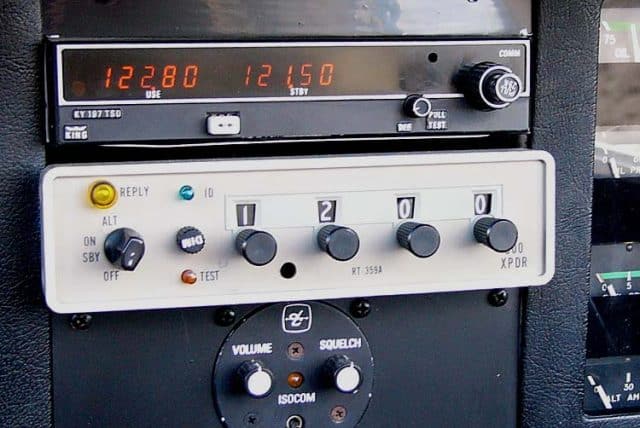
Also, those flip-flop radios like the King one you show, do they allow you to receive on the standby frequency as well? The very similar looking ones I’ve used don’t AFAIK. If so, how do you turn that on and off – normally you have the next frequency you’ll use set up on the standby (e.g., tower when you’re taxiing out on ground) and it’d be quite confusing to be listening on that as well.
Ok, full admission, I picked that radio shot because it said 121.5 and it looked a bit like I remember from the 152. But as I recall, you couldn’t listen in on the standby frequency, as you say, so it really want the best image for the piece!
When I was active in the ham radio scene in Europe (early 1990s), this kind of shenanigans became frequent once the hobby acquired certain popularity in my country, to the point that the standard channels became quite unusable. Anonymity + large audience. Internet saw the same phenomenon writ large.
One of the complaints that I saw was that Guard had become as bad as CB radio, as it happens.
This is not new, Sandy Powell and Mike Lithgow did this over seventy years ago at the Farnborough airshow. That was barking and growling but not meowing. It was broadcast over the tannoy and, to cap it all, one of their aircraft had reversible pitch props and was seen backing off!
I spent a happy summer holiday working for Sandy after he had retired from aviation when he was running a lovely country pub in Warwickshire. He had been in the RAF from 1936 through to 1946 – flying bi-planes to jets – and ended up as deputy commandant of the Empire Test Pilots’ School. After that he was a test pilot for Percivals and the Lockheed Brake Company. He wrote on aviation topics for his local newspaper and published a couple of monographs on test piloting. Mike Lithgow was also a test pilot after service in the Royal Navy and was sadly killed with his crew when the BAC 1-11 they were testing entered an irrecoverable deep stall.
I would love to know why animal noises (and why now meow, specifically, but I’m fond of the combo theory)
It all seems a bit childish, and ATC nor emergency frequencies should be used or silly ga,es.
When I was flying air cargo, all by night, we pilots otten did do this kind of silly thing: making stupid oises. But at least it was on the company frequency and maybe it helped to while time and prevent pilots to fall asleep.Especially during the ong and dark winer nights, any diversion was welcome.
The night ops shift did not appreciate it either, and we were soon told off by ops control. The sound was not “meow”, it was compared to stranded whales.
At least, during the night we were usually given “direct routings”.
Yes, I’m sure it’s partly boredom and partly just a form of interaction, and it’s short enough to be unlikely to block an emergency (as opposed to telling someone off for using guard when you think they don’t need it)
It all seems a bit childish, and neiter ATC nor emergency frequencies should be used or silly games.
When I was flying air cargo, all by night of course, we pilots otten did this kind of silly thing: making stupid noises. But at least it was on the company frequency and maybe it helped to while time and prevent pilots to fall asleep. Especially during the long and dark winter nights, any diversion was welcome.
The night ops shift did not appreciate it either, and we were soon told off by ops control. The sound was not “meow”, it was compared to stranded whales.
At least, during the night we were usually given “direct routings”. And little or no delay in the approach sequence. Which of course helped.
I don’t think that any crew member had any major trouble staying awake.
Did I really post it again after making a few corrections?
Maybe I fell asleep this time? Meow !
Haha, forgive me for not cleaning this up; it’s just too funny!
mreowww