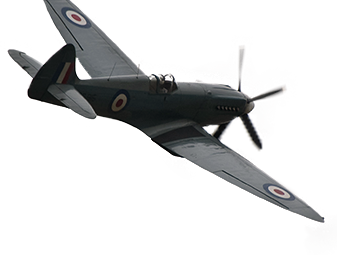
The First Jet to Land on an Aircraft Carrier (Deliberately)
“The Vampire was the first jet to land on a moving aircraft carrier deliberately.”
This quote from Airshow Luke, our MC at the Legacy of Liberty airshow, made me almost lose sight of the jet. Not because I doubted the claim. The DH-100 Vampire was one of the first single-engine jets and so it made sense that it could have been the first to land on an aircraft carrier. No, it was the use of the word “deliberately” that threw me.
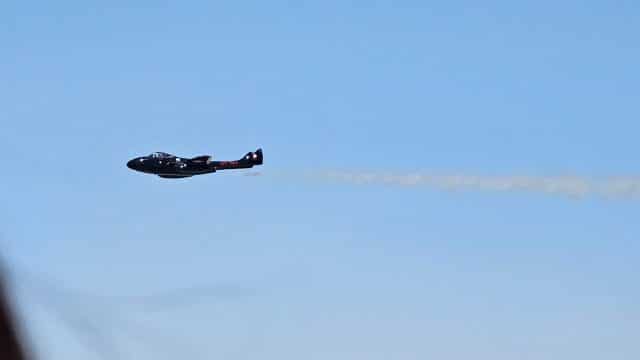
How do you land on an aircraft carrier by accident?
It seems difficult to imagine what this might mean, so of course I had to go looking…
The first aircraft to land on a ship was in 1911. The aircraft was a Curtiss Pusher biplane, flown by Eugene Burton Ely, part of the Curtiss Exhibition Team. The Navy asked Ely directly if he’d like to give it a go, which he did, and Curtiss thought this was a grand idea. First, the Navy modified USS Birmingham with an 83-foot wooden platform (just over 25 metres) and attached floats to the wings of the Curtiss Pusher.
I have to say, I’m not sure I’d describe that take off as all that successful.
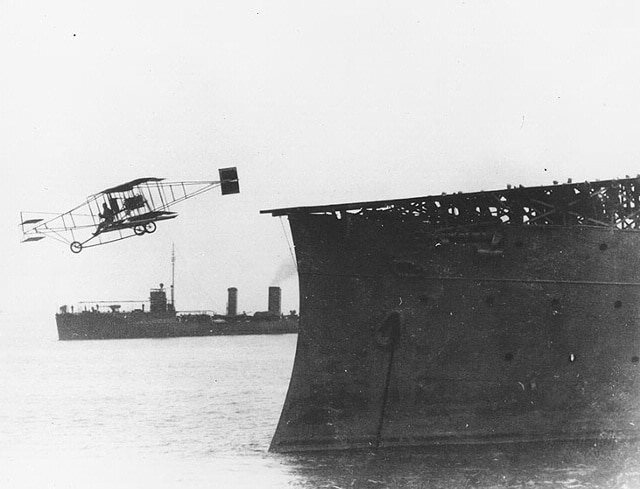
Here’s the account from National Air and Space Museum.
Ely succeeded in making the first take-off from a ship, barely. The Curtiss rolled off the edge of the platform, settled, and briefly skipped off the water, damaging the propeller. Ely managed to stay airborne and landed 2 ½ miles away on the nearest land, called Willoughby Spit.
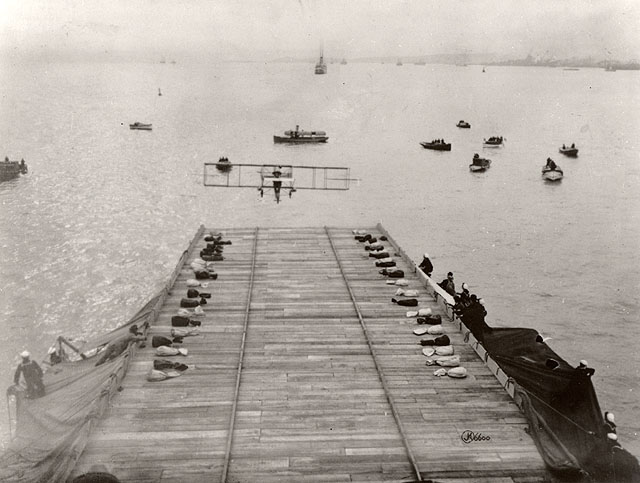
Nevertheless, Ely was ready to try the landing. For this attempt, the Navy added a 120-foot platform to USS Pennsylvania, paid for by the Curtiss Aeroplane Company. They strung twenty-two hemp cables across the platform, held in place with 50-pound sandbags. At the end of the platform was a canvas awning to catch the aircraft.
The Curtiss Pusher was modified to have longer wings and hooks on the landing gear. Ely wore bicycle inner tubes and a football helmet.
Again from the National Air and Space Museum:
Crowds lined the shore and boats collected in the harbor to witness the daring flight. At 11:00 a.m., Ely took off from nearby Tanforan Race Track and headed for the Pennsylvania. To the delight of thousands of spectators, Ely made a safe landing, the arresting equipment working perfectly. After lunch with the ship’s captain and a few photographs, the platform was cleared and the Pennsylvania was pointed into the wind. Ely took off, flew past the crowd, and landed safely back at Tanforan. Naval aviation was born.
That brings us to why it was a struggle to land turbo-jet powered aircraft, specifically. The problem is that an aircraft carrier is a moving runway, dipping and rising with the swells. With a piston engine, you can quickly open the throttle for a bit more lift, or throttle back for more drag. But jet engines are slow to respond, which means it is much harder to get the aircraft in sync with the ship.
The US Navy claim that the “first landing of a jet-powered aircraft on an aircraft carrier” was achieved by a Ryan FR-1 Fireball, flown by US Navy pilot Jake West.
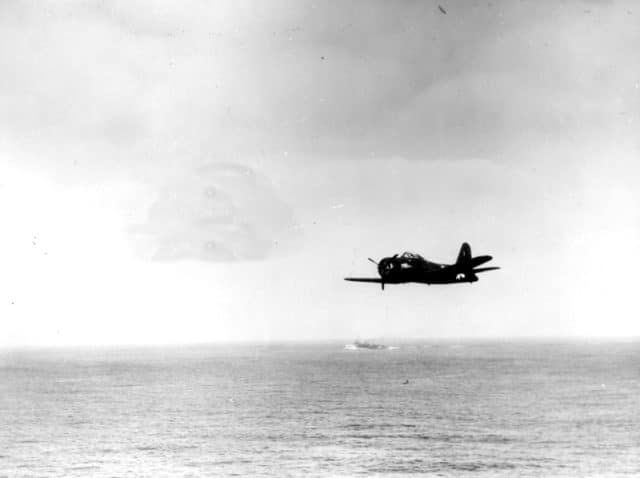
To my amusement, the issue with this “first” is not that he accidentally landed on an aircraft carrier, but that he was accidentally a jet.
The Ryan Fireball was designed as a fighter for aircraft carriers. Fast and light, it was a composite-powered aircraft, with both a piston engine and a jet engine. Landings were made using the piston engine on its own, but when West was on approach to land on the USS Wake Island, the piston engine failed. The ship raised a crash barrier for the emergency landing. West air-started the jet engine and continued with the landing on the jet engine. The Fireball blew through all the arrestor cables but the last, before crashing into the crash barrier.
The point here is that West did not intentionally land a jet on an aircraft carrier. There’s also some question as to whether the piston engine suffered only a partial failure, so that West was able to use both the piston and the jet in order to land.
Despite these caveats, the US Navy still claim this as the first jet landing on an aircraft carrier, which I suppose it is if you avoid the words “deliberately” and “successful”.
One month later, in December 1945, Royal Navy test pilot Eric Melrose Brown landed a prototype de Havilland Vampire (LZ551/G) on HMS Ocean.
He had already gained success by trialing the de Havilland Mosquito for aircraft carrier landings so he was the obvious choice for this test.
Brown explains:
After this, the idea of landing a jet on an aircraft carrier came up.
Brown was immediately interested, as he admitted in a history.net interview, because he was “tremendously keen to beat the Yanks”.
This time, the aircraft was the second prototype of the DH-100 Vampire, Britain’s first single-engine fighter jet. The prototype was modified with larger flaps, heavy duty shock absorbers in the landing gear, and a reinforced structure (presumably in case it also ran into the crash barrier).
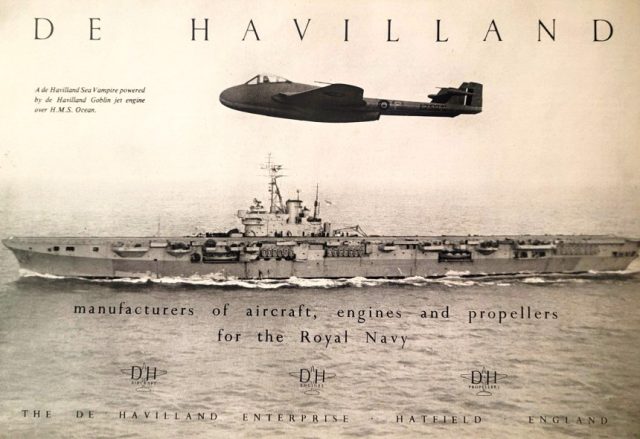
On the day of the test flight, the weather was marginal; the flight took place in what Brown called “a knife-edge decision” to attempt a landing on HMS Ocean.
The waves were high and the ship was rocking in the swells. According to Vulcan to the Sky‘s interview with Brown in 2015, the carrier signalled him to return to Ford. Brown claimed that he did not have sufficient fuel to return. The captain cleared the deck and Brown aimed for the fourth of the ten arrestor wires. But then he misjudged the upswing of the heaving deck.
“Landing on deck is a bit like Russian Roulette”, Eric says, due to the pilot being at the mercy of the sea. This prompts his second revelation. “I landed too soon. You try to catch an upswing. I didn’t quite get the upswing at the right moment. This meant I landed more aft than I intended”. And so Eric in fact landed on the first wire (and the back end of the Vampire touched the deck).
Brown then took off again in what was indisputably the first jet take-off from a carrier, commenting later that the Vampire took off “like a scalded cat!” Brown made four landings that day (and caught the fourth arrestor wire on the fourth try).
The first take-off and landing from a US Navy carrier was seven months later, in July 1946, a McDonnell XFD-1 Phantom.
So that is the mystery complete: Airshow MC Luke is completely correct in saying that the Vampire Jet was the first jet aircraft to land on an aircraft carrier deliberately.
And as a bonus prize, Brown’s memoir, Wings on my Sleeve, has just been added to my wish-list.








A fascinating bit of history.
When I was learning to fly at Hanscom (Bedford MA), one of the instructors observed that there was an aircraft carrier permanently parked near downtown Philadelphia, in line with PHL’s main runways, and expressed a desire to do a touch-and-go on it on his career-last approach to PHL. I don’t remember what commercial airplane he was flying that he thought a touch-and-go wouldn’t cost him a wing….
Well, considering they’ve managed to land (and launch!) a C-130 on a carrier…
I would vote C-130 “most likely to take out any aircraft carrier in its path” rather than the other way around, to be fair.
Heck, they even managed it with a U-2:
https://www.cia.gov/stories/story/project-whale-tale-u-2-flights-off-aircraft-carriers-2/
Nice, this was new to me!
I love the idea of a career-last goal!
Wings on my sleeve is a great read , you will enjoy that Sylvia . Eric winkle Brown certainly lived a charmed life ! Some of the stories would make your ears curl ! 😄
Sounds good!
Eric Brown is a hero of mine.
Not only does he have the first jet carrier launch/landing, but he has the most carrier landings at 2,407.
He’s flown more types of aircraft than anyone else (487 and that’s not counting model variants)
I saw the high number of carrier landings but didn’t know he had the most nor more types of aircraft. What a life he led!
Would the Vampire Take off from one of the QE class Carriers without a CAT? My theory is if it can also land with simple wires, it could still be a useful addition. With Modern construction materials, engine and avionics it could become the basis for an AEW / Air refuelling a/c especially with autopilot ie a drone.