Fatal Gulfstream G200 Crash in the Dominican Republic
On the 7th of June 2026, a Gulfstream G200 crashed at La Romana International Airport in the Dominican Republic, killing both pilots. The twin-engine business jet, registered in the US as N318JF, was owned by Aibonito Aviation, based in San Juan, Puerto Rico. It had arrived in La Romana to refuel as a part of a repositioning flight to Texas, US, to pick up a private passenger. La Romana Airport has a single concrete runway, 11/29, with a length of 2,950 metres (9,700 feet). The crew names have been released; both were professional pilots with experience on type and current medicals.
The flight departed normally from runway 11 at 15:30 local time / 19:30 UTC. ADSB data shows the aircraft climbing to the southwest to 8,400 feet. At about 16 miles out from La Romana, the flight crew declared an emergency and were quickly cleared for an emergency landing on runway 11. The aircraft initiated a left-hand turn back towards La Romana and descended for approach to runway 11 but initiated a go-around, continuing past the airport. After circling northeast of the airport, the aircraft lined up to land on runway 29.
Videos of the landing show the aircraft veering off of the runway. The undercarriage collapses and the left-hand engine is ripped away. The jet then burst into flames. Both pilots were killed in the fire, the aircraft was destroyed.
Warning: this video, showing two different viewpoints from the ground, is hard to watch.
It is difficult to find provenance on viral videos at this stage. I’ve seen multiple accusations that the videos are generated by AI (is this the new “looks photoshopped”?!). I can confirm that the multiple angles I’ve seen all agree and that the video matches the media accounts.
YouTuber Capn Bloggs has uploaded two of the videos from unnamed sources which are slowed down to two frames per second.
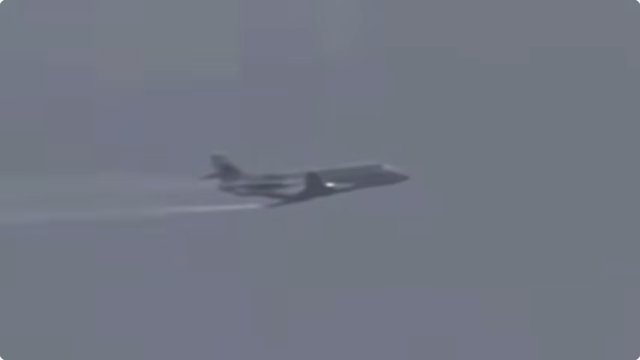
The first video shows the G200 in the air with vapour at the trailing edge. The G200’s jettison outlets sit between aileron and flap, so this is likely the flight crew jettisoning fuel to get their landing weight down.
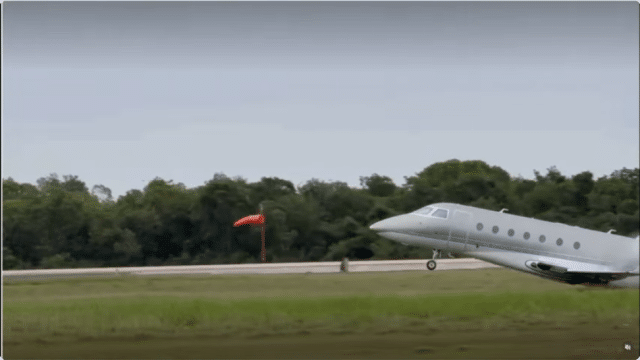
In this slowed version of the video, the windsock is clearly visible in the direction of travel, showing that the G200 landed with a tailwind that AVweb calculates at 8.7 knots.
I have not found the ATC interactions or official details on what the emergency might have been, though local media have reported an engine failure. FL360aero reports a hydraulic problem but does not give any source and gets the registration wrong. Neither issue would cause the aircraft to be unsafe for landing; however, a hydraulic failure would cause degraded braking on the ground.
In the Dominican Republic, the Comisión Investigadora de Accidentes de Aviación (CIAA) is the investigative body charged with leading the investigation, with the United States representing the state of registration and Israel representing the state of manufacture.
However, the Consejo de Capitanes (lit: Council of Captains, a think-tank of Dominican-born captains working for US airlines) have asked for the investigation to be led by the United States. Francisco Diaz, the founder and president of the Consejo de Capitanes, has released a statement (in Spanish) which refers to the new ICAO procedure under Annex 13. This amendment to Annex 13, which comes into force in November 2028, is to address concerns of regulatory bodies with conflicts of interest, specifically referencing the known problem where investigative reports are simply never released at all (I have a number of these in my pending list!).
Francisco Diaz writes that the CIAA has still not released a final report in the case of a Gulfstream G-IVSP which crashed in the Dominican Republic in 2021. The preliminary report showed that the crash was caused by a maintenance error, in which the hydraulic lines for the spoilers were incorrectly connected, rendering the aircraft uncontrollable. There are claims that the regulatory body in charge of the airline, the Dominican Institute of Civil Aviation (IDAC), had received many reports of maintenance issues from pilots before the crash. Francisco Diaz points out that the current director of CIAA was, at the time of the crash, the director of the Dominican Institute of Civil Aviation, which would necessarily be part of the investigation.
As yet, there is no statement from the CIAA other than that they are investigating.






An awful looking accident.
Do you think the pilots were knocked unconscious during the rough landing, or as the nose pitched up and then slammed down again ? The cockpit area seemed to survive the initial explosion, but hard to see after that how the fire spread .
I can’t think of a case of the pilots being knocked out by a hard landing but if something became detached, it could happen.
You can see in the flight data (altitude/groundspeed diagram) that they’re hand-flying after the missed approach (the altitude line is “squiggly” and below 1500 ft), and then there’s a point where the altitude becomes steady again for their second landing attempt.
The mystery is why they needed to land so quickly that they couldn’t maneuver to the downwind side of the runway, and why they veered off almost as soon as they touched down.
I like squiggly as a technical term. But yes, I see what you mean now. It is odd; they took their time returning and then appear to have decided to accept a bad approach with the wind behind them. I haven’t seen anything about the recorders yet.