
GPS Jamming, Stop Buzzer, and the Crash Near Sierra Blanca
Shortly after midnight local time on the 14th of May 2026, a medical flight en route to transport a patient crashed into terrain, killing all four on board. The NTSB has released their preliminary report.
The aircraft was a 1979 Beech C90 King Air, registered in the US as N249CP and operating as an air ambulance. The King Air and crew were based at Roswell Air Center in Roswell, New Mexico.

It was late on the night of the 13th of May when the flight crew received the mission to fly to Sierra Blanca Regional Airport to pick up a patient for transport to Albuquerque. Sierra Blanca is on the Fort Stanton mesa, 15 nautical miles northeast of Ruidoso, New Mexico, with an elevation of 6,814 feet.
There is no tower: approach and departure services are provided by Albuquerque Center. The airport has two instrument approaches on runway 24: ILS (or LOC) and RNAV (GPS).
The pilots and two flight nurses departed Roswell at 23:52 and contacted ZAB, Albuquerque Air Route Traffic Control Center, requesting instrument flight rules clearance to Sierra Blanca. The weather was clear but it was a dark night with no moonlight. The flight was cleared “as filed” with an initial altitude given of 12,000 feet above mean sea level.
At midnight, the controller contacted the flight to say that they were at 13,000 feet, a thousand feet above their assigned altitude. The flight crew reported that they were correcting their altitude and that the flight had lost GPS capability.
There were three Notices to Airmen (NOTAMs) in effect that were relevant to this flight.
SRR 05/010 SRR SVC AUTOMATED WX BCST SYSTEM U/S 2605132257-2608132300
SRR 05/009 SRR SVC AUTOMATED WX BCST SYSTEM U/S 2605132256-2606182359EST
Translation: The Automated Weather Broadcast System (AWOS) at Sierra Blanca Regional Airport is unserviceable (out of service) under reference 05/009 starting May 13, 2026 at 22:56 UTC (estimated through June 18, 2026 at 23:59 UTC), and under reference 05/010 starting May 13, 2026 at 22:57 UTC through August 13, 2026 at 23:00 UTC.
GPS 05/018 ZAB NAV GPS (WSMRNM GPS 26-13)(INCLUDING WAAS, GBAS, AND ADS-B) MAY NOT BE AVBL WI A 366NM RADIUS CENTERED AT 333638N1063320W(TCS048041) FL400-UNL, 326NM RADIUS AT FL250, 240NM RADIUS AT 10000FT, 240NM RADIUS AT 4000FT AGL, 210NM RADIUS AT 50FT AGL. DLY 0300-0629 2605130300-2605140629
Translation:
Global Positioning System (GPS) signals—including WAAS, GBAS, and ADS-B services—may be unreliable or unavailable due to military testing.
Affected Location:
Centred at **33°36’38″N, 106°33’20″W** (TCS VOR/DME 048° radial at 41 NM / White Sands Missile Range area).Affected Altitude & Radius Limits (nautical miles):
– FL400 to Unlimited: 366 NM radius
– FL250 (25,000 ft): 326 NM radius
– 10,000 ft MSL: 240 NM radius
– 4,000 ft AGL: 240 NM radius
– 50 ft AGL: 210 NM radiusSchedule
Daily: 03:00 UTC to 06:29 UTC
Dates: May 13, 2026 at 03:00 UTC through May 14, 2026 at 06:29 UTC
These notices, which were included in the flight crew briefing package, served to inform pilots that the automated weather service was out of service and that military GPS jamming was possible from 9pm to half past midnight on the nights of the 12th and again on the 13th of May at White Sands Missile Range. The military complex is used for developing and testing GPS jamming and spoofing technology and responses. IEEE Spectrum reports that disruptions caused by this testing can reach over 500 kilometres around the base.
Sierra Blanca is about 30-40 nautical miles (55-75 km) from White Sands Missile Range.
Jamming is the broadcast of noise on the satellite navigation frequency loud enough to drown out the satellite signals. The military testing would take out four systems at once as they were all based on the same satellite navigation.
However, it’s unlikely that the flight crew of the King Air took this in. A standard briefing package for an airline or cross-country flight can easily run 50 to 100+ pages, containing hundreds of individual NOTAMs. The vast majority of these are low-priority or operational noise including unlit grass obstructions, temporary cranes far from active paths, or minor grass-mowing operations near runways. When high volumes of trivial data are presented alongside critical safety warnings, human attention naturally falters, leading to information overload.
Flight Global wrote about ICAO’s global campaign for NOTAM improvement five years ago.
Pilots back global campaign to cut excessive NOTAM burden
[ICAO] has highlighted a web-based tool for NOTAM analysis of different global regions.
On 1 April, the tool shows, there were over 36,300 active NOTAMs of which 3,264 were classified as ‘old’ – having over three but less than 12 months’ duration – and over 2,700 were considered ‘very old’, with duration of more than a year.
[…]
The organisation acknowledges that the situation has serious safety implications.
IFALPA president Capt Jack Netskar warned, in a letter to aeronautical information services providers last September, that the volume of published NOTAMs has reached the point where it “overwhelms the capacity” of pilots and other personnel to assess the information.
In March 2024, a controller at Albuquerque Center reported (see spreadsheet below) that in his sector, “the pilots are NEVER aware” and suggested that the GPS jamming be given greater prominence, to reduce the radio chatter/frequency congestion caused by pilots asking about it in the air.
It is more likely that the pilots noticed the lack of a weather report: there was no Meteorological Aerodrome Report or Terminal Aerodrome Forecast for Sierra Blanca. However, based on their later requests for the RNAV and later the ILS approach, it seems clear that they didn’t understand the impact of this.
The Sierra Blanca approach plates state clearly that if the local altimeter setting is not received, the two instrument approaches are not authorised.
A barometric altimeter needs a current local sea-level pressure setting to read true, and instrument approach minima are designed on the assumption that the crew has one. This setting is broadcast by the automated weather system. As the weather station was out of service, there was no altimeter setting, which meant that the instrument approaches were not available. The RNAV approach was doubly unavailable, as it also requires GPS.
The flight crew asked for a heading. The controller gave a heading of 275° towards Sierra Blanca and asked the flight which approach they intended to fly. They requested the RNAV approach to runway 24.
The controller was aware of the military testing. They telephoned their operations supervisor and requested that the military stop jamming. The request to halt military jamming for a safety-of-flight reason is a “stop buzzer” or “cease buzzer”. A controller can make this request on the basis of pilot reports, where it is escalated through the management chain before being passed to the military range.
After this request, the controller cleared the flight to the REYOK intersection with a heading of 350°, which would have them crossing the ILS approach path. The flight crew acknowledged and turned north. During the turn, the flight crew requested the ILS approach instead of the RNAV approach, as they had lost GPS.
There is no reference in the NTSB’s preliminary report of anyone telling the pilots about the GPS jamming or that neither instrument approach at Sierra Blanca was authorised as long as the weather station was out of service.
The King Air continued on the northerly heading for about twenty nautical miles at a GPS altitude of 12,600 feet. During this time, three other aircraft reported that they had lost GPS, with one asking for additional assistance from the controller.
At five minutes past midnight, the controller informed the flight crew that they could expect radar vectors, in which the controller takes responsibility and hands the pilots a series of headings, for a straight approach to the runway. The operations supervisor contacted the military and asked them to stop jamming. ADS-B data shows that the jamming paused two-and-a-half minutes later (00:07:34).
Three minutes later, the flight crew reported that they “had a visual on Ruidoso”. They were about 31 miles northeast of the airport. The radio call was interrupted by another aircraft. The flight crew called again, confirming that they had a visual on Ruidoso and that they could “go visual”, that is, continue a visual approach to Sierra Blanca without the need of navigational aids as they had the airport in sight.
The controller cleared the flight for a visual approach to Sierra Blanca and that they could cancel their IFR in the air or via the flight service station after landing.
The flight crew acknowledged the clearance and said they would cancel IFR in just a few minutes. That was the last radio call from the flight.
The King Air turned southwest towards Sierra Blanca. Between the aircraft and the airport were the Capitan Mountains, with peaks up to 10,201 feet.
The operations supervisor at Albuquerque told the military that the aircraft was now on visual approach and they could resume jamming. The ADS-B data shows that jamming resumed immediately.
The King Air began descending towards Sierra Blanca.
A few minutes later, the flight made a slight right turn in a continued descent. At about 9,400 feet, the aircraft climbed about 400 feet, travelling at 150 knots ground speed. It crashed into the mountains at an elevation of 9,950 feet. The crash was not survivable. Flames from the crash started a forest fire which burned for three weeks, destroying over 28,000 acres with a fire suppression cost of over USD37 million. The fire was finally fully contained on the 12th of June.
This is the first fatal accident where the NTSB has cited GPS interference as a potential factor. But AOPA has been flagging this as an issue since early 2019.
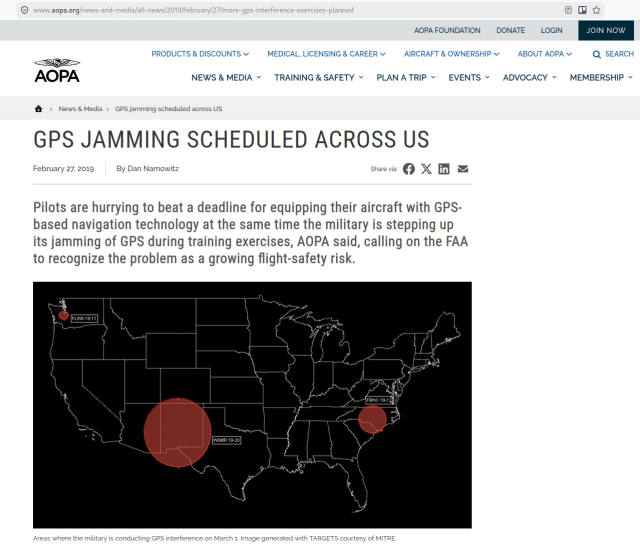
AOPA’s report on this incident cites multiple reports in the Aviation Safety Reporting System database.
In March 2021, a controller at Albuquerque Center watched a jet at FL240 (~24,000 feet) go significantly off course during jamming from White Sands. The controller vectored the aircraft clear of White Sands restricted airspace and then cleared it to descend and proceed direct to the flight destination. The next time the controller scanned the flights, he found that the aircraft was making a 90° turn back into White Sands airspace. By the time he told the aircraft to stop descending, it was inside the missile range’s restricted airspace.
In December, another Albuquerque controller had an aircraft on a descend-via RNAV arrival that could not navigate safely, and at the same moment a colleague had a second aircraft between two pieces of restricted airspace, deviating into it.
That same year, Mark Harris of IEEE Spectrum reported on the situation:
FAA Files Reveal a Surprising Threat to Airline Safety: the U.S. Military’s GPS Tests:
Early one morning last May, a commercial airliner was approaching El Paso International Airport, in West Texas, when a warning popped up in the cockpit: “GPS Position Lost.” The pilot contacted the airline’s operations center and received a report that the U.S. Army’s White Sands Missile Range, in South Central New Mexico, was disrupting the GPS signal. “We knew then that it was not an aircraft GPS fault,” the pilot wrote later.
The pilot missed an approach on one runway due to high winds, then came around to try again. “We were forced to Runway 04 with a predawn landing with no access to [an instrument landing] with vertical guidance,” the pilot wrote. “Runway 04…has a high CFIT threat due to the climbing terrain in the local area.”
CFIT stands for “controlled flight into terrain,” exactly what happened to the King Air on the 14th of May.
The IEEE Spectrum article was followed by another in October 2021 highlighting controller confusion over when a stop buzzer could be requested: FAA Fumbled Its Response To a Surge in GPS Jamming: Confusion over stopping military tests had flight controllers fuming:
The White Sands Missile Range (WSMR), whose tests appear to have caused the GPS jamming in both recent complaints, estimates it receives “in the low single digits” of stop buzzer requests a year.
A spokesperson for WSMR told Spectrum: “The US Army takes the safety of its operations extremely seriously. Calls for a cease buzzer are taken seriously and range control has not denied or ignored any cease buzzers. WSMR has also never requested or required any internal organization or outside agency to not make use of the cease buzzer in the event of an emergency, or unsafe event.”
But the ASRS reports tell a different story: the stop buzzer requests are not making it that far. I pulled all the references to stop buzzer from 2021, when IEEE Spectrum started highlighting the problem. Here are the results from the database: ASRS_DBOnline results as CSV. Only one is not relevant to our discussion.
Let’s look through them together.
First, let’s look at ACN 1796402 in March 2021 report which I referenced above. After the jet descended into White Sands airspace through FL216, the controller called the range and asked them to stop buzzer.
I called WSMR and asked them to “stop buzzer”, they answered with “O.K.”. Facility Manager on Duty later informed me we can’t ask them to “stop buzzer” and to just keep putting aircraft on headings. Give controllers the ability to have WSMR stop GPS jamming during high traffic periods and move their jamming operations to mid shifts.
In ACN 1862562 in December 2021, a controller reports that refusing requests to pause jamming are commonplace.
Aircraft X was issued a descend via clearance for the RNAV arrival into ZZZ. The GPS jamming at Whitesands was effecting the safety of flight of the aircraft to the point to where they couldn’t navigate safely. I asked the Controller in Charge to stop buzzer(ATC procedure to cancel GPS Jamming) and was blown off was told “we’re not doing that”. Refusing to stop buzzer is commonplace in ZAB, push back and peer pressure is common.
In March 2024, ACN 2091189 is from a controller with multiple reported issues from pilots.
Feeling that safety was degrading, I called the Operation Manager on my VSCS (Voice Switching Control System) only to find that it was forwarded to TMU (Traffic Management Unit). I asked the TMU to have the Operations Manager call me, not understanding why the line was forwarded to TMU in the first place. After hanging up, multiple pilots said they had GPS and ADSB issues. I called the Operations Manager again, and the line was still forwarded to TMU. I asked to relay to the Operations Manager that the GPS jamming needed to stop and that aircraft were advising they would potentially have to come off their route. After hanging up, the Supervisor in the area finished his phone coordination and left the area to discuss the situation, only to return with the understanding that the Operations Manager had decided to continue the GPS jamming and not “stop the buzzer” because the aircraft still had other ways to navigate.
Another report in the same month, ACN 2100050, presumably from the same jamming event, has a furious controller with 18 years experience in ATC:
Yet another serious safety issue, by the same OM I reported a couple weeks ago, due to not doing a “Stop Buzzer” call as per our facility standard operating procedures, SOP. Yesterday we had GPS jamming in effect with multiple aircraft on headings, aircraft turning on their own about 40 degrees and weather up to about 33000 ft. The OS (Operations Supervisor) called the OMIC (Operations Manager in Charge) to ask to stop GPS jamming due to controller workload issues. The OM and the OS then had an offline, not recorded, conversation about the issue. The OM played the “20 questions” game with the OS and decided to not make the “Stop Buzzer” call to the proponent. Again, I would like to reiterate from my last report, the OMIC does not make the final determination to “Stop Buzzer,” the OS/CIC (Controller in Charge) does. The only reason why the OMIC is referenced in the SOP directive is because they have the phone numbers for the proponent, and they are required to report on the network when they make the call. A little while later another CIC called the OM for the same thing. The OM again played 20 questions with the CIC, asking “is this really a safety issue.”
There are two reports in ACN 2103374 in March 2024:
Working Sector 19 with westbound ELP departures with GPS jamming is becoming a real problem. Every single ELP departure during the GPS jamming exercise required a heading because they were unable to navigate. This increased the complexity of the sector drastically. On top of that, every single aircraft checking on into Sector 19 was inquiring about the issues with their ADSB and/or their GPS being unusable. This, in itself, created a lot of frequency congestion in the sector. Sector 19 also had areas of moderate-extreme precipitation affecting aircraft routing and navigation. The OS (Operations Supervisor) on duty at the time was standing behind me to overlook the sector because he knew that I was very busy. Even after seeing what was going on in the sector, the OS did not issue a STOP BUZZARD [sic]. I myself did not ask for it either, but it was very apparent that it needed to be done. Previous days and days after Day 0, Controllers had multiple issues with the GPS jamming exercises and requested a STOP BUZZARD. At one instance, an aircraft actually had issues maintaining altitude during the jamming in an area of high terrain. Another day in particular, a STOP BUZZARD was requested to the OM (Operations Manager) on another busy session with jamming and the OM refused the request. THAT IS UNACCEPTABLE. If a controller working the sector requests a STOP BUZZARD it should immediately be turned in with no hesitation and the jamming should stop. The sector is the Air Traffic Controllers jurisdiction and is ultimately the one who determines when safety is of concern. Suggestions: WSMR should conduct their GPS jamming exercises at a time of day when traffic volume is lower to limit the amount of commercial and private aircraft that are affected by it. OS/CIC (Controller in Charge) need to be more proactive and call a STOP BUZZARD when it is apparent that the controller is getting busy. It seems that some OS’s and more so CIC’s are hesitant to call a STOP BUZZARD. The chain of command that a STOP BUZZARD request goes through should be re-evaluated. Why do we need the approval from the OM? What does the OM know about the current state of a sector receiving GPS jamming? At least have the OM monitor the sector at times during GPS jamming to see how it is affecting the commercial and private aircraft. GPS jamming exercises are posted in the NOTAM system. However the pilots are NEVER aware. GPS jamming should become a more important notice to pilots so that they are better prepared.
The Controller in Charge statement in the report mirrors the controller’s frustration and repeats the accusation that the higher-ups get “upset” then asked for the jamming to be stopped.
I called the OM (Operations Manager) to stop buzzer, admittedly with slight hesitation, because of the recent pushback in the facility on halting GPS jamming. Its my job to maintain the safety of the NAS so I laid out the situation for the OM clearly, as not to get any pushback. The OM asked if I could get some callsigns of A/C the jamming was affecting. I told him it was affecting all A/C as they were all asking about it, clogging up frequencies, and requiring headings. He came down to the area and it was explained to him again. Once the jamming stopped the controllers were able to better gather themselves and perform their jobs better and safer. I thought what we had done was a good move and when I spoke to the OM again, to my surprise, he was extremely dissapointed. He had the radar display replay pulled up of Sector 19 struggling with GPS jamming. Suggestion: Our agreement has been that anytime the FLM (Front Line Manager)/CIC deems GPS jamming a safety issue it is our call to ask the OM to Stop Buzzer. Why there has been any pushback at all is beyond me. Why we have to provide any more of a reason than its unsafe and overwhelming to our controllers is beyond me. It’s a major safety issue, especially when you already have the complexity of bad rides and weather, during the busiest hours of the day. I was happy with the call I made. All I’d like to do is to follow the agreements in place and not be treated with disrespect for making a safety call. This has become a major point of issue, without proper explanation as to why our OM’s get upset when we ask to stop buzzer.
And another report in April 2024, ACN 2105330, which says that multiple controllers had asked to stop the jamming:
Starting at XA30, GPS jamming from White Sands started and immediately aircraft started to take over the frequencies and talk about losing their ADSB and transponders. Multiple controllers on sectors quickly asked the supervisor to “stop buzzer” because the complexity and workload was increased to unsafe levels. The supervisor talked to the Operational Manager about stop buzzer and it didn’t take affect until at least 30 minutes to an hour. I’m not sure how long it took, but I called the OMIC (Operations Manager in Charge) line directly to talk to the Operational Manager, but it was forwarded to TMU (Traffic Management Unit), which was both frustrating and surprising. I had an aircraft almost deviate into the range because they were having navigational issues and I had thought that jamming had stopped. We were also told before the shift when our supervisor went to standup briefing that there would be no jamming. When multiple controllers ask for stop buzzer and there is no response it shows how both unprofessional and how disrespected the controllers feel. If they don’t trust us with stop buzzer, then why have the ability make the request? Also, why is the OMIC line forwarded to TMU? We can’t even have a direct line to the Operational Manager and have to go through a third party just to get ahold of them. If a request is made by controllers, why is it questioned so much? They don’t trust us to make a decision and would rather us work in unsafe situations with complex and high volume traffic.
There are two reports in 2025:
Flight crew filed the report in ACN 2263156. They were en route to Albuquerque when they were informed of military jamming but reassured that it would not affect flights into Albuquerque.
Just as we switched to approach control, both GPS units were unavailable and of course it took the EGPWS (Enhanced Ground Proximity Warning System) with it. (no terrain display). We contacted approach and they said we could expect jamming all the way in! With no alternate airport, and no way to fly any of the RNAV approaches, we felt like we were getting painted into a corner. I was NOT going to execute a night visual approach into mountainous terrain (especially without the EGPWS). To complicate matters, approach control was working approach, tower and ground freqs. They did notify us that other aircraft were electing to fly the ILS runway 3. We accepted that, reloaded the approach, and planned a 40 flap with a 10 knot tailwind. On short final, the winds (aircraft NAV display) were 180-200 at 35 knots. Tower called winds were 180@13 (exactly a 10 knot tailwind for runway 03…interesting). We did however discuss, accepting winds in excess of 10 knots for landing. (Captains emergency authority) With all this being said, we landed uneventfully, the GPSs both came back on line around 2000 feet agl, and we got everyone safely to the gate. ** **Cause: No enroute NOTAMS that I saw describing the airports / locations affected by Military GPS jamming ATC (ZAB) knowledge of jamming that affected our decision making Combination of multiple factors/ Winds/ night time / all NON-ILS approaches requiring GPS Unaware of any aircrew/ATC actions to stop jamming if safety of flight is involved (i.e “stop buzzer” ) call from crews Dispatch knowledge of jamming outcome on approach availability / applying alternate airfield
And finally, ACN 2205365 in January 2025 reports the same reluctance to request that the jamming be stopped at Salt Lake City Air Route Traffic Control Center:
As soon as radar contact was lost I went to my OS (Operation Supervisor) and asked for stop buzzer due to the situation. Instead of calling for stop buzzer the OS came over to our position, stood behind us and tried to give us instructions on what to do, all of which we were unable due to reasons listed above. The OS finally went to call for stop buzzer, by which time we reacquired radar on Aircraft X. Recommendation: OS should have accepted controller request for stop buzzer GPS jamming mission sheet with anticipated affect should be placed at the position, this used to be done and was stopped for some reason. GPS jamming should have been cancelled after BOV radar outage.
Together, these reports paint a rather damning picture.
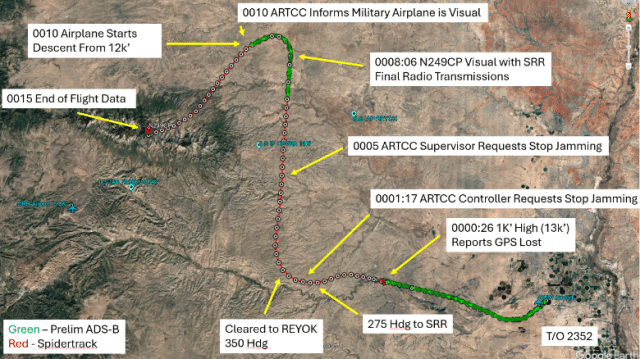
In the case of the King Air this year, White Sands did pause the GPS jamming. But let’s look at the timeline:
00:01:17: The controller telephoned their operations supervisor to request that the military stop jamming
00:05: Four minutes elapsed before the operations supervisor contacted the military to stop jamming.
00:07:34: A further two-and-a-half minutes elapsed before ADS-B data shows the jamming paused.
That’s over six minutes from the initial request, with multiple aircraft reporting issues.
00:10 The operations supervisor contacted the military to say they could resume jamming.
00:10:27 Less than half a minute later, ADS-B data shows the jamming resumed.
00:15 The King Air crashes into the side of a mountain.
Yesterday, New Mexico’s congressional delegation went on record with a letter to Defense Secretary Pete Hegseth demanding answers.
NM lawmakers demand answers from Pentagon after fatal medical flight crash and wildfire:
“If the DoD had not been jamming GPS in the region,” the lawmakers wrote, “it is very likely that the crash would have never occurred, four people would still be alive, and this wildfire would not have started.”
Lawmakers warned that as electronic warfare grows more routine in national defense, military operations could pose increasing risks to civilian flights without stronger coordination with the Federal Aviation Administration and new safety measures. The delegation also asked the Pentagon to disclose whether GPS jamming has affected other civilian flights and to collaborate with federal safety officials on new emergency protocols.
The NTSB’s investigation is still ongoing and the final report may substantially change the picture. However, it is clear that there have been long-standing concerns among Albuquerque Center controllers that asking for GPS jamming to be paused or cancelled is met with resistance. Right now, it sure is feeling like this was an accident waiting to happen.










One may be inclined to wonder what happened to the patient, as well. Transport by air is usually only for quite severe conditions requiring swift movement to a hospital.
Jon
I just edited the article to make it clearer: they were picking up the patient in Ruidoso, so it was only flight and medical crew on board.
No no, it was quite clear at the outset that the patient was not on the aircraft.
But the patient was waiting for the aircraft that didn’t show up. What then happened to the patient?
(Oops, no, that was the same Jon. Sorry about that.)
Oh no! A plethora of Jons!
But good question! I feel bad that I didn’t even think about that. I’ve just been through the news articles from the time, as I have them right here, and no one seems to have commented on this.
It’s described as a “medical transport mission” which might mean that the patient was being transferred rather than rescued, which at least means that they were in constant medical care.
I don’t think the military has any fault here. What if it had been a situation where the GPS antenna cable came loose? I think they would still have flown into a mountain. People need to be prepared for when the magic location box takes a shit and stops working, just like any piece of equipment can do.
This is not an “accident waiting to happen” – this is people being over-reliant on sensitive equipment that can fail, to the point they can’t cope if it does. This reminds me of the German tourists that followed Google Maps 50 miles down a dirt road in the Arizona desert and nearly died of heatstroke.
I mean, we can always blame the pilot. If he or she had not made any mistakes at all, it would be fine.
I agree with you that GPS is just another tool and also, yes, there is heavy reliance on that tool. But in my opinion, that’s evidence that we should be explicit when making that tool unavailable. There have been seven years of agitating about NOTAMs and that the lack of GPS should be more clearly announced. There is a specific override for controllers to ask for the jamming to be paused in the interests of flight safety, and yet, when they attempt to use it, they get push back. On this flight, the GPS came and went repeatedly, it would have worked fine as they departed until they reached an altitude where the jamming affected their receiver. They probably wasted considerable time trying to work out what was wrong. They don’t appear to have ever been told that this was a non-issue. The GPS then came back, they relaxed, and said they were fine for a visual. Clearly, they weren’t, and we can point fingers for that. But then the GPS disappeared again in that final approach, and for what?
Not to mention an overburdened controller trying to deal with four flight crews all reporting the lack of GPS and two requesting special assistance. Again, we can complain about the pilots, but that doesn’t change the situation. The controller cleared the accident flight for an instrument approach to an airfield where the instrument approaches were explicitly denied.
I think that in this day and age, where the military can no longer tuck their experiments away at White Sands without affecting civilian aircraft, we need clear information and processes. I am not intending to point the finger at the military. My intent is to highlighting the whole big mess and ask what we can do to fix this, rather than blame the flight crew for not coping with an unexpected failure and then wait for the next avoidable CFIT.
My first thought was that the military should be taking their project somewhere far away where it won’t affect civilians; I understand Kwajalein is still being used for missile tests, so maybe it would be suitable for jamming tests. All it would take is one episode of a general’s airplane losing direction for the testers to understand that when somebody says shut down, they shut down and \then/ ask “How long?”
I’m glad I no longer have the stamina to do red-eye flights across the US; given how wide an area those tests affect at airliner cruising levels, I’d be very wary of taking one out of LAX.
I think White Sands was established to be a remote and out of the way testing range; it’s certainly the biggest, which once upon a time was probably enough range to not have to worry too much about civilians. Isn’t it White Sands where they encouraged the locals to believe they had experienced extraterrestrial sightings so that the military could keep the spy plane under wraps?
“Remote and out of the way” may have applied 80 years ago and/or when the military was testing more-confined devices such as the captured V-2 and WAC Corporal sounding rocket (although Wikipedia mentions, among other incidents, a misdirected missile that ended up south of Juarez). I don’t think there’s any place in the US that can be considered remote if its influence is extending 366nm wide and an indefinite distance up — we’re not nearly as densely populated as Europe, but that’s a huge area in which to affect commercial air travel. (NB: my estimate from looking at scales on GoogleMaps is that the circle shown in the insert from the AOPA report is for the ~240nm radius for altitudes that most of their readers would be flying at, not the 366nm radius for the altitudes that major passenger jets would be flying at.)
I would have thought that misinformation to cover for a spy plane would have centered around Edwards, which I think of as more associated with aircraft testing than White Sands (which is mostly for missile (and artillery?) testing, although a landing area was extended enough to handle the Space Shuttle). OTOH, the infamous Roswell is much closer to White Sands (155 road miles per GoogleMaps) than it is to Edwards (>900). There’s so much chaff about UFOs that anyone could have said anything….
Also cheerfully worth noting is that launching rockets is one endeavour during which it is very important to know what the weather is like in the upper atmosphere at exactly that moment – and the way to find out, fastest and cheapest, are weather balloons.
That are often mistaken for UFOs. Hmm!
I respectfully disagree. The military very much is at fault here. They are as much at fault as if they had fired off a howitzer and had the shell land in your bedroom.
Pointing out the many other ways your bedroom could explode does not absolve them, nor does pointing out that you should get used to living in other parts of your house in case your bedroom explodes.
In this case, the military testing a weapon (and yes, GPS jamming IS a weapon) killed four innocent people. No, they didn’t mean to. But they did, through their own deliberate actions. They are at fault.
The difference is between one aircraft having a GPS issue, or all of them: it severely increases controller workload and degrades the quality of assisstance ATC might provide.
GPS jamming affects not just one “slice of the cheese”, but several.
This reminds me of the night approach into Steamboat Springs earlier this year that also hit a ridge. The idea is that the crew think they’re fine because they can see the runway, but when they stop seeing the runway, it’s too late to do anything about it. GPS wasn’t even jammed that time.
Interesting! I’ve added it to my pending list to watch for the final report.