Early Evidence in the Palm Beach Learjet 60 Crash
On the 1st of November 2026 shortly before 13:00 local time, a Learjet 60 crashed in Palm Beach County, Florida. This has received mainstream media attention primarily because of the disturbing audio and unexpected violence of the crash, which has left a deep crater. There were two pilots and seven passengers on board, all of whom died in the accident.
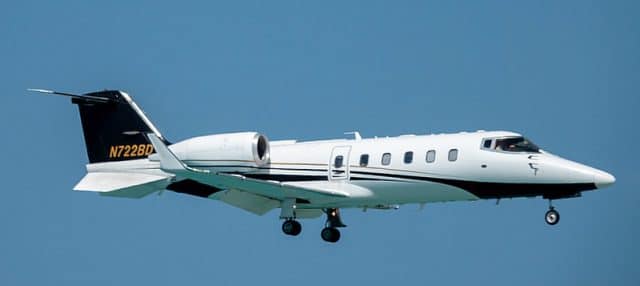
The Learjet 60 is the last of the 1960s Learjet line: a stretched Learjet 55 with Pratt & Whitney Canada PW305A engines. The business jet has a service ceiling of 51,000 feet. This model has the highest accident rate in its class, which has come up a lot in recent reports, but I want to highlight that these are mostly landing accidents:
Business Jet Traveler wrote about the issue in 2008:
One accident occurred after a hydraulic-system failure knocked out everything you need to slow down a jet-flaps, spoilers, brakes, thrust reversers-and the pilots elected to try landing on a 5,400-foot runway, anyway. (The book says you need 11,000 feet of runway in that situation.) Another resulted from a flight crew’s attempt to land on a snow- and ice-slicked runway with a tailwind and the anti-skid braking system turned off. (The book says don’t try that, either.) Yet another happened after the pilots landed with a ground speed of 210 knots-just a wee bit faster than the normal touchdown speed of around 132 knots-and an unsuspecting deer didn’t get out of the way in time. (The airplane then veered off the runway, crossed the taxiway, impacted a ditch, and burst into flames.) See a trend here?
But even under ideal circumstances, the airplane has certain characteristics—most notably small brakes and tires-that put a premium on landing skills. The brakes are a bugaboo left over from the aircraft’s predecessor, the Model 55, whose brakes are even smaller. Notwithstanding their small size, however, the 60’s brakes are not usually an issue when the airplane is flown by the book. That’s thanks to the massive thrust reversers attached to its engines. After landing, they can slow down the airplane really fast. (Stow the beverages before landing, too.)
I think it is fair to say that the Learjet is an unforgiving aircraft. However, last week’s accident does not fit the pattern behind the Learjet 60’s high accident rate and I have not found another case of a Learjet 60 losing control/breaking up at high altitude.
The privately-owned aircraft, registered in the US as N722BD, was a charter flight (Part 135) to the Bahamas with two crew and seven passengers on board. They departed normally from Austin, Texas at 10:37 local time that morning.
About two hours into the flight, Miami Air Route Traffic Control Center warned of moderate to extreme weather ahead in a storm about a hundred nautical miles across. The flight was cleared to descend from FL410 (~41,000 feet) to FL350 (~35,000 feet).
About ten minutes before the crash, the co-pilot is reported to have texted her boyfriend, also a pilot, saying “I’ve got turbulence, I’ve got ice.” The same article states that the co-pilot had 1,300 hours of flying experience.
The NTSB have opened their investigation and confirmed that at about 12:47 local time, cruising at 35,000 feet, the co-pilot reported that they were managing light clear icing but experiencing moderate turbulence with significant altitude deviations. The media briefing videos from Monday and Tuesday can be found on the same page.
Shortly after, they asked to climb to 37,000 feet, which was approved by Miami Center. But a mayday call came less than 30 seconds later, the co-pilot calling that they were in an uncontrolled descent which increased rapidly as she described an overspeed condition.
The co-pilot continued to call out their altitude and descent rate as they plummeted towards the ground.
I can’t help but be affected by her reporting the situation as professionally as she still could in a panicked voice, while knowing that this data was only useful for a crash analysis after the fact. They were clearly in an unrecoverable situation.
As of right now, the cockpit voice recorder has not been recovered.
The LiveATC audio between the Learjet 60 and Miami Center has not been directly confirmed by official sources but neither is there any reason to doubt its provenance.
This transcript is based on that audio with reference to the crowd-sourced version compiled by Wikimedia users. Some of the more frantic radio calls are hard to decipher. Most notably, the co-pilot calls out a name which has been reported as Jack, but I clearly hear Jeff, which was the pilot’s name.
N722BD Learjet 60: 722BD, 350, moderate turbulence, plus or minus… okay, now 700 feet, 600 feet…
Miami Center: November [inaudible] roger. Say outside air temperature?
N722BD Learjet 60: -47°C. We’re managing the ice, but it is moderate turbulence. We’re direct Freeport.
Miami Center: Okay, N722BD, roger. Let me know if you need anything else, I’m just working you into my airspace right now.
N722BD Learjet 60: Thank you. If you have any better ride, let us know. 2BD [Two Bravo Delta, confirming who is speaking].
Miami Center: N2BD, the ride should improve in my airspace. You’re kind of far outside of it right now, you can expect a better ride ahead.
N722BD Learjet 60: Roger, 2BD. Now we’re picking up precipitation. We need to climb 370 if able, 2BD.
Miami Center: N722BD, roger. Climb and maintain flight level 370, no further right than your present heading for traffic.
N722BD Learjet 60: Climb 370, 2BD.
N722BD Learjet 60: 722BD, we’re descending 8,000. Mayday, mayday. We’re descending 10,000 feet per minute.
Miami Center: N722BD, roger.
N722BD Learjet 60: Declaring an emergency, 722BD. We are in an overspeed condition. Descending 20,000 feet per minute.
Miami Center: N722BD, roger. Altitude your discretion, let me know what you need.
N722BD Learjet 60: We’re going to crash into the ground. 722BD. [scream]
Miami Center: N2BD, I’m here with you. Talk to me.
N722BD Learjet 60: We are descending 22,000 feet, and we are banking 60 degrees. [inaudible]
[male voice praying in the background]
Miami Center: N2BD, roger. I’m here with you, [inaudible]
N722BD Learjet 60: [scream] [inaudible] Look outside, Jeff. Look outside. Holy fuck [bleep], we’re out of time! [inaudible]
Miami Center: N2BD.
Miami Center: N2BD, how do you hear?
Miami Center: N2BD, Miami.
The co-pilot is the only voice making radio calls from the flight, although a male voice can be heard in the background, reciting a common Christian prayer (Our Father). Friends of the captain have identified the voice as his, but this has not been officially confirmed.
VASAviation has created a video which includes earlier audio and a weather map. The distressing calls by the co-pilot have been muted. Note that the radio calls have not been officially synched with the tracking data; this is an estimate by VASAviation.
The NTSB has not yet confirmed the weather situation; however, based on the NOAA weather radar at the time of the flight, the crash happened in the area of a large and active thunderstorm.
Local public works teams have been pumping water out of the main impact crater to allow the investigators to search for critical wreckage and the cockpit voice recorder. On Wednesday, the governor declared a state of emergency for flooding.
The jet’s left elevator was located a few miles away from the crater, in three pieces. This means that it broke off before the aircraft hit the ground. The question will be if it contributed to the upset or came off of the aircraft during the violent descent.
I have regularly complained about aviation websites that offer analysis and reconstructions without any sources, making it impossible to check their logic.
Czech website map.flights has created a detailed reconstruction of the flight based on ADS-B data. I particularly like the transparency of map.flights, with clear details of the network, the maths, and the limitations, making it easy to see how their conclusions were reached.
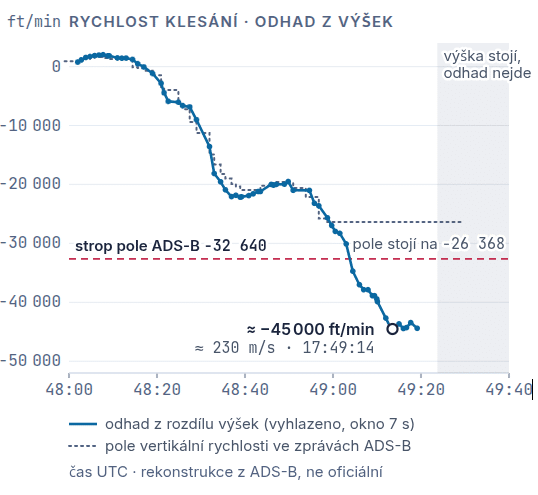
Solid line: descent rate estimated from the difference between barometric altitudes, smoothed over a 7-second window (figures in the text use a shorter ~3-second window, hence slight differences). Dotted line: the vertical-rate field broadcast by the aircraft itself. From 17:48:58 it stayed at −26,368 ft/min; the ADS-B field format cannot represent more than 32,640 ft/min. From 17:49:23 altitude is frozen, so the estimate can no longer be computed. Reconstruction from ADS-B data from our network, not an official reconstruction.
I particularly like the transparency of map.flights, with clear details of the network, the maths, and the limitations, making it easy to see how their conclusions were reached.
One rumour being repeated as fact is that the same crew had been involved in a similar situation in May. The primary source of this seems to be the Daily Mail whose original article published the day after the crash, accompanied by a photograph of the 20-year-old co-pilot sitting in the cockpit in a tank-top, smiling at the camera. The headline read: “Listen to woman flying Learjet that crashed being scolded by air traffic control for downplaying turbulence months before Florida fireball.”
A female pilot flying the same Learjet that crashed in [Florida](https://archive.is/o/GkmmZ/https://www.dailymail.com/news/florida/index.html) was heard being scolded by air traffic control months before for downplaying turbulence.
The woman was flying over Newark in New Jersey in May when an air traffic controller asked ‘Why are you climbing?’
Here’s the audio from ATC.com from Newark Approach, Northwest sector, at 00:27:59 UTC on the 7th of May:
At this point, no one official, not even the Daily Mail, has stated that this was the same pilot, other than by implication. It is definitely the same aircraft, it may well be the same crew. But even if it is: if after listening to that, you think the problem is the young woman at the beginning of her aviation career, not the 55-year-old captain of the flight, then I don’t know what to say.