Four Aircraft on the Runway: Incursion at JFK
On the 17th of April an Airbus A330-343 operated by Swiss International Air Lines abandoned their take-off when they saw the runway in front of them was full of planes.
OK, a bit of hyperbole there: there were three on the runway and one about to enter. Let’s back up.
It was a clear day at John F. Kennedy International Airport in New York. The airport was running a “North Operation” using the two parallel runways 4-Left and 4-Right.
The two runways are controlled by two local controllers. Local controller 1 (LC1) is responsible for operations on runway 4-Right as well as the taxiways between 4-Left and 4-Right. Local controller 2 (LC2) is responsible for operations on runway 4-Left.
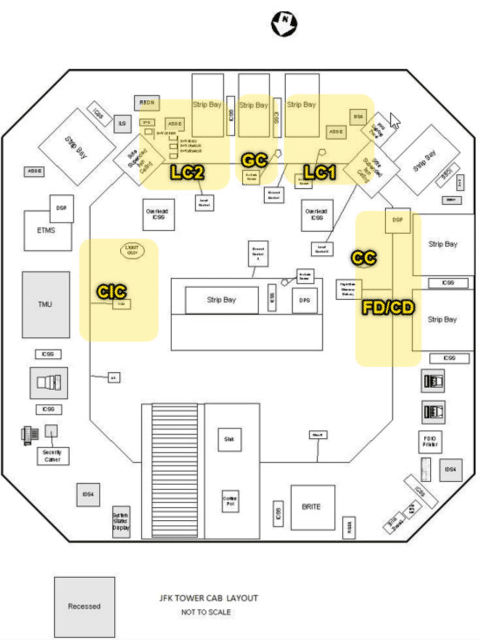
Aircraft must cross 4-Left to get to 4-Right, so it is up to Local controller 1 to coordinate those crossings with Local controller 2. The runway has multiple crossings so that it is possible to cross multiple aircraft at once, rather than stopping take-off and landings for each individual crossing.
The controllers holding the positions that day were both very experienced. Local controller 1 had been a controller with the FAA since 2015 and assigned to JFK since 2019. He had been off work the two days previous to the incident. Local controller 2 had been a controller in the US Navy before joining the FAA in 1997. He had been assigned to JFK since 2011.
Air traffic controllers at JFK have a surface surveillance system, Airport Surface Detection Equipment, Model X (ASDE-X), which uses data from multiple sources to track aircraft and ground vehicles. Aircraft and vehicle locations are are shown on a color display overlayed on a map of the airport. The system predicts the path of landing and departing aircraft, using their locations and ground speed, with visual and aural alarms which trigger for possible runway incursions.
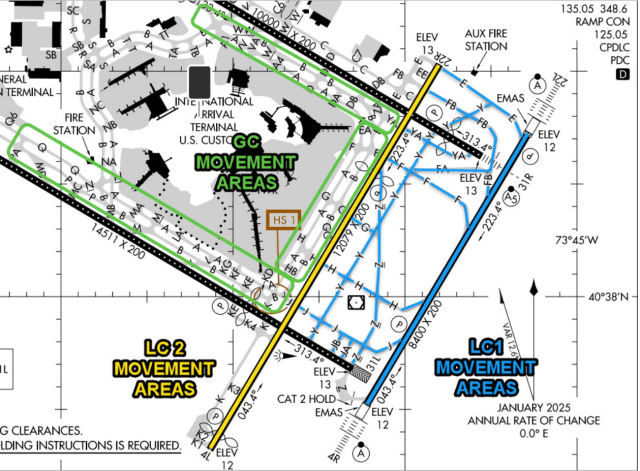
The airport image below highlights the controller areas. In blue is runway 4-Right and the taxiways between the runways, which were all under local controller 1. In yellow is runway 4-Left under local controller 2. In green are the taxiways from and to the gates, controlled by Ground.
On that day, Delta Air Lines flight 29, a Boeing 767-432ER, was cleared to land on runway 4-Right. The Delta Boeing touched down at 16:26 and local controller 1 gave the aircraft its taxi instructions including the instruction to wait at taxiway H until a gate was available and assigned.
At the same time, Swiss International Air Lines flight 17, an Airbus A330, began taxying from the gate for its planned departure on runway 4-Left.
Delta Air Lines flight 420, an Airbus A220-100, was cleared to land on runway 4-Right and touched down about 16:40. American Airlines flight 2246, a Boeing 737 MAX 8, and Republic Airlines flight 5752, an Embraer E175LR, were inbound.
The Delta Boeing waiting at taxiway H was told that its gate was now available. Local controller 1 asked them to continue via taxiway H and hold short of runway 4-Left: that is, wait for explicit instructions to enter the active runway.
He instructed the Delta Airbus that had just landed on 4-Right to clear the runway and wait at taxiway G for their gate to become available.
The American Airlines Boeing landed at 16:43 and the Republic Embraer landed at 16:44.
Local controller 1 told the Delta Airbus to enter taxiway G and hold short of runway 4-Left. Local controller 1 then instructed the American Airlines Boeing and the Republic Embraer to clear runway 4-Right and hold short of runway 4-Left.
Meanwhile, local controller 2 instructed Delta Air Lines flight 550, an Airbus A321, to line up and wait for clearance to depart on runway 4-Left.
I know this is hard to follow so let’s pause and look at the aircraft positions from left to right.
Delta Air Lines flight 550, an Airbus A321, is on runway 4-L, waiting to depart.
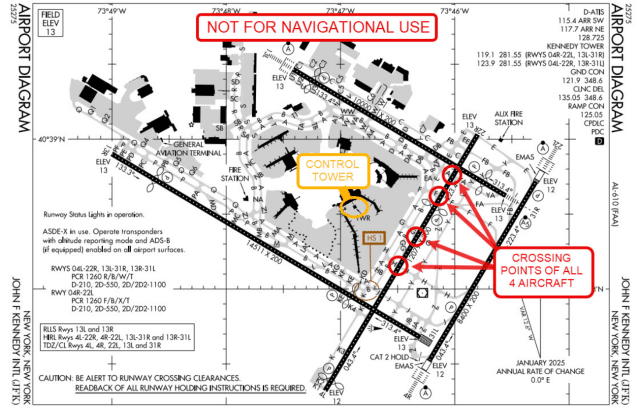
Four aircraft have landed on runway 4-R and are waiting for permission to cross runway 4-L. The Delta Boeing is holding short at taxiway H, the Delta Airbus is holding short at taxiway G. The American Airlines Boeing is taxying towards taxiway YA and the Republic Embraer is on taxiway F. This means they will each be able to cross the runway at the same time at different points: H, G, YA and F. Delta Airlines flight 550 is on the runway, waiting for clearance to depart. A Swiss International Air Lines Airbus A330 is waiting to enter Runway 4-L for their departure.
Local controller 2 cleared Delta Air Lines flight 550 for take-off from runway 4-L. The controller then asked the Swiss Airbus to line up and wait on runway 4-Left. Then he turned to local controller 1 in the tower and told him that his waiting aircraft could cross runway 4-L behind the departing Swiss Airbus at taxiways YA, G, F, and H.
Local controller 1 replied, “Roger, behind the departure, I’ll go one [aircraft] at each.”
Local controller 1 told the Republic Embraer to remain on taxiway F and hold short at runway 4-L. Then he asked the Delta Boeing to cross runway 4-L at taxiway H, behind the departing aircraft.
Local controller 2 cleared the Swiss Airbus for take-off.
Local controller 1 instructed the American Airlines Boeing to cross runway 4-L at taxiway YA.
Local controller 2 asked Delta Air Lines flight 550, which had departed, to change frequency to Departures, at the same time as local controller 1 cleared the Republic Embraer to cross runway 4-L at taxiway F. Local controller 1 then instructed the Delta Airbus to cross the runway at taxiway G.
All of the waiting incoming aircraft were now cleared to cross the active runway.
The surface surveillance system recorded the Swiss Airbus moving forward as it started its take-off roll on 4-L.
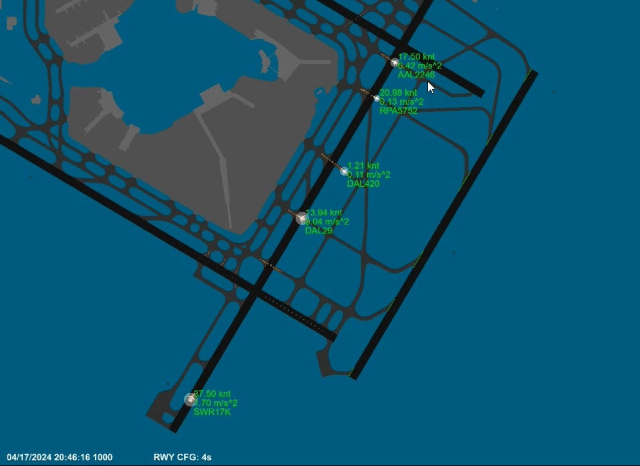
The flight crew in the Swiss Airbus saw the other aircraft entering the runway ahead and aborted their take-off. They reached 50 knots (58 mph, 93 km/h) before hitting the brakes. The Delta Boeing, the American Airlines Boeing and the Republic Embraer were all on the runway while the Delta Airbus was at the runway’s edge at taxiway G.
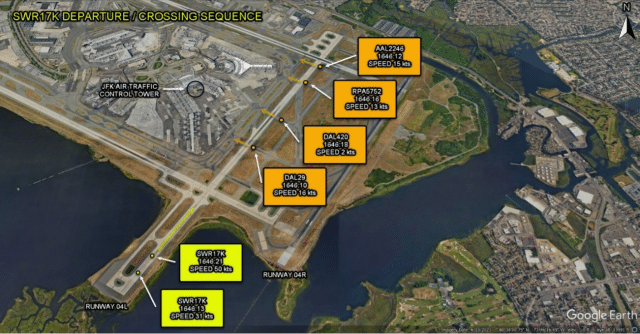
The distance between the Swiss Airbus and the Delta Boeing was less than 5,000 feet; about 20 seconds away at full take-off speed (140-150 knots).
Local controller 2 acknowledged the rejected take-off and told the Swiss Airbus to exit the runway where it intersects with runway 31-left, the closest intersection. All runway entrance lights illuminated and extinguished.
The ASDE-X had not alerted the controllers to the runway incursion because the Swiss Airbus had never reached a ground speed that the system recognised as a take-off state. By the time the Swiss Airbus had gathered speed, it would have been too late.
The exchange between the two controllers, sat either side of the ground controller, was not recorded.
Local controller 2 had expected the four aircraft to cross after the Swiss Airbus had taken off. He had scanned runway 4-L and checked the ASDE-X display and seen that it was clear before clearing the Swiss Airbus to take off.
But local controller 1 said he had acknowledged the instructions to cross the runway behind the departure, by which he meant the departue of Delta Air Lines flight 550 and in front of the Swiss Airbus. Only after he had instructed the four waiting aircraft to cross, he said, did local controller 2 clarify, “it was behind Swiss.”
In his post-incident interview, local controller 2 said the complexity was high (4 to 5 out of 5) with constantly crossing traffic.
Local controller 2: I cleared I believe it was a Delta aircraft for takeoff. I think it was a Delta. It could be an American. I don’t remember who it was to be honest. I cleared someone for takeoff. I put Swiss in position. The aircraft was passing Golf approaching Foxtrot and was rotating. I told the local 1 controller behind Swiss.
Interviewer: Slow down a little bit. I’m sorry. Go ahead.
Local controller 2: Behind Swiss 1-7 Kilo, cross 4 left, at Yankee Alpha Fox Golf Hotel. He said, roger. I cleared Swiss for takeoff. I put the next aircraft in position. Traffic was on the ten-mile final. I advised them about the traffic, and Swiss said they’re rejecting takeoff.
He said that he followed the procedure, explicitly saying behind Swiss and listing the crossing points.
Another person in the interview asked how the other controller would know which aircraft was meant: are they looking at the aircraft or are they looking at the ASDE-X?
Local controller 2: Well, I said Swiss.
Interviewer: Okay.
Local controller 2: There’s only one Swiss.
He admitted to being a little pissed off.
Local controller 1 felt that he had done a proper readback of what he’d heard.
Local controller 1: I heard behind the departure, to which I stated roger, behind the departure, go one at each, which was H, G, F, Y-A.
He then explained in more detail.
Local controller 1: The crossing was given from [local-2] to go, as far as I heard, behind the departure to cross one on each intersection, G-H-F and Y-A. And as the Delta took off, I immediately started crossing at H and went to the the furthest one after that, which was Y-A, and then came back F and G, to then after I had already started my crossings, to hear the local-2 controller saying, hey, it was behind Swiss. And at that point, I still had things going on. I still had aircraft landing on 4-Right. I told two of the aircraft to expedite. But at that point there was really not much I could do other than continue to work and make sure I keep all the other aircraft safe.
Local controller 2 believed he had specified the Swiss Airbus, while local controller 1 understood the current departure, which he interpreted as the Delta flight which had just departed.
Local controller 1: I didn’t hear Swiss at all.
The other staff said they were not sure what local controller 2 had actually said; they only became aware of the situation afterwards, when local controller 2 said, “Hey, I said behind Swiss!”
Cab coordinator: I do think there’s value in [recording the conversations] for situations like this where can have hindsight, look at where the coordination broke down, but do I think it’s going to prevent anything? No, I don’t think so, because they heard each other. They just misunderstood what the other was thinking.
Last month, the NSTB released their final report, which offers a single probable cause:
Nonstandard crossing phraseology and ineffective coordination between local controller 1 (LC1) and local controller 2 (LC2) which resulted in degraded shared situation awareness, and a runway incursion.
After the dust had settled, Swiss International Air Lines added a comment to the incident paperwork:
We at Swiss have major concerns about the safety at JFK airport. And would like to see improvements in the communication between ATC controllers, the quality of ATC transmissions regarding standard phraseology (use of “slang”) and the speech rate. It is also questionable, if there is any kind of automated runway incursion warning systems in place.
As a result of this incident, JFK Tower changed their procedure to state clearly that if a controller receives a conditional crossing clearance, they must read back the entire clearance. In addition, all crossing coordination is now recorded.




These sorts of conditional clearances make me deeply uneasy for the same reason as LAHSO clearances. Yes, it saves a few seconds to have aircraft moving in preparation for takeoff and landing, but it degrades the margin of safety if anything unexpected happens.
If the arriving pilots in the Swiss A330 had been a bit lies attentive, this could have turned into a serious tragedy. I’m not sure the time savings would seem quite as worthwhile had that happened.