The Loss of B-52 Spirit of Aggieland II
On the 15th of June 2026, a B-52 Stratofortress crashed at Edwards Air Force Base shortly after take-off. There were eight on board and no survivors.
The B-52 Stratofortress is a long-range heavy bomber built by Boeing. It has eight jet engines mounted in four pods with a maximum takeoff weight of 488,000 pounds. The B-52 entered US Air Force service in 1955 as a Cold War nuclear deterrent, designed to reach targets deep inside the Soviet Union. A total of 744 were built across eight variants, labelled A-H.
Several bombers have been designed to replace The B-52 and it has outlived them all. As of the beginning of this year, the Air Force operated 76 of the B-52H, the only variant still in service, out of the 102 delivered between 1961 and 1962. The fleet is expected to remain in service through 2050. When a B-52 is destroyed, the Air Force can only backfill by pulling a stored airframe from the Boneyard in Arizona.
This B-52H was serial number/tail number 60-0061 (fiscal year 1960 + aircraft number 0061) and received the nickname Spirit of Aggieland II while at the 307th Bomb Wing in the mid-2010s. Aggieland refers to Texas A&M University (originally known as the State Agricultural and Mechanical College of Texas). The B-52 Stratofortress uses a “Spirit of [name]” naming convention, with aircraft officially named “Spirit of [state]” “Spirit of [city]” or “Spirit of [institution]”.
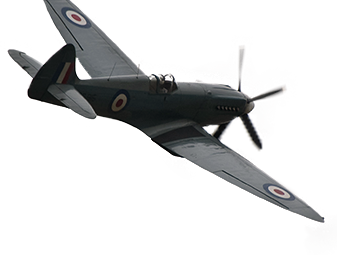
But in this case, it’s a play on words, as Spirit of Aggieland is the name of the official song of Texas A&M University, based on a poem written in 1925. The B-52 got the name in 2015, when the commander of the 307th Bomb Wing was inspired by a photo of a P-51 fighter with “Spirit of Aggieland” painted on the nose during World War II.
Scramble wrote that the aircraft had previously carried “Die Laughin’ Jester” and “Man-O-War II” on the port side before “Spirit of Aggieland II” but that it arrived at Edwards with no markings at all.
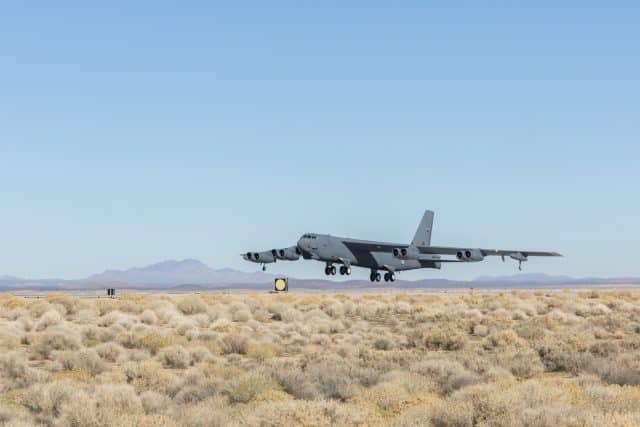
Spirit of Aggieland II was on loan to the 412th Test Wing, based at Edwards Air Force Base, for a series of tests supporting the B-52 Radar Modernization Program.
The B-52 is being modernised because there is nothing to replace it with yet. The B-21 Raider is in development but not in service. The B-1B Lancer is being retired. The B-2 Spirit fleet is small and expensive to operate. The B-52, the oldest of the lot, is the one the Air Force is keeping and to keep it flying through 2050, the service is putting the fleet through upgrades that touch almost every major system. The largest is the Commercial Engine Replacement Program replacing the eight Pratt & Whitney TF33 turbofans, which date to the 1960s and are increasingly difficult to maintain, with Rolls-Royce F130 engines. In December 2025, Boeing was awarded the contract to modify and test two B-52s with the new engines ahead of a planned fleetwide retrofit. Re-engined aircraft will carry the designation B-52J.
The radar is a separate program. The B-52’s existing radar is old enough that replacement parts are becoming difficult to source. The $3.3 billion Radar Modernization Program replaces it with a new system: the AN/APQ-188, built by Raytheon and integrated by Boeing. The new radar is solid-state, meaning it has no moving parts to wear out, and it can track multiple targets simultaneously. The upgrade also includes new mission computers and displays for the navigator stations.
In December 2025, Spirit of Aggieland II went to Boeing’s Kelly facility as the first to receive the AN/APQ-188 radar modification. From there, it flew directly to Edwards Air Force Base for extensive testing throughout 2026.
Edwards is home to one of the longest paved runways in the US, at 15,024 feet. (The longest active paved runways are Shigatse Peace Airport in Tibet, China, and Ulyanovsk Vostochny Airport in Russia, tied at 16,404 feet or 5,000 metres. The longest in the US is 16,000 feet in Denver, Colorado.)
The B-52 lifted off from the 15,000-foot runway and then dropped sharply, impacting the ground further along the runway.
The base confirmed the mishap on social media after images appeared online showing a massive plume of black smoke rising from the location. The smoke was visible from weather satellite. The B-52H carries up to 48,000 US gallons of fuel (312,197 pounds/141,610 kilogrammes).
The B-52H has a standard crew of five: aircraft commander, pilot, radar navigator, navigator, and electronic warfare officer. The aircraft that crashed at Edwards had eight, including two Boeing employees.
One of the early reports on the Edwards crash called it the deadliest B-52 accident since 1982. When I went to look, I found two fatal B-52 crashes only a year apart. In October 1981, a B-52D on a low-level night training mission crashed into sand dunes near La Junta, Colorado, killing all eight crew. A witness driving to her bakery in the pre-dawn dark saw the explosion: “I thought at first it was the Northern Lights. But then I figured something blew up, like a gas station. But it was too big for that.”
Then on the 29th of November 1982, a B-52G caught fire on the ground at Castle Air Force Base in California. No one was injured but the runway was badly damaged and the Castle AFB training operations were moved 100 miles north, to Mather Air Force Base.
A few weeks later, one of those training aircraft, a B-52G, crashed after take-off, killing all nine on board.
The archived version of the now defunct Project Get Out and Walk, a site dedicated to the history of aircraft ejection systems, quotes an email from Retired USAF Msgt Jeff Noeker:
This incident involved two of Castle’s training aircraft. They took off as a MITO (Minimum Interval Take Off) The lead aircraft was a B-52 H with TF-33 fan jet engines. The #2 aircraft was a B-52G with J-57 turbojet engines. Normally, the turbofan engine generates about 5000 pounds more thrust than the J-57 and that is why the H-Model went first. But in this instance, the G-Model was using water injection which causes the J-57 to meet or exceed the thrust of a TF-33. 1200 gals of demineralized water is injected at two points into the engines and is used up in less than two minutes. This fact was not taken into consideration during the planning of this mission as the previously explained issue rarely , if ever, actually occurred. However, in this instance it did. After liftoff, the G-Model quickly began overtaking the H-Model. To prevent collision, the student pilot retarded the throttles without giving consideration to the water injection being used. This should have not have mattered as the water injection system is supposed to cut out automatically when the throttles are reduced beyond a certain point as the engines cannot tolerate that much water at a less than optimum power setting. Due to a malfunction, the water did NOT shut off and the engines were unable to cope with it. They began flaming out. The aircraft was nearly at it’s max gross weight of 250 tons and there was was not enough altitude to recover, that soon after take off.
The loss of life in a crash is always tragic. And yet, somehow, I find the loss of Spirit of Aggieland II particularly sad. It will be quite some time before we know exactly what happened; the aircraft was destroyed and largely consumed by the fierce fire after impact. The rest of the Stratofortress fleet was meant to be updated after the extensive testing and validation at Edwards but whether the upgraded B-52J will lead the fleet into the next 25 years is back to being an open question.







So very sad, and such a rare malfunction to cause it.
The BAC 1-11 500 series with Rolls-Royce Spey engines also had a demineralised water injection system for hot / high / heavy take-off.
During my line training the instructor wanted to demonstrate the substantial power increase.
So he decided to turn it on for a particular take-off. It was not required and the water tank was not full, but because of the cold temperature in cruise it had to be empty if it was not required.
It wasn’t, but instead of dumping it he turned it ON during take-off.
The water ran out before V-1. It was not a problem, we met the performance requirements without the water injection.
The reduction of performance when it stopped was so dramatic that the cabin crew thought that we were abandoning the take-off.
So I can imagine what initially happened, only in this case the loss of thrust when the power was reduced was followed by a simultaneous flame-out on all engines. Too much water for the engines to keep running acted as a fire extinguisher.
Normally, this would not have caused an accident. It was not a “pilot error” but a very rare failure right at a critical moment.
This is so very sad because you know as a crew, including the contractors, were doing their best to upgrade a ’50s era plane (that’s still very capable) and keep it working and fighting.
I really hope it wasn’t an age-related factor like a structural failure.
Gene,
As I commented I have flown aircraft in which engine thrust could be boosted by injection of demineralised water into the hot section during take-off. It was a different type of aircraft, with different engines but the principle is the same:
With the engines at maximum thrust, the injected water vaporised instantly. The steam thus created increased the volume of the exhaust gas very substantially. A mixture of gas plus the bypassed air from the fans normally is the source of the thrust. I don’t think that the older B52 had fan engines, but that does not matter. The water injected turned into steam. And steam can by itself generate a very high amount of power. On top of that, the water cooled the turbines so more fuel could be injected too. So the combined result of all this was a very substantial power increase.
The two aircraft were very close, the accident aircraft started to overtake the preceding one.
Normally, this should not have caused the problem: the pilot corrected and reduced power. And reducing power below a certain setting should have turned the water off automatically.
Unfortunately, this system was faulty. The engines at reduced power setting, below a certain value, could not cope with the amount of water still pouring into the hot sections. So this quite literally “extinguished the fires”, a complete flame-out.
I have no idea if the sudden cooling would have actually damaged the engines to the extent that a relight was not possible. They were far too low for an engine restart anyway.
This tragedy had nothing to do with a structural failure. Under normal circumstances it should have been well within the ability of the crew to solve it, but the circumstances were not normal.
I would call this a freak accident.
Rudy, wasn’t there an accident in Germany with a BAC 1-11 where the demineralized water somehow was swapped with kerosene due to unlabeled or mislabeled barrels?
Yes that is correct. Actually I knew the F/O. I was just employed as a banner towing pilot in Germany. There was a sudden law to oblige first officers to have at least a “dormant” ATPL.There was a sudden need for first officers as many who had actually already been employed had to go back to a flying academy. There was one at Essen-Muelheim where I was stationed and the students as well as we, “Bannerschlepp” pilots, had our lunch in the Gaststaette of Frau Niggemeyer. One was a young woman who got her chance on the BAC 1-11, I forgot which airline. It must have been in 1969. The take-off must have mandated a “wet”t take-off. Sadly the water tank was topped up by mistake with jet fuel.. At first, the take-off went as normal. The water, having a higher specific gravity, reached the engines first. But when the jet fuel was sprayed into the hot sections this was far more than they could take and disintegrated.
The captain managed a controlled landing on an Autobahn, but they were unable to stop before a viaduct. If I remember correctly, the aircraft skidded and slammed sideways into the pillars killing the cockpit crew and I believe some passengers in the forward section.
This is what I seem to remember, I should really try to look it up, or maybe Sylvia will do that for us?
There is a detailed account of that accident and its underlying causes here:
https://admiralcloudberg.medium.com/carnage-on-the-autobahn-the-crash-of-paninternational-flight-112-6391af4d1d51
Thanks. Yes I commented because the I had met the F/O a few times in the Gaststaette at Essen-Muelheim airport. She had just been lucky and managed to get a job in a very highly competitive environment. And it led to her death.
Thank you for writing on this tragic accident. A friend of mine is an engineer at Boeing on the B-52 program and it is amazing what they are doing with such an old yet extremely reliable tough aircraft.
I wonder if this particular aircraft had been reengined at least partially? I am guessing not as it was specified to the radar testing. Still strange circumstance.
A very small point of terminology: “solid state” usually refers not to no-moving-parts but to a system using transistor rather than valve electronics. I haven’t been able to confirm from mild research that the AN/APQ-166 uses transistors, or even get an introduction date for it, but given that the B-52 was being designed during the post-WWII changeover it seems very probable.
The step change for the AN/APQ-188 is, as you say, that it’s electronically scanned rather than having to move an antenna; to use the buzzword, it’s an AESA, Active Electronically Scanned Array.
Having seen the images allowed out–wonder where all the wreckage is–even in very hard crashes–most of the time, there are landing gear assemblies, and the eight engines seen, along with many time, the tail and aft fuselage remaining. Just saying, this one must have not only been severe, but also very hot from the onboard fuel load as well. My heart goes out to the families and all those concerned.
Having spent eight years at Edwards, I know how it feels, to launch an aircraft–only to have it not make it back. And more names of those that are pushing the limits as their daily duties.
Accidents, especially aviation accidents are always sad. Especially If there is loss of life, there are loved ones, family, friends, husbands, wives, children left behind. My heart goes out to them.
On the bright side: I spent most of my working life in aviation. From 1965 until 2008. As flight ops controller to commercial- and airline pilot On my first solo cross country flight I broke many rules that should have been the end of my flying career, even myself. As a banner towing pilot we dragged our banners back home regardless of the weather. And on one of my very first IFR longer distance flights, in a Cessna 172 with basic instruments, at night, I was caught out by a sudden extensive blanket of fog that covered not only my destination, Schiphol Amsterdam, but also my alternates in an alarmingly short period of time.. I landed in Cat 3 weather conditions when few airlines were even cat 3 certified. I was also flying recreationally. I was a member of the Tiger Club in Redhill. I spent a substantial part of my life at airports, or passing through them.
So I would, statistically spoken, have been in a position to be involved in, or at least witness quite a few accidents, yes?
The answer is NO. I seem to remember five. Only five. Over a period of 43 years, that is evidence of how safe aviation really has become, or is.
And, during my years as an airline captain, I followed the rules. From thereon, no more “stunts” – except that I went up in a Tiger Moth for some aerobatics (from Galway, Ireland) when given the chance.
And last year I had a glorious 45 minutes as a passenger with a “paraglider” over Lake Bled in Slovenia.
Recently I heard of an airline captain who enjoys aerobatics in her spare time. There still are some real pilots left.