How Low Is Too Low? Airlink Flypast at Cape Town DHL Stadium.
On Saturday the 29th of August 2026, South Africa’s Springboks faced off against New Zealand’s All Blacks in the second test of the four-match “Rugby’s Greatest Rivalry” series. The match opening at Cape Town’s DHL Stadium drew international attention last week. Let’s skip to the chase: South Africa won 33-26.
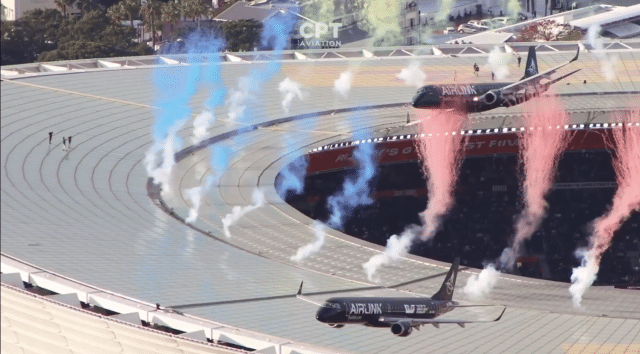
But that’s not what made the headlines. Shortly before kickoff, two Airlink aircraft made a formation flypast over the stadium filled with an audience of somewhere between 56,000 and 62,000 fans. A black Embraer E195 (ZS-YDE) represented the All Blacks and a green Embraer E190 (ZS-YAE) represented the Springboks. Each aircraft had three captains on board: commander, co-pilot and safety/technical officer. The two aircraft departed Cape Town International and held over Robben Island before starting the flypast.
This YouTube video by CPT Aviation is excellent footage of the flypast; skip forward to 02:59 to see the low pass over the stadium. I recommend sound on to hear the person in the background lost for words.
In the video, you can see the lead aircraft passing extremely low over the roof with the trailing aircraft appearing to fly through the coloured smoke of the pyrotechnics.
We’ve seen issues like this before, notably the foreshortening effect visible in This must be the photograph of the year.
But the flyby shown in the video doesn’t seem to suffer from significant perspective issues.
Final comment on this from me today (phew you say). The pitch up of the lead aircraft and the climb and breakaway by the second coincides exactly with the firing of the pyrotechnics in front of them. Were they flying lower than they meant to be? 1/2 pic.twitter.com/M8CQPinHNr
— Greg Bagwell (@gregbagwell) August 31, 2026
Flightradar24 used the ADS-B altitude data and local pressure to estimate the aircraft’s actual height.
Lowest ADS-B altitude (standard pressure above mean sea level): 50 ft.
Altitude corrected for QNH (1019 hPa): 205-210 feet AMSL.
DHL Stadium elevation: near sea level
DHL Stadium height: 164 ft.
Clearance over stadium: 41-46 ft.
This is a little bit misleading, however, because the margin for error is very large. Radio altitude, which the pilots would have been using, offers a direct measurement from the belly of the aeroplane to the roof, much more exact than ADS-B altitudes. The local pressure (1019 hectopascals) is rounded to a whole number, where one hectopascal is equivalent to 27 feet near sea level. That’s a significant deviation relative to the claimed 41-foot clearance. They used an approximate stadium height of 164 feet; however, DHL Stadium does not have a flat roof, which means the clearance over the stadium varies over the crown, the edge and any of the higher fixtures. FlightRadar24 explicitly flags that this is not an official measurement but I would argue that even claiming a clearance of 41-46 feet is overly confident. Mainstream media are now citing that figure with no caveats.
However, the FlightRadar24 data clearly confirms that the two Embraers were uncomfortably close to the stadium for the flypast.
South African Civil Aviation Regulation 91.06.32 ordinarily prohibits flight over a congested area or an open-air assembly below 1,000 feet above the highest obstacle within a 2,000-foot radius. However, as is common for events such as this, it is possible to get an exception from the South African Civil Aviation Authority (SACAA). Cape Town News reports that lower operations require specific approval (bolding from the original):
But Regulation 91.06.32 contains an explicit exception. The minimum does not apply in the same way where low flight is necessary for take-off or landing, or where prior written approval of the Director has been obtained. That exception is critical when analysing planned displays, demonstration flights and specially authorised flypasts.
Airlink released a statement the day after the event to state that this is exactly what happened: the flight over the stadium received prior approval and complied with it.
Statement on the flyby at Cape Town DHL Stadium:
_30 August 2026, Cape Town -_ Airlink notes the concerns expressed in various social media and online forums regarding yesterday’s formation flyby over Cape Town’s DHL Stadium.
The flight demanded careful planning and rehearsal, as it required navigating at low altitude, at around 150 knots. The South African Civil Aviation Authority (SACAA) and Air Traffic Navigation Services provided valuable guidance, approval and support to ensure a safe flyby.
The two aircraft were flown by highly-experienced crew, with each comprised of three senior captains operating in the roles of commander, co-pilot and safety/technical officer.
The data recorded by both aircraft’s digital flight data recorders (black boxes) indicate that the flights were performed within the SACAA’s approved and rehearsed safety altitude and speed limits for the flypast.
Airlink, on its own initiative, has volunteered these data sets to the SACAA so it can independently review and verify that the flypast was in accordance with the flight authorisation.
While Airlink appreciates the interest and concern, it will refrain from making any further comments while the SACAA reviews the flight data.
In other words: the flypast took place as planned and as authorised. Airlink have passed the flight data to the South African CAA to confirm.
This did not calm the masses but it did highlight a very specific question: what did the South African CAA actually approve?
As of this week, SACAA have confirmed only that three flypast applications had been submitted. The first took place on the 22nd of August at Ellis Park in Johannesburg and was uneventful. The second was the Cape Town event, which was approved as a Special Air Event after a simulator practice flight and briefing.
SACAA Statement on the Airlink Flypast at the DHL Cape Town Stadium
Following various discussions in the media relating to the events of the past weekend, the SACAA initiated compliance verifications, engaged the operator, obtained the Flight Data Recording downloads as well as other additional requirements.
The Regulator has begun its analysis process and has requested additional information from the operator to reach an informed position.
The full report will be shared with the operator once their assessment has been completed. The SACAA statement also reports that on Tuesday the 1st of September, Airlink withdrew its application for the third flypast, which was planned for Saturday’s match.
Airlink followed up with another statement on the same day which underscores that the South African CAA have not opened an investigation but only a review.
Unlike public flight tracking mobile apps that rely on rudimentary satellite positioning information, the DFDRs on modern commercial jetliners are sophisticated devices able to trace over a thousand parameters and data points to present a precise and complex picture – measured in milliseconds – of every control input, power settings, altitude, horizontal and vertical speed, pitch attitude, acceleration and the visual flight path along with numerous other readings.
Due to the complexity, the number of parameters and other factors to be examined, it is unrealistic to expect immediate feedback and recommendations from the SACAA.
The third approved flyby was planned for the third test match at FNB Stadium in Johannesburg, which Airlink confirm has been cancelled, citing weather issues. It is uncommon to cancel based on weather four days in advance of an event, and the cancellation is largely presumed to be a direct result of the media attention to the flyby at Cape Town. As of writing, the local TAF is showing light wind and broken cloud with a 30% chance of light thunderstorms.
South Africa has a longstanding tradition of stadium flypasts, most famously in 1995 before the Rugby World Cup final, when SAA Captain Laurie Kay flew Boeing 747 ZS-SAN “Lebombo” over Ellis Park Stadium.
Laurie Kay: The man, the legend:
“GOOD LUCK BOKKE” was stencilled on the underside of the Boeing 747, the fly-past was a very closely guarded secret and the whole world was caught by surprise as the aircraft came low over the stadium and powered up as it climbed out, the stadium shook as an unforgettable moment in history was created.
I could not find any case of an enforcement action in South Africa from a stadium flypast.
There’s a further angle to this case. Assuming that the SACAA approved this flyby, the next question will be whether that approval was considered and correct. And now we have the SACAA investigating the SACAA, a clear conflict of interest. The SACAA are already under fire regarding a Cessna Citation crash in January 2020. This was the SACAA’s calibration aircraft and three SACAA employees were killed in the crash. The Ethiopian AAIB, who carried out an independent investigation, reported that SACAA had violated several of its own regulations in relation to maintenance and equipment on the plane.
The Citizen published an update on this case yesterday: Creecy seeks fresh inquest into fatal 2020 private jet crash near George
The Ethiopian investigation found that the crew lost control of ZS-CAR after entering an unusual attitude in cloud-obscured mountainous terrain, but also identified regulatory failures within SACAA’s Flight Inspection Unit, where Captain Tolo was employed.
It found that a required annual flight data recorder (FDR) inspection had not been conducted, rendering the aircraft’s certificate of airworthiness invalid, that its FDR did not record nine mandatory parameters and that there was no record of a required inspection before the aircraft returned to service six days before the crash following an engine-related serious incident.
The manuscript was drafted by whistle-blower and now dismissed SACAA airworthiness inspector and former accident investigator Jeremiah Visser, following his own examination of the ZS-CAR crash.
But the important news is that the Springboks and All Blacks are now tied, ready for the third match of the series, which will take place tomorrow in Johannesburg.







As always, I love the context you’ve dug up!
My personal opinion is that you accept 50 ft obstacle clearance when you come in over the runway fence to land (when you don’t hit a streetlight on the approach, anyway), so the question is whether the approach to the stadium could be flown with the same precision as a landing: it was straight, level, and over water except for the last 400m or so. Your clip shows the aircraft starting to climb as soon as they were past the stadium, suggesting they could have climbed away at any time.
Here’s a 2023 video of the fleet captain of Safair, explaining the preparations they do for the same type of stadium overflights; I assume Airlink work to the same standard:
https://youtu.be/h1lntb0h0-4
And here’s leaked footage from aboard the aircraft:
https://youtu.be/vFzDNsA4l-Q
Are you suggesting that if this flypast was flown with the same precision as an approach to land it was ok?
Since I’ve watched the first video I linked, I’ve been convinced that this overflight was executed with at least as much care as an approach to land, if not more. I can’t speak to the precision, as I don’t have access to the flight plan and the flight data, but we see the pilot in the lower aircraft make what apppear to be minor corrections as the aircraft closes on the stadium. The fact that these corrections were small (and possibly a reaction to turbulence in lee of the stadium) speaks to the precision of the approach.
The suggestion that this overflight was safe rests mostly on SACAA approving it as safe, and Airlink stating that the flight was executed as approved.
Most arguments that this was unsafe say “this looked unsafe” or “this looked unsafe; trust me, I’m a pilot”, and don’t take some misleading camera angles into account.
Head-on camera angle
Side view
Please stop referring to an “approach” as it is misleading. An approach is a precision guided flight path for a commercial airliner to a touchdown point some 1500 ft beyond the threshold. That gives 80ft over the threshold and double that over a typical boundary fence. This was a flypast. True they had to approach the stadium but the only precision was the Mk1 eyeball. A well known weak link.
45/50ft over the stadium was far too low and left no margin for error or technical malfunction not to mention birds sitting on the top flying into an engine. If this flypast was approved to 50ft (which I would be very surprised at) with circa 60000 souls in the stadium, then SACAA would be forced to share any blame for any disastrous consequences that ensued.
The break away of the wingman was, in my view, the startle effect of the pyros which he wasn’t anticipating and or he lost visual contact with the leader who was so much lower.
Overall, I think this manoeuvre was ill conceived, left little or no margin of error, and should not have been performed.
Do the phrases “visual approach” or “non-precision approach” mean anything to you?
Do you know whether the team ensured that there were no large swarms of birds in the area? An observer on the roof would suffice. And there were several people on the roof.
The wingman broke away as planned, and the leader also turned right shortly after, because a straight flight path would have taken them over the city and into a mountain. (I suspect the head-on cameras were positioned on the mountain.) I see no evidence that this was planned differently.
You are judging Airlink and the SACAA without knowing what considerations and preparations went into this overflight.
For some reason I can’t reply to Mendel’s last comment directly so it’s here.
Yes I’m very familiar with non-precision and visual approaches. As a military fast-jet pilot with several thousand hours low flying at 100ft and carrying out countless flypasts I believe I’m qualified to offer an opinion. I’m not judging. Just sharing my thoughts and views. Thanks.
Please stop referring to an “approach” as it is misleading. An approach is a precision guided flight path for a commercial airliner to a touchdown point some 1500 ft beyond the threshold. That gives 80ft over the threshold and double that over a typical boundary fence. This was a flypast. True they had to approach the stadium but the only precision was the Mk1 eyeball. A well known weak link.
45/50ft over the stadium was far too low and left no margin for error or technical malfunction not to mention birds sitting on the top flying into an engine. If this flypast was approved to 50ft (which I would be very surprised at) with circa 60000 souls in the stadium, then SACAA would be forced to share any blame for any disastrous consequences that ensued.
The break away of the wingman was, in my view, was the startle effect of the pyros which he wasn’t anticipating and or he lost visual contact with the leader who was so much lower.
Overall, I think this manoeuvre was ill conceived, left little or no margin of error, and should not have been performed. I am not criticising the skill of the pilots whatsoever. It was just a wholly inappropriate and risk laden (v benefit) manoeuvre.
I don’t think that’s a good analogy. A fence will break away (unless it’s at that Korean airport); a stadium won’t. An approach path has radio beams and PAPI (or at least VASI) to give the aircraft a continuous indicator of the right path, instead of being suddenly there like a stadium. Perhaps most important is that the fence is a fence, keeping people out of the approach area (if you’re not on that ?Caribbean? beach); there might have been 60,000 people in that stadium for pieces to fall on if a plane was a little low.
The stadium wasn’t “suddenly there”. Its location remains fixed, the overflight was trained beforehand, and if you don’t go under a certain minimum altitude, you cannot hit it.
(Whereas an approach is set up with the purpose of making you hit the ground, even under unfavorable weather conditions or with a defective aircraft.)
My point was, however, that we do accept small obstacle clearances in situations where the flight path is well known beforehand, the pilots know precision is required, and they have trained for it sufficiently.
We’re all hoping SACAA will shed more light on what exactly their overflight approvals entailed.
You appear to be trying to justify what happed with a wholly specious argument.
I usually find your comments pretty sensible but I can’t agree with you on this at all.
Yes, the likelihood of catastrophe is low, but the opportunity of avoidance for those exposed is zero and the consequence could be on par with the Bhopal disaster & in the same order of magnitude as the bombing of Hiroshima.
Hard to imagine an aircraft, the people, the weather & the rest of the details that make I this insane stunt all adding up to a Probable Loss of Life in the order of 10^-6 to 10^-5 that most governments use as the tolerable risk to the general public.
And all this for what? Some chest beating from the hosts & maybe some oohs & aahs (or ‘WTFs’) from the potential victims?
It’s ok to disagree, but if you need to use hyperbole, that doesn’t help you appear convincing.
Bhopal: “A government affidavit in 2006 stated that the leak caused approximately 558,125 injuries”; Hiroshima: “Hiroshima: 90,000–166,000 killed” (quoting Wikipedia), which is hard to achieve when the 250m wide stadium holding maybe 60,000 people is overflown by an aircraft with a 40m wing span.
And your “hard to imagine” is pretty much the same level of discourse as “this looked unsafe”. When it comes to the imagination, fear and sensationalism have the upper hand.
Bhopal directly killed about 10-15k people, the larger number is somewhat contentious.
I’d suggest that crashing into a stadium wouldn’t be far off that.
I wrote a paper on it, so I’m reasonably across it.
I’m not going to continue arguing, there’s enough people challenging your views here.
If you want more you can pop over to PPRUN to see literally not a single person agreeing with your take.
This discusses the flights themselves — the approvals/rehearsals/execution. It will be interesting to see what (if anything) comes out about the approval process, e.g. whether anyone thought about a bird strike (a possibility raised by commenters in the post you link to).
But who was in charge of the fireworks? Was flying through a smoke(?) discharge approved, or did somebody touch off the display a tad early? The plume itself would only have obscured the cockpit windows for a small fraction of a second, but it would have been very distracting; also, did whatever was in the plume stick to the windows or blow clear?
Friends of mine told a story about visiting South Africa in 2002 to attend some kind of celebration put on by the government. The culmination of the event was a flypast that included an Airbus streaking over the heads of the crowd at low altitude. The South Africans loved it; the American attendees flinched and ducked. Afterward, one of their hosts asked them how they’d liked the flypast. My friend said “We’re from New York City. That stuff isn’t fun to us just now.”
From what I’ve read, this stadium flypast isn’t the first of its kind (although the margin of error may have been unusually small), so perhaps flying big jets at low level is just a South African custom. I’m not expert enough to assess the real risks, although I believe that airshows in the rest of the world now keep the flightline well away from the crowd (a safety measure inspired by the Ramstein air show disaster) rather than aiming directly at them.