Why KLM Cut the Steering Cables on Two Perfectly Functional Boeing 737s
Last month, we looked at the night of 28th of November 2004 at Barcelona Airport. KLM 1673 ran off the runway at high speed, stopping just short of a canal. We focused there on the experience on the runway and the evacuation. This week, I want to consider the events leading up to the runway excursion.
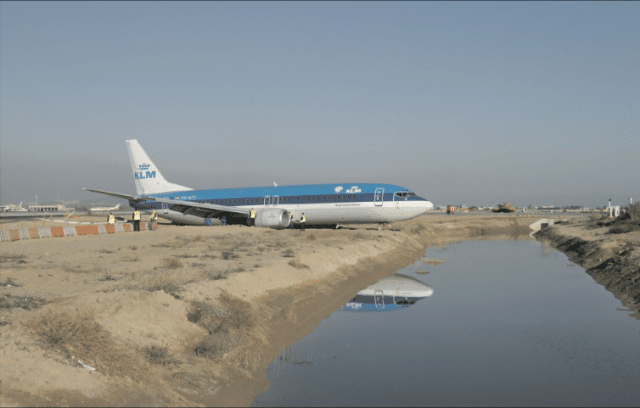
That day, the flight crew had flown from London Heathrow to Amsterdam-Schiphol. There, they changed aircraft to the accident aircraft, a Boeing 737-400 registered in the Netherlands as PH-BTC, which would operate the scheduled passenger flight to Barcelona Airport.
There were 140 passengers and four cabin crew on board. The first officer was the Pilot Flying and the captain was the Pilot Monitoring.
As they lifted off, travelling at 152 knots of airspeed and with the nose pitched up by one to three degrees, the flight crew saw a low-flying bird crossing the runway from left to right. There was a loud thud.
They had clearly suffered a bird strike somewhere around the nose landing gear. Already in the air, there was very little they could do.
They moved the landing gear lever upwards, watching for unusual vibrations or signs of hydraulic issues. The main landing gears and nose wheel landing gears all retracted normally. All of the instruments looked normal. Once they were established in the climb, the captain called Amsterdam ATC to report the incident: KLM 1673, upon the rotation, we hit a bird. It’s on the runway.
The flight crew agreed to continue the flight to Barcelona. After they were established in the cruise, Maastricht air traffic control contacted the flight to pass on a message from Amsterdam. “They had a check on the runway and the only [unintelligble] found was small pieces. They think it was quite a small bird.”
The flight crew response makes for an uncomfortable visual. “Yes, it was not quite a large bird, but maybe it is still somewhere in our aircraft.”
The flight crew sent an ACARS message. ACARS is a continuous data monitoring system which is used to transmit and receive messages about the flight and can be used by the crew and the operator to communicate using text messages. The message went to KLM operations both in Amsterdam and Barcelona: UPON ROTATION BIRD STRIKE IN AMS. POINT OF IMPACT PROBABLY THE NOSE GEAR.
They did not find any other issues and about an hour later, as they prepared for their approach to Barcelona, they sent a second message: OPERATION NOT AFFECTED.
Barcelona Airport had one long runway, 25/07, and a second parallel runway had just opened two months before the accident, in September 2004 (in 2022, these runways were renamed to 24/06). On the days before the accident, construction was in progress on the left side of the runway strip (the safety area either side of the runway) for the older runway, 25R/07L. The runway was 45 metres wide and the strip was 120 metres wide; the works were compacting and asphalting the unpaved ground on the left side. The new asphalt was about 10 cm below the runway level, leading to a step down.
There was a wide rain drainage canal parallel to part of the runway which was 107 metres (350 feet) from the runway centre-line and considered to be outside of the runway strip. But the strip was particularly narrow: ICAO requirements are for a strip to be at least 300 metres, so in this case, each side should have had 150 metres of strip, not 60. Based on this, the drainage canal would have been inside of a strip of the proper width.
There was also an unused concrete pipeline buried in the strip under loose sand.
The flight crew watched carefully as the landing gears lowered and locked into place. Everything seemed fine.
They landed centreed on the runway travelling 140 knots airspeed with the nose pitched up by four degrees. The flight data recorder recorded the peak vertical acceleration of 1.43 g. As the first officer slowly lowered the nose, the thrust levers were moved to reverse and the ground speed began to reduce.
And then an exclamation within the cockpit with an immediate application of right rudder.
The aircraft turned left and ran off the runway.
It wasn’t possible to see exactly where the aircraft touched down and there were no pieces of aircraft found on the runway. The first clear markings were at the end of the touchdown zone, where both nose landing gear wheels left marks to show that they were rotated fully to the left as the aircraft veered. This meant that the nose wheel was already cranked to the left before the pilots could have done anything about it.
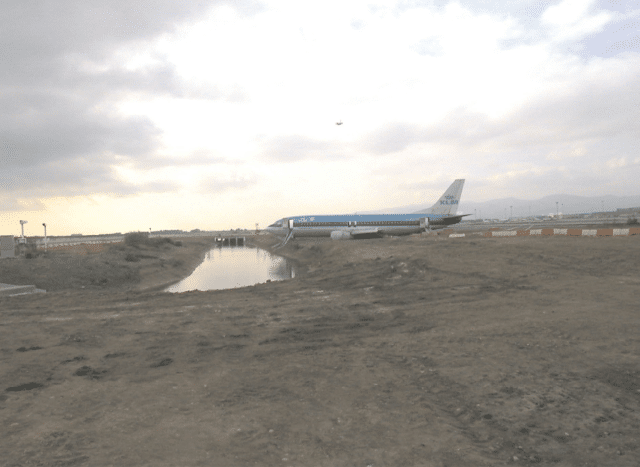
From the moment they left the pavement, the flight data recorder parameters were no longer reliable. They crossed the paved construction area, jumped the 10 cm step and then passed over the 20 cm deep trench. On the other side, they crossed a sand-covered area with the landing gear dragging through the unprepared surface. They crossed a plastic fence line and then the nose landing gear and the left-hand landing gear hit the buried pipeline. Both gears collapsed. As we saw, the evacuation was chaotic, but there were only five minor injuries.
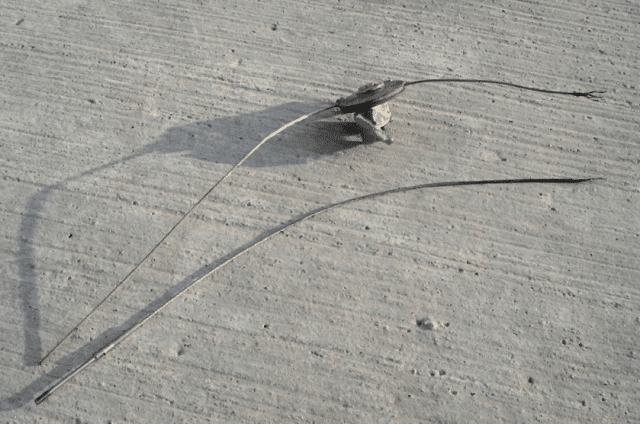
When they inspected the wreckage, they quickly found issues with the nose-wheel steering cables.
On the Boeing 737, the pilots can use the rudder pedals and the tiller to steer, but these don’t move the nose wheel directly. Two cables labelled NWSA and NWSB, each a bit thicker than a bicycle brake cable, form a single cable loop which runs either side of the nose gear. The cable tension reacts to the pilot input and the current position of the wheel. This information is used to position the steering metering valve, which ports 3,000 psi hydraulic pressure to the steering actuators. The cable loop is the link between the pilot’s input and the steering valve. One cable was broken and the other was jammed.
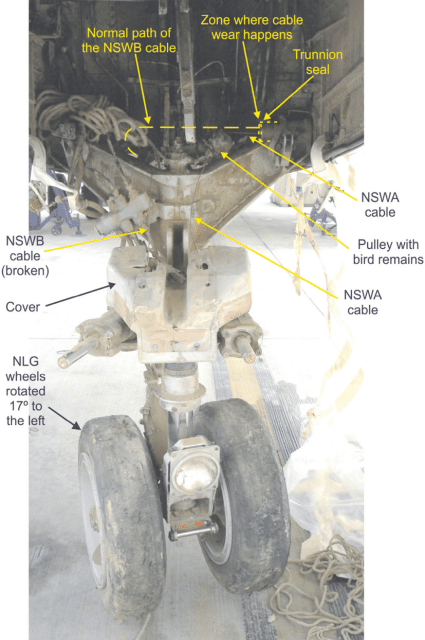
It will come as no surprise to discover that they found bird remains in the aircraft nose landing gear area. These remains were identified “following their established procedure” as belonging to a young buzzard, Buteo buteo, sex unknown.
At Amsterdam, they found a bird’s head on runway 18L. The bird remains were identified as a buzzard, Buteo buteo.
The report doesn’t specify what the “established procedure” involved: feather analysis? DNA tests? I’m dying to know. OK, Amsterdam had the head, which I imagine makes species identification fairly straightforward.
But what matters here is that both airports independently identified the same species. A buzzard had flown into nose landing gear area on take-off and did not survive the encounter. The estimated weight of the young buzzard was between 700 and 1,000 grams.
We hear a lot about bird strikes but the truth is, mostly they don’t do any damage to the aircraft. This bird, even if it was on the large side, should not have been able to cut through a full-strength cable. The cable was expected to cut through a kilo-sized bird like a knife through butter.
(another uncomfortable image, sorry)
The stainless steel cables were only two years old and they’d been inspected on schedule without any reported defects. The most recent inspection was March 2004, eight months before the accident.
However, there was a known issue with these cables becoming worn before their time. If lubricating grease got onto the cables, then bits of sand/particles could become trapped in the grease, which would then rub against the cable as it passed in and out of the pressurised zone.
Cable NWSB, which had broken on impact with the bird, showed traces of grease and extensive wear from such rubbing. Cable NWSA was also extensively worn.
Boeing’s recommended procedures specifically state not to use grease near the cables. There were no log book entries or explanation as to why grease had been used on/around the seal.
KLM immediately ordered an inspection on the entire fleet to see if any other seals had been lubricated with grease (the report does not share the results).
When the flight crew initially heard the bird impact, the weight was already off the nose landing gear, so there was no ill effect from the broken cable or the jammed pulleys. They raised the landing gear and saw no evidence of critical damage from the bird strike. Then they touched down and immediately started veering left.
The investigation discovered at least three other cases related to loss of control after cable issues:
- one where a bird sheared the cable and the aircraft stopped on the runway
-
one where the cable was fouled (not broken), causing some steering issues during the taxi
-
one where the cable snapped and the aircraft exited the right side of the runway.
It’s impossible to prove that the cable would not have broken if the cables showed only normal wear and tear. But under the circumstances, it’s clear that the condition of the cables was such that they never stood a chance.
The resulting loss of directional control on the ground could be catastrophic and yet, there were no certification requirements to protect this area against bird strikes. Boeing argued that the probability of breakage was low and adding some sort of shield to protect the area could be deformed on a bird strike, jamming or breaking the cable and causing other unexpected hazards. There had only been one other case where a 737 had actually departed the runway due to a bird strike, in over 100 million flight cycles.
Besides, said Boeing, in the case of a broken nose-wheel steering cable, the nose gear would centre. The problem was that the flight crew had not followed procedure. On top of that, the pilots had tried to used the tiller, which was explicitly documented as not to be used in such a situation. Heavy differential braking might have helped; but the crew didn’t have time to coordinate their response, and only briefly both used differential braking, as required. Boeing believed that the crew could have recovered, if they’d just allowed the nose-wheel steering to centre.
The investigation filed their final report, with the conclusion that despite their training and experience, the flight crew was unable to quickly recognise the cause of the deviation and respond correctly to keep the aircraft on the runway.
KLM were not happy with the report concluding that the experienced crew had botched the landing. First of all, this was all only obvious with hindsight: the flight crew would have had to immediately conclude that they were confronting a fixed left nose wheel. But equally, the symptoms could have been the result of an unexpected crosswind, uneven braking, tyre failure, reverse-thrust asymmetry or something else wrong with the steering. They did not have any cockpit indications of the nose-wheel angle or steering cable warning.
As a part of their objection, KLM decided to test Boeing’s claim to see for themselves. They cut the nose-wheel steering cables on two of their own Boeing 737s.
The results were clear.
- Cutting the NWSA (left-hand) cable produced a steering input of around 12° to the right.
-
Cutting the NWSB (right-hand) cable produced a steering input of around 20° to the left.
The nose wheel did not centre.
KLM took the results directly to Boeing, who through their own testing were able to recreate the results. They supplied the Comisión de Investigación de Accidentes e Incidentes de Aviación Civil (CIAIAC) with new data, acknowledging that the information they’d given the investigation was wrong.
In a Boeing 737-300/-400/-500 with a dual tiller configuration such as the accident aircraft, a cable fracture would cause the nose-wheel steering angle to deflect 20.4° to the left or 9.3° to the right.
This fit the accident results. Once the right-hand cable (NWSB) was broken, the nose gear deflected 17° to the left, leading the aircraft off the runway from the moment the nose wheel touched down, exactly as the flight crew had described.
Neither the flight crew nor the ground maintenance technicians who were told about the bird strike thought any special precaution was needed. With no warning, the crew was unable to quickly identify the nose-wheel steering malfunction during the landing roll. But with the new data, it was clearly unlikely that any action by the crew could have recovered from the deflected nose wheels in time to keep the aircraft on the runway.
Boeing had claimed that the nose gear would recentre, that if the crew did anything at all, the best response would have been heavy differential braking. But a simulation with full right asymmetric braking at 3,000 psi showed that, although the aircraft may have slowed down and stayed on the runway longer, it still would have run off the runway at approximately 30 knots (instead of 80-90 knots). And another simulation showed that the increased loading on the nose gear could have actually increased the yawing moment, thus increasing the deviation. The point is that none of the simulations showed a clean recovery procedure; they simply proved that if you told the pilot in advance what was going to happen and what the best response was, the aircraft would slow down. The excursion was near inevitable.
The investigation was reopened.
The crew had approximately 8-9 seconds between nose wheel touchdown and the aircraft leaving the runway. No procedure existed for this scenario. Boeing’s own documentation incorrectly said the failure would self-correct.
In the revised CIAIAC final report, the analysis concluded that the excursion was likely inevitable, though they still blamed the pilots in the conclusion.
**3.2. Causes**
It is considered that the accident probably happened because during the takeoff a bird strike broke one of the cables of the nose wheel steering system of the aircraft, which made that the nose wheels were rotated to the left during landing, causing a veering to the left that could not be arrested by full rudder deflection as the aircraft decelerated. The subsequent application of brakes and other actions by the crew could not avoid that the aircraft went outside the runway surface.
The damages to the aircraft were increased by the condition of the runway strip due to the airport construction works.
Contributing to the breaking of the cable was the fact that it was severely worn locally. The wear could be traced back to the incorrect application of grease to the cable system during maintenance. Despite the training and experience of the flight crew, they were unable to quickly recognize the possible cause of the deviation of the aircraft and to keep the aircraft on the runway.
More importantly, the investigators concluded that no data was provided to the crews or even existed, and that more information and training were needed to avoid such an accident happening again.
- tell operators what a broken cable actually does
- train crews that even a few degrees of nose-wheel deflection can wreck directional control, so that they reach for heavy differential braking fast.
- reconsider the impact of the failure of the nose-wheel cables, which was rated only as “major”, whereas the actual effect of a broken cable could be catastrophic.
They also recommended that the FAA require Boeing to review the design of the B737 to ensure a fracture of a NWS cable will not result in a hazardous deflection of the nose wheels.
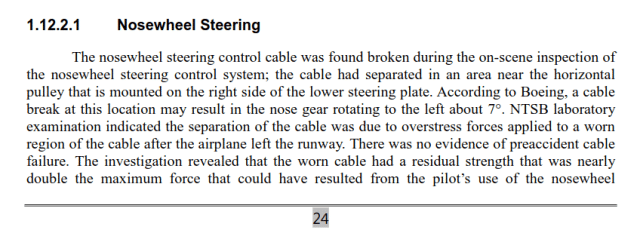
That said, I didn’t find any evidence that anything changed as a result. An NTSB report from 2010 quotes Boeing to say that the broken cable could deflect the nose wheel by about 7°, so at least they stopped giving out wrong information.
Of course, none of this means that a major change to the aircraft was needed. Boeing’s stance from the beginning was that the risk was sufficiently mitigated through maintenance instructions (preventing the grease application that caused the cables to become worn) rather than requiring an airframe redesign.
In 2019, the CIAIAC released their annual report which recorded that on the 15th of October 2019, twelve years after the recommendation, they had a response to their recommendation to the FAA to review the B737 design. The FAA had reviewed the accident with Boeing and “determined an unsafe safety of flight condition does not exist”.
Again, this may be a reasonable conclusion. But the timing of the response is interesting. Lion Air flight 610 and Ethiopian Airlines flight 302 had crashed and the Boeing 737 MAX was grounded. The FAA was under fire for insufficient oversight of The Boeing Company and presumably belatedly decided to go through all the open issues.
To be fair, I have not found any further Boeing 737 accidents caused by a broken steering cable. The CIAIAC presumably agreed; they graded the response as satisfactory and formally closed the recommendation.




Sorry, I find the following sentence rather confusing:
“The pilots had not followed procedure, including using the tiller, which was explicitly documented as not to be used in such a situation.”
Is it that Boeing said that the pilots should have used the tiller but didn’t while, at the same time, the documentation said the tiller should not be used? I.e, that Boeing contradicted their own documentation?
Ouch, yeah, that wasn’t well put.
The documentation explicitly said not to use the tiller in such a situation but they were trying everything and anything, including the tiller. Boeing then said that they shouldn’t have and (initially claimed) that if they had just stopped touching things, the nose wheel would have recentred.
I’ll try to rewrite this without using the negatives so oddly.
Ah, right, thank you. That makes sense.