KLM 1673 Veers Off the Runway with Full Right Rudder
On the 28th of November 2004, a Boeing B737 ran off the runway at Barcelona Airport. The weather had been good at Barcelona that evening. The flight crew agreed to land with flaps set to 30°, autobrakes setting 2 and standard reverse thrust, all within standard operational procedures. As they approached, the landing gear lowered and locked into place. The wind was 240° at 8 knots, perfect for runway 25 right.
They called Barcelona Tower to confirm their clearance.
KLM 1673: Cleared to land 25R KLM-1673
Tower: Wind check 240° 08 kt.
They landed centered on the runway, travelling 140 knots airspeed with the nose pitched up by four degrees. The flight data recorded the peak vertical acceleration of 1.43 g: a standard, smooth-to-firm airliner landing. As the first officer slowly lowered the nose, the thrust levers were moved to reverse and the ground speed began to reduce.
The moment that the nose wheels touched the runway, the Boeing veered left. The first officer immediately applied right rudder. For a moment, it seemed like he had it under control. But then the first officer found he had to apply more and more right rudder to keep the aircraft from continuing to drift to the left. The captain realised the same and also applied right rudder. Soon, they were both providing full deflection.
The first officer scanned the instruments, searching for some explanation. The reverse thrust appeared symmetrical, both engines were producing reverse thrust equally. They fought to keep the aircraft on the runway heading. The left and then right main gear tyres left dark skid marks on the runway as the aircraft continued to try to steer left.
The pilots attempted to apply differential braking to the right. One of the pilots saw that the amber autobrake light was already on, which meant that manual braking had caused the autobrakes to be deselected. They were going to run off the runway anyway. He started to apply both brakes, hoping to at least slow the aircraft, while keeping the rudder fully deflected. Both pilots turned their nose-wheel steering tiller to the right, with no effect.
They were travelling somewhere between 85 and 91 knots (98-105 mph or 157-169 km/h) as the aircraft barrelled off the runway and over the shoulder. The thrust reversers stowed, the command likely caused by an involuntary jolt than an intentional action.
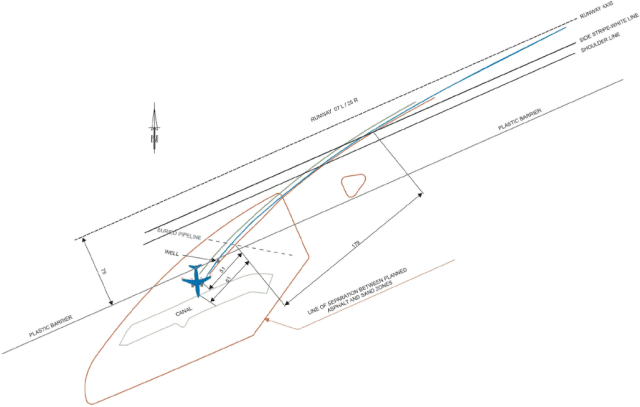
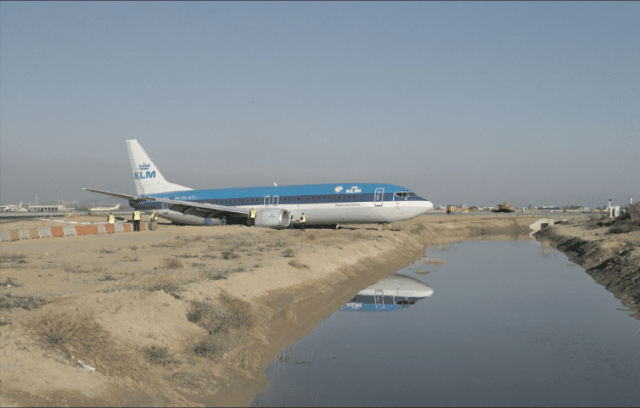
They bumped down onto an asphalted construction area about 10 cm below the level of the runway, then dropped into a 20-centimetre trench where the asphalt ended with a jolt of 1.494 g. The aircraft ploughed on through loose sand and struck an underground concrete pipeline. The landing gear collapsed. It travelled another fifty-five metres or so (180 feet) before stopping just short of a rain drainage canal with the steady wail of the landing gear horn filling the cockpit.
As the aircraft came to a stop, the cockpit went dark. The landing gear horn continue to sound. A waft of light smoke drifted through the cockpit. It smelled electrical. The captain quickly commanded the first officer to begin the emergency evacuation procedure while he took a look at the cabin. His recollection was that there was no emergency lighting: the passengers and cabin crew sat in the dark. The captain returned to the cockpit to check the emergency lights switch. The first officer mentally ran through the memory items for evacuation but struggled to find the stand-by power switch in the dark.
The air traffic controller in the airport tower could no longer see the aircraft, just a cloud of what looked like smoke or dust.
Tower: KLM 1673?
Tower: KLM 1673?
The cloud began to dissipate and the Boeing 737 appeared in the haze, sideways, pointing towards the tower.
Tower: EXS 313 please go around, set heading 328
The call to go around stepped over a radio transmission from the Boeing, rendering it unintelligible although the word “evacuation” could be clearly heard.
KLM 1673: [almost intelligible, possibly “evacuating…KLM 1673 evacuating”]
The captain used the passenger address system to command an emergency evacuation and selected the EVAC signal on. He called to ask if the Tower could hear them and and then confirmed that they were evacuating, followed with “Mayday, mayday, mayday” to ensure that it was clear that they were dealing with an emergency.
The firefighters called on ground frequency to say they had entered the runway.
A minute later, the flight crew called the tower again.
KLM 1673: Barcelona tower, are you sending emergency vehicles?
The Boeing 737 had slides mounted on every door of the aircraft. The doors at the front are 1L and 1R, at the rear are 2L and 2R, while the four overwing exists are O1L, O1R, O2L and O2R. In the cockpit is an additional emergency exit for the flight crew, using escape ropes on the sliding windows.
The cabin crew moved quickly to open the doors and deploy the slides. With the aircraft at an angle, they struggled to latch the doors only. Worse, when they found that a door was inoperable, a single cabin crew member could not easily move to the other door as the passengers were in the aisles and blocking the path.
The slide at the front right-side, the 1R exit, twisted as the cabin crew tried to deploy it, making that exit unuseable.
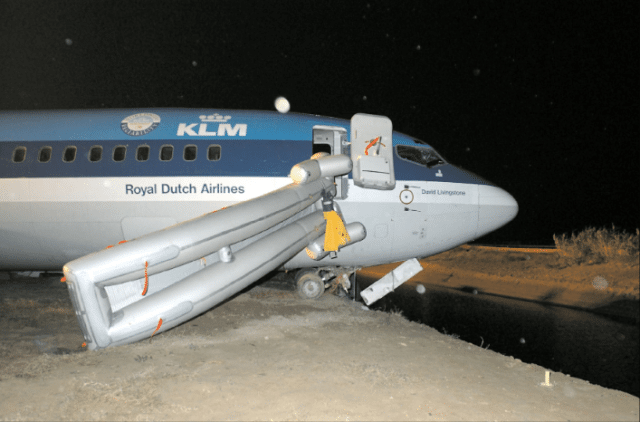
The cabin crew member at the rear right-side, the 2R exit, said that the slide appeared to have deployed at a bad angle and decided it was not safe for evacuation. Later, the slide was found to be displaced towards the rear of the aircraft but there was no actual malfunction.
Passengers seated at the overwing exits were able to open the doors without issue; in fact, some had already left the aircraft before the call to evacuate. A seven-year-old flying as an unaccompanied minor was taken off the aircraft by another passenger.
Others who were exiting at the front left-side exit (1L) found that the slide dropped them into the water in the canal.
Many passengers took baggage and personal items with them, causing some small delays. Cabin crew asked all passengers to leave personal items behind, but (on this flight, in 2004) this was not part of the preflight emergency instructions and it was not printed on the card.
Meanwhile, the fire fighters were speaking on the ground frequency, first to say that they could not see anything (presumably checking the runway) and then to say they’ve seen the aircraft wreckage. They saw that the right engine was smoking and began applying foam. Passengers and cabin crew exiting the aircraft reported inhaling some of the particles from the foam.
Passengers were clustered on the runway, smoking and taking photos. Both engines were still at dangerously high temperatures. Firefighters shouted them back (“This thing could explode!”).
In the cockpit, the two pilots called the tower to say that the passengers had evacuated and they were now leaving the aircraft.
The captain felt drops of something wet as he slid down from door 1L. The first offer slid down after him, jumping off the slide about three quarters of the way down to avoid landing in the ditch water. He turned back and saw the foam from the firefighters coming over the aircraft.
This was the first that the flight crew knew that the fire brigade was on the scene and blanketing the right-hand side of the aircraft.
Medical personnel arrived on the scene and began evaluating the situation. Some of the passengers had minor injuries from the evacuation but there was no one who needed emergency treatment. Airport officials arrived but communication was difficult as some of them had limited English.
Barcelona’s emergency plan stated that in case of an emergency evacuation, the passengers should be taken to the location Módulo 0. At that location, uninjured people are kept in one room with another room for relatives nearest the train station. There’s also a press room and a morgue. Airline staff are here able to provide for the uninjured victims. Friends and relatives are attended by psychologists if needed.
But as there were no serious injuries, the airport officials decided that the passengers should be taken to Módulo 4 instead. From there, the few passengers who needed medical assistance could be taken to the airport medical room. The plan was relayed to the airline representatives.
Buses dropped the passengers off at Módulo 4, but they arrived at the terminal to find there was no one organising the situation. There were no blankets for the passengers, some of whom were cold and wet from evacuating at the canal. There was no water or space for them to recover from the traumatic event. And worst of all, there was no sign of any of the airport officials.
Customers booked for the return flight to Amsterdam began to arrive, looking to retrieve their already checked-in baggage, as they had seen that the flight was cancelled. The cancelled-flight passengers became mixed with the accident passengers. The frantic cabin crew tried to deal with both sets of passengers at once. Meanwhile, accident flight passengers who had correctly left their carry-on luggage on the aircraft became frustrated that they were not given any updates as to when and how they could retrieve their personal items.
Barcelona had emergency plans and procedures for the situation; airport officials had simply decided to ignore them.
Finally, another airline stepped in, offering use of their lounge to the crew and the passengers, an offer that was gratefully accepted. Eventually the chaos subsided.
I found this investigative report particularly interesting because they took the time to look at the evacuation failures and interviewed all of the passengers after the event to find out their perspective on what had happened.
But at this point, the flight crew still had no idea what had happened. It was just thirteen seconds from a smooth touchdown to dumping a five-million-dollar aircraft at the edge of the canal. There was no warning, no gauge, no indication anywhere on the flight deck.
Next week we’ll look at what failed and whose fault it was.






Loose sand is not a bad choice for slowing down.
It doesn’t surprise me that the nose wheel tiller steering didn’t work; at that speed it’s easy to oversteer, and then the nose gear loses grip and skids along. I’m surprised that differential braking didn’t work, either; I would’ve bet that right thrust reverser not deploying would be pretty much the only thing that could cause this.
I’m also now wondering whether runway excursions to the left are more common; Emirates SkyCargo Flight 9788 in Hongkong a year ago was to the left as well. (Wanna bet what caused it? ;)
Mendel: the report says that the problem was a broken nosewheel steering cable (not properly serviced, and struck by a bird on takeoff), not an issue with the thrust reverser.
There is also a lot of discussion about the failures of the evacuation systems; apparently there was a long-standing problem with one of the slides (pictured above), and there’s some disagreement about whether even the emergency lighting was or wasn’t working. That is … discomfiting.
I did not look at the report because I didn’t want to spoil next week’s post for myself.
I always struggle with how to deal with the very long articles. It has belatedly occurred to me that I could have done it the other way around; talk about what happened first and then focus in on the evacuation second.