Hot Air Balloon Rescue in Texas
On the morning of Saturday the 28th of February 2026, a brightly coloured hot air balloon launched near Longview, Texas. There were two onboard. I’ve not seen anything that mentions the weather. It would be very interesting to know more about what the wind was that morning. So far, the only data I’ve seen is from the fire fighters, reporting 9-17 knots, gusting 21 knots at 1,000 feet above ground level. They weren’t particularly interested in the wind direction.
But as a hot air balloon pilot, you need to be. Hot air balloons have very limited lateral control. Changing altitude is the primary method of finding different wind directions. To some extent, you just go where the wind takes you.
In this case, the wind took the hot air balloon too close to a guyed mast.
A guyed mast is a slender, typically steel lattice structure held upright by sets of guy wires anchored to the ground at intervals, essentially a tall pole stabilised by cables. A freestanding tower over 400 feet becomes more structurally demanding and prohibitively expensive. Guyed masts can be built very tall and are relatively cheap; broadcast masts routinely reach 1,000 feet or more using this design. However, they also have a far larger footprint because of the guy lines.
The FCC registration lists this particular mast at 352 metres (1,155 feet). Constructed in 1996, its primary tenant is KYKX 105.7 FM, who pride themselves on offering the best country music in East Texas.
At around 8am local time, the hot air balloon struck a guy wire on the mast.
I know this is awfully pedantic but the headlines all talk about the collision with the mast. But when you are working with ships, and I feel also hot air balloons, it is important to distinguish between a collision, in which both subjects are moving, and an allision, where a moving subject impacts a stationary one. The guyed mast was not going anywhere, thus this was an allision.
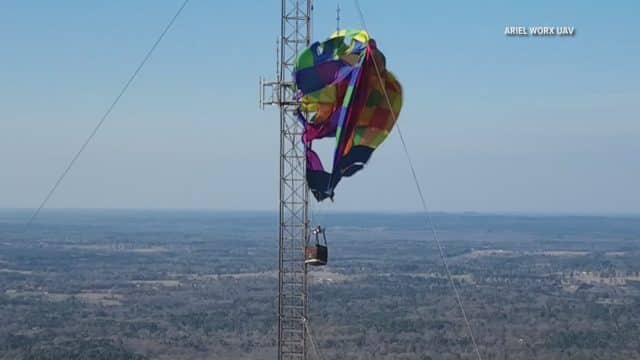
They allided into the guy wire, which ripped the balloon’s envelope.
A hot air balloon has three main parts: the envelope (the fabric bag that holds the hot air), the burner (which heats the air), and the basket (where the pilot and passengers stand).
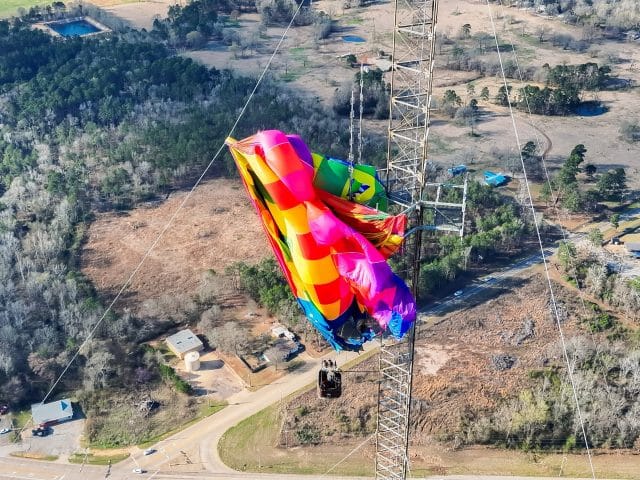
The torn fabric wrapped itself around the wire and became entangled in the mast structure. The basket with the pilot and passenger dangled helplessly at 925 feet above the ground.
They used a mobile phone to declare an emergency. They shut off the fuel valve and tried to secure the basket. And then they waited.
The Longview Fire Department received a dispatch of an emergency at 8:15 and 35 firefighters responded to the scene. Shortly before 9:00, the fire department was ready to start a rescue attempt.
Longview Fire Department Lt. Stephen Winchell described the operation as “the Super Bowl of rope rescue.” With 18 years of rope rescue experience, he said that he had never worked above 350 feet before this day. Fourteen firefighters climbed the structure using multiple rope systems at different heights. Drones were deployed the monitor conditions and confirm the exact entanglement height.
Those drones also gave us this great video released by the Longview Fire Department.
Experience the Longview Fire Department’s dramatic rescue close to a 1,000 feet in the air, in what experts believe is the highest climbing rope rescue in fire service history.
Sans Hawkins, the Chief Engineer of KYKX said that his top priority, when he first heard of the collision, was to stop the country music broadcast.
Sometimes I feel that way about country music too. But this was for good reason.
The balloon had struck the guy wire just 43 feet below the active FM antenna. KYKX broadcasts at 100 kW ERP. ERP (Effective Radiated Power) is the measure of how much signal an FM station is effectively pushing out. In North America, 100 kW is the maximum: a full-power commercial FM station. For comparison, a low-power community FM station might run 10–100 watts.
There’s a great thread about radio towers on Mike Holt’s Forum, a reference forum for electrical professionals. I was particularly struck by this comment about the risk of FM vs AM:
Higher frequencies have greater heating effects on the body. Standing next to a 50 KW AM tower will have practically no effect on you, but if you climb up a tower and hang next to a FM antenna radiating 50KW, you will feel it…the old-time tower climbers tell me that you will first feel heating in your eyes and testes. The RF exposure standards are weighted based on frequency…the higher the frequency, the greater the risk for tissue damage due to heating. There’s more to it than that, but it’s too much to discuss here.
What you need to know, if you are going to fly into a communications mast, is that AM and FM operate at very different frequencies and the human body absorbs RF energy much more efficiently at FM frequencies than AM. Aim for AM.
There’s a real-world case from Rfsafetysolutions where a climber wearing protective gear found that even at 10 percent power, the RF levels near the FM antennas were dangerously high. When two of the three stations were turned back on at full power without warning, the climber’s protective suit started smoking.
It’s easy to understand why Hawkins said his first priority was to get KYKX off the air.

The climbers reached the two occupants at around 10:00. One was standing in the basket; the other was sitting. Crews secured the basket to the mast with half-inch static rope and then handed harnesses to the occupants. Both put on harnesses and then climbed out of the basket. They swung over to the structure, over 900 feet above the ground in 20 mph wind. By 11:00, both balloon occupants were secured on the mast.
The descent took nearly two more hours, with both reaching the ground, uninjured and apparently in good spirits, at 12:45, almost five hours after they’d struck the wire.
That Monday, Tower King crews climbed the mast again to remove the balloon. The Wireless Estimator wrote about the high-angle rescue:
The hot air balloon that became entangled on a broadcast tower north of Longview, TX, was safely removed by Tower King technicians Marshall Salsman and his nephew Adrian Salsman, who used specialized rigging and a cable-suspended work platform more than 900 feet in the air to lower the balloon’s gondola and retrieve the canopy. After climbing the tower to set up ropes, a winch, and a “pan” basket, the crew secured and cut the balloon free, carefully lowering the gondola before gathering the large envelope, a difficult task in the wind. Although both men are experienced tower workers, Marshall—who has 30 years in the industry—said the unusual balloon entanglement required adapting to a situation unlike typical tower work.
And to the relief of country music lovers in East Texas, KYKX resumed their broadcast.





“ Sans Hawkins, the Chief Engineer of KYKX said that his top priority, when he first heard of the collision, was to stop the country music broadcast.
Sometimes I feel that way about country music too. But this was for good reason.”
You have a clever wit about you, Sylvia!
This is an excellent piece. Learned a lot about masts, radio waves and heat energy, and hot air balloons! Kudos to all involved.
The video was on several news sites, but with very little context; all of this is fascinating. I wonder whether the balloonists were let down in harness or had to climb down all that ladder — that’s a lot, even going down, for people who aren’t used to that kind of work.
It will also be interesting to hear what the FAA has to say about this; I know nothing of the laws, just that most balloonists rise near sunrise or sunset because the winds are typically lower then — but what constitutes “lower”, and how do they test it? Skydivers drop a weighted streamer from over the zone to see how far and in which direction from the zone they should jump; are balloonists required to send up a dummy to see which way it goes and how fast, or do they rely on the winds-aloft forecasts that pilots use?
In this case, they sent up two! ;)
The video shows the balloonists being lowered in harnesses, in stages.
You can see the wind at https://earth.nullschool.net/#2026/02/28/1400Z/wind/surface/level/orthographic=-94.44,32.30,5000/loc=-94.440,32.300 , unless I messed up.
It’s great to see this accident reported in-depth!
I looked at this link again; the page itself isn’t clear, but the path suggests this is surface wind, which wasn’t the issue — I was asking whether there’s any way to know what the winds aloft are. ISTR that wind on the ground can be much less than wind at a modest altitude; am I misrecollecting, or is “surface” taken to mean “ground and low-level”?
And yes, my original question was not really clear….
You can change the level for which the wind is displayed.