Fuel Switches in the Cutoff Position on China Eastern flight 5735
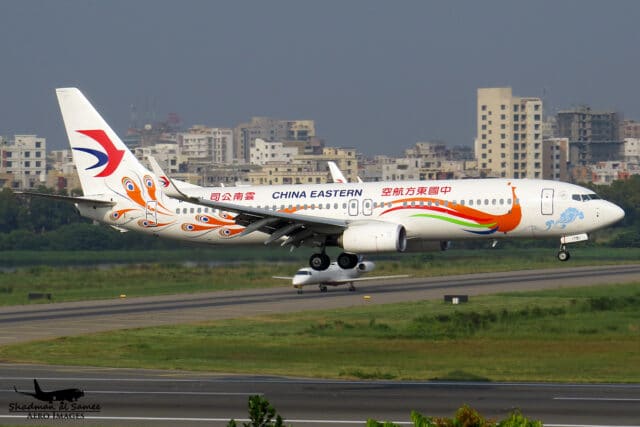
On the 21st of March 2022, a Boeing 737 passenger airliner crashed into a mountain. This was China Eastern Airlines flight 5735 flying from Kunming to Guangzhou in the People’s Republic of China. All 132 souls on board perished in the crash.
This was the first fatal crash of a Chinese mainline carrier in nearly twelve years. China’s commercial aviation safety record had been one of the strongest in the world.
The aircraft, a Boeing 737-89P registered in China as B-1791, was not yet seven years old and up-to-date on maintenance. The flight departed slightly late from Kunming Changshui International Airport at 13:16 local time for a two-hour flight. The weather was cloudy but visibility was good.
There were three pilots on the flight deck. The captain had 6,709 flight hours. The pilot listed as the first officer with 31,769 flight hours was one of the most experienced pilots at China Eastern Airlines, where he was a flight instructor/captain. The pilot listed as the second officer had only 556 hours flight time; China Eastern Airlines confirmed he was there for observation, in order to build up experience.
We have no idea who was at the controls.
The aircraft was cruising at 29,100 feet and entered the control zone of Guangzhou at this altitude at 14:17.
Three minutes later, at 14:20, air traffic controllers noticed that China Eastern Airlines flight 5735 was descending rapidly. They immediately attempted to contact the flight crew. There was no reply.
Flightradar24’s playback of the flight based on ADS-B data showed the sudden descent as starting at 06:20 UTC (14:20 local): the Boeing seemed to plunge from 29,125 feet to 7,426 feet above mean sea level. The next update showed a brief recovery to 8,600 feet before descending again. The final update shows the aircraft at 6,525 feet, 4,375 feet and, finally, 3,225 feet before the flight disappeared. The descent took place over three minutes.
China Aviation Review showed the following footage of the crash: the first is said to be CCTV footage from a local mining operation, the second is dashcam footage with no attribution.
Dash cam footage pic.twitter.com/w8iOzHblXE
— ChinaAviationReview (@ChinaAvReview) March 21, 2022
The Boeing 737 crashed into mountainous terrain near Wuzhou in Guangxi. Local residents heard a loud explosion and reported a massive bamboo fire in the area. Local firefighters arrived at 15:05 with more being dispatched from outside the area at 16:40. The fire was finally extinguished at 17:25.
There were no survivors.
As the crash took place in the People’s Republic of China, the investigation falls to the Civil Aviation Administration of China (CAAC). The NTSB participated as the accredited representative of the state of design and manufacture (the United States), with technical advisers from Boeing, the FAA, and engine-maker CFM. In practice this meant that when CAAC’s own attempts to download the badly damaged flight recorders ran into trouble, the storage modules were worked on jointly at CAAC’s Beijing laboratory and at the NTSB’s recorder lab in Washington, with CAAC engineers and NTSB engineers named as a joint team.
From Ruibao News:
NTSB engineers landed on a key diagnosis — the stutters, echoes, and digital noise in the first CVR download were not problems with the audio itself. The chip’s internal “address lines” were broken. By way of analogy: the magnetic tape was still there, but the index that told the playback machine which order to read it in had been torn up. NTSB rebuilt the connector — pulled off the housing, insulated with Kapton tape, reshaped the bent pins one by one — and pulled the data again. All four channels (captain, first officer, observer, cockpit area mic) came back at “excellent” quality. The path from “completely unintelligible” to “excellent” was a team of engineers at a microscope workstation, straightening bent pins one at a time.
The NTSB transferred the extracted data from all four CVR audio channels (rated “Excellent”) and produced a Cockpit Voice and Flight Data Recorder Combined Download Report, dated 1 July 2022. This was a factual report describing what was on the recorders, how it was recovered, and what condition the data was in. NTSB then handed everything from the CVR to CAAC and, as is normal practice, retained no copies of the audio. However, they did keep their FDR working files, on the basis that those would be needed to support CAAC in assembling the final report.
That final report has never appeared.
The CAAC issued their preliminary 30-day report in Chinese in April 2022 and an interim report in March 2023, which concluded only that the investigation was continuing because the accident was “very complicated and extremely rare”. The two-year update in March 2024 was more substantive, stating that the preflight qualifications of the crew, maintenance staff, airport support staff and air traffic controllers had all been in line with requirements, that there had been no abnormality in radio communications before the crash, no dangerous weather at the crash site, and no evidence of dangerous goods in the cargo or baggage.
What CAAC have not said, in any update, is what they think happened.
The third anniversary in March 2025 came and went without any update at all, as did the fourth in March 2026. In May 2025, when a Chinese citizen filed an open-government information request asking for the investigation progress report, CAAC refused, citing risks to “national security and social stability.”
In January 2026, a Chinese citizen filed a Freedom of Information Act request with the NTSB, asking for the agency’s records on the investigation. The NTSB responded on 29 April 2026 with the recorder report and supporting materials. The requester posted them to GitHub and Wikimedia Commons.
On 1 May, the NTSB also published the recorder report to their FOIA Reading Room, confirming the documents as authentic.
Inside that recorder report is this key sentence: while cruising at 29,000 feet, the fuel switches on both engines moved from the run position to the cutoff position. (bolding mine)
The two switches sit side-by-side on the throttle quadrant and can be operated by one hand on the Boeing 737NG. The report confirms that both engines spooled down and the autopilot disengaged. Figure 12 and 13 show the final 90 seconds of recording, which even without NTSB analysis look pretty damning.
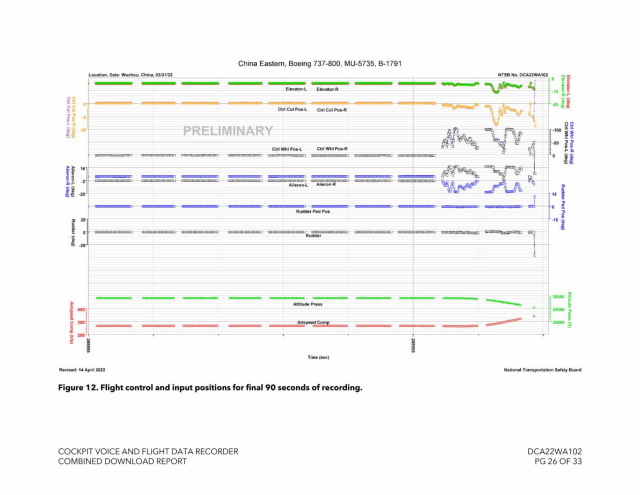
Figure 12 plots the final 90 seconds of FDR data. For the first 60 seconds the aircraft is in cruise and the traces are flat. Then, in the final 30 seconds, both elevators deflect substantially downward and both control columns are pushed forward — a sustained nose-down command from the cockpit. Both control wheels swing wildly across a wide range, oscillating through the descent, with the ailerons mirroring those inputs. The rudder stays largely neutral until a sharp deflection at the very end. Pressure altitude drops from 30,000 to about 25,000 feet over the visible window, and airspeed climbs sharply as the recording ends.
Please note that none of this is stated in the NTSB report; the only evidence for a nose-down command exists in the images of the FDR results. We do not know the circumstances in the flight deck. The NTSB text focuses on the FDR recording which terminated in less than half a minute after the fuel switches moved to CUTOFF:
The data stopped with the aircraft in a descent at approximately 26,000 ft. It did not capture the remainder of the descent and final accident sequence. Investigating the reason for the premature end of the flight data it was found that while at cruise at 29,000 ft, both engine N2 values decreased rapidly below the point at which the generators drop offline. The FDR does not have a battery backup, so without power from the aircraft generators it will power down. This is different from the CVR, which does have a battery backup and can continue recording for at least 10 minutes after the loss of the aircraft generators. Looking for the reason that the engine N2 dropped below the generator cutoff speed, it was found that while cruising at 29,000 ft, the fuel switches on both engines moved from the run position to the cutoff position. Engine speeds decreased after the fuel switch movement.
The report does not analyse the extracted data or put forward a probable cause.
In the immediate aftermath of the crash, a popular conspiracy theory on Chinese social media was that the crash was a murder-suicide carried out by the captain, and that the highly experienced first officer (rumored to be his former instructor) was powerless to stop it.
The CAAC has denied the theory wholesale without offering any alternative explanation.
However, based on the FOIA released document, it certainly seems that a person on the flight deck deliberately cut off the engines and that other than a very brief recovery at the start, no pilot was successful in pulling the aircraft out of the dive.
As of writing, the CAAC have made no public comment. CNN confirmed that they reached out to CAAC and to China Eastern but received no response. State media has not addressed the FOIA release. To be fair, the news broke during the May Day holiday period, but silence on this story is hardly new.
It’s nagging at me that a pilot cutting off the fuel appears as a consequential cockpit issue in four of the recent cases that we’ve discussed or that I’m in the process of writing about (Transair 810 (July 2021), China Eastern Airlines flight 5735 (March 2022), Air India 171 (June 2025) and Jeju Air 7C2216 (Dec 2024)).






Quite frightening. Of course, 4 incidents out of millions of flights is not huge, but still… and the fact that the others were unable to prevent it is interesting.
Do we know of any cases where a pilot tried and was stopped by the co-pilot?
I should be clear: two of the four were clearly inadvertent. The other two (which includes MU57358 are not proven, though it seems likely. Good question and I shall go looking. There was the case of JetBlue Flight 191 https://fearoflanding.com/accidents/accident-reports/jetblue-captain-break-down/