Forced Down North of the Arctic Circle
Despite the name, Coldfoot Airport, Alaska was pretty warm on the morning of the 22nd of June, 2026: a pleasant 17°C/63°F with a mild breeze of 5 knots and good visibility. It was a great day for flying.
Coldfoot is remote: a tiny settlement about sixty miles north of the Arctic Circle with a population of 34. Its importance is mainly as the critical halfway point 250 miles north of Fairbanks and 240 miles south of Deadhorse. There’s no local Air Traffic Control; departures and arrivals are operated by Anchorage ARTCC, over 550 miles away (~900 kilometres) using long-range radio and satellite. Flight services are provided by Fairbanks FSS.
The aircraft was a Cessna 208B Caravan a single-engine turboprop with a fixed tricycle landing gear. It’s a popular utility aircraft with its large unpressurised cabin. This particular Cessna Caravan, registered in the US as N94AW, was seven years old and operated by Wright Air Service, Inc, licensed as a commuter air carrier and an on-demand air taxi.
On that day, the Caravan was flying nine passengers from Fairbanks to Anaktuvuk Pass Airport, 118 kilometres to the north-east, with a stop at Coldfoot to refuel. The pilot filed a flight plan for CVFR (VFR in controlled airspace) and they departed Coldfoot for the second leg of the flight shortly after 10:00.
About fifteen minutes after departure, the pilot heard a long whining noise. They were flying over the Alaskan wilderness at around 8,200 feet, over wholly unpopulated land. Coldfoot was over 30 kilometres away, with a 5,000-foot mountain between the aircraft and the airport.
The pilot could not see anything abnormal in the engine indications but nevertheless immediately took the decision to turn back towards Coldfoot. Shortly after turning back, the propeller RPM began surging.
For five long minutes, the surging of the propeller RPM and the whining noise continued. Then the noise ceased, with little explanation as to why. The pilot said later that the surging appeared to stop only after the engine and propeller RPM decreased.
The engine power continued to decrease. Still some twenty miles from Coldfoot, it became clear that they did not have enough engine power to continue.
The pilot tried to feather the propeller, adjusting the pitch of the propeller’s blade. This was an attempt to reduce drag and give the aircraft more gliding distance. At first it looked like it was working but ultimately, he could not get it to feather fully.
They were descending. The pilot had no choice but to land the aircraft in the mountainous, rocky land. He spotted a riverbed and turned towards it.
It was at this point that one of the nine passengers started recording the descending flight on his mobile phone. He wrote about what he saw.
…the plane made a loud noise, our pilot listened for the noise and it was clear he realized something was wrong, with the plane. He turned back towards Coldfoot and tried gaining some altitude. The plane engine seemed to be revving up and down. Each time the engine seemed to rev, the entire plane lurched back and forth. After around five minutes, it was clear the engine was losing power. The pilot turned back to us and said that he was looking for a spot to land. I cinched my seatbelt tight. Moments before impact, I decided to record the event.
They landed hard on the uneven terrain. The nose landing gear collapsed and the left wing struck the ground. The pilot attempted an emergency engine shutdown but the engine seemed commited to staying on. You can hear the propeller clearly as the pilot evacuates the passengers, urging them to get away from the aircraft before he returned to try to shut down the engine. About two minutes after touchdown, he was finally successful.
An Alert Notice (ALNOT) was broadcast to initiate search and rescue. The Emergency Locator Beacon had started transmitting on impact. The operator had installed a satellite -based tracking system and the software was quickly able to pinpoint the location.
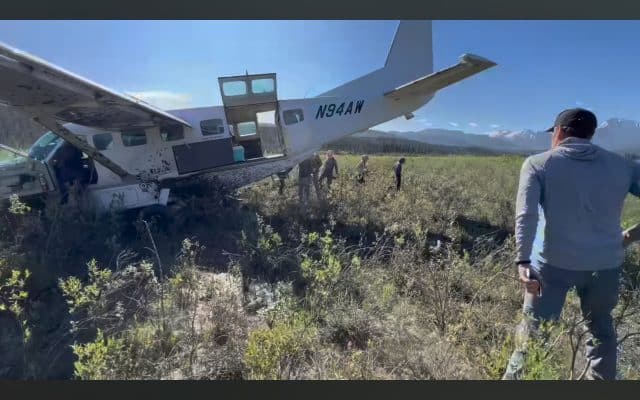
It isn’t clear to me if the pilot managed to speak to anyone at all. The first they knew that they’d been found was a single-engine aircraft flying over the crash site. About two hours from the time of impact, a helicopter landed nearby. Two contractors from a local drilling site had arrived to rescue the party. They could only carry four at a time and it took a further two hours for them to ferry everyone back to Coldfoot.
Only the pilot had suffered any injury: a split lip as they impacted the riverbed. The aircraft was extensively damaged.
The top comment on the video is by user @steelYZ65:
I knew the landing was going to be safe the moment i saw that Pilot’s mustache. With Great Stache comes Great Responsibility.
User @walterwilliams210 lets us know that the pilot is well-known in the area:
This landing is exactly why Louie is a legend in Anaktuvuk Pass. I’ve seen him land in the most overcast weather where most pilots would cancel the flight. I’ve literally heard other pilots say, “If Louie isn’t flying, I ain’t either.” He has the best instincts and knowledge in the Brooks Range, and he proved it by bringing everyone home safe from this.
The NTSB preliminary report is out, relating the pilot’s sequence of events, which follows what we can see in the video. The NTSB’s Alaska chief said they were moving fast because this aircraft and its engine are everywhere in the state’s air taxi fleet.
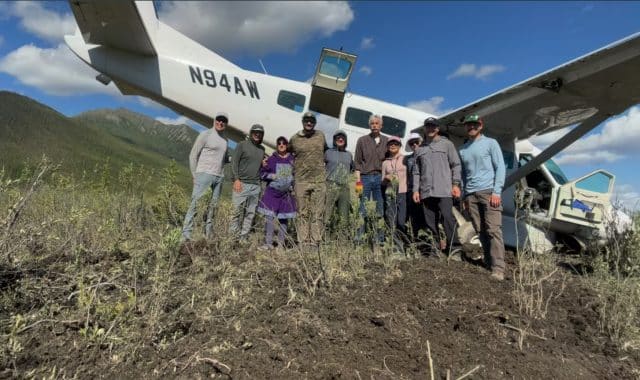
The eight-minute video is a rare pleasure, offering the passenger’s personal experience of what it is like to be involved in a plane crash in Alaska. I particularly liked the group photo as they awaited rescue.







According to an old Car & Driver report (they were driving minivans across Alaska) the town is also known as ‘Coldfood’ among the truckers. It’s on the Trans-Alaskan highway – the road from Fairbanks to Prudhoe Bay.
Jon
I actually typed “Coldfood” instead of Coldfoot at one point and caught it at the last minute. Good to know you would have had my back if the article had gone live with that typo!