Air India Sudden Descent Injures 24
On the 4th of August 2026, Air India flight AI2379 was en route from Phuket to Delhi when the aircraft suddenly and unexpectedly descended (“suddenly plunged”) 300 feet, resulting in multiple injuries. It isn’t completely clear what happened but the best source for the basic details seems to be covered by The Hindu reporting and Firstpost’s explainer
The aircraft was an Airbus A320-251N, registered in India as VT-EXO, delivered new to Air India in November 2018. The flight departed Phuket on schedule at 08:25 local time (06:55 IST).
There were 137 passengers on board and eight crew (two flight crew, six in the cabin). The first officer was the Pilot Flying and the captain was the Pilot Monitoring.
They were in the cruise, about two and a half hours into the flight, flying over Odisha when something went wrong. New Delhi TV reports from an internal Air India Flight Safety report that the captain was out of his seat, standing behind the first officer, discussing the aircraft’s air conditioning system. There were multiple alerts, including that the aircraft was stalling. The autopilot disengaged and the nose pitched up. The first officer pushed the nose down for the stall recovery. However (again, according to NDTV) that the aircraft pitched down so sharply causing “a sharp negative-g excursion”.
Firstpost relates the passengers’s recollections: cabin crew called for everyone to immediately fasten their seatbelts as luggage fell from the overhead bins.
“Everything was flying… the service cart and everything… for about 30 to 40 seconds. We genuinely felt we were gone.”
Passenger @minchen_t posted video recorded directly after the upset to Twitter, calling it the worst two hours of their life.
Air India: Phuket – Delhi, 04.08.2026.
pic.twitter.com/3bVjcZZ18g— Minchen (@minchen_t) August 4, 2026
From NDTV’s article quoting the internal report:
The captain, still out of his seat at this stage, described watching the first officer and every loose object in the cockpit, including himself, float upward as the aircraft briefly went weightless. An amber caution on the Engine Warning Display later confirmed the jet had exceeded its -1g structural limit during the event.
The captain said that he tried to steady the first officer as he made his way back to his seat, activating the seat belt sign. Once he was strapped in, he took control of the flight, increasing the thrust for the recovery. The report stated that the aircraft lost a maximum of 300 feet. Alerts after the upset were said to include “door arm forward emergency” and “transient hydraulic caution” .
After the recovery, the captain was informed by cabin crew that several passengers and two cabin crew members had sustained serious injuries.
The Pioneer quotes “a senior official associated with Delhi ATC” that they received a call for urgent assistance from the flight after they had crossed the Odisha airspace where the upset occurred.
The pilot of Air India flight AI2379, operating from Phuket to Delhi, communicated the PAN-PAN alert after crossing Odisha airspace. He informed ATC that around four-five passengers had been injured and that the aircraft required landing assistance
Other media reports state only flight crew asked ATC to organise an ambulance lift and medical staff at the parking bay closest to the runway exit.
The AAB has collected the Flight Data Recorder and the Cockpit Voice Recorder from the aircraft.
Air India released a statement, quoted by mainstream press, that the aircraft suffered from “brief in-flight turbulence” but released a second statement a few hours later, without referencing turbulence.
Earlier today, Air India flight AI2379 operating from Phuket to Delhi experienced a sudden loss of altitude during cruise. After the momentary event, the aircraft continued normally and landed safely in Delhi at 11:07 hrs IST.
Later that day, the DGCA, India’s civil aviation ministry, referred to a “transient technical fault”.
India’s civil aviation ministry stated that 20 passengers and four crew members were injured, with 12 hospitalised (8 passengers and 4 crew). They pointed out that certain material gathered during the investigation is confidential while the investigation is in progress and asked the media and the public to respect the investigation process.
This did not seem to stem the tide of leaked information. A photograph of a post-flight maintenance report, timestamped after the aircraft landed, shows a series of hydraulic faults.
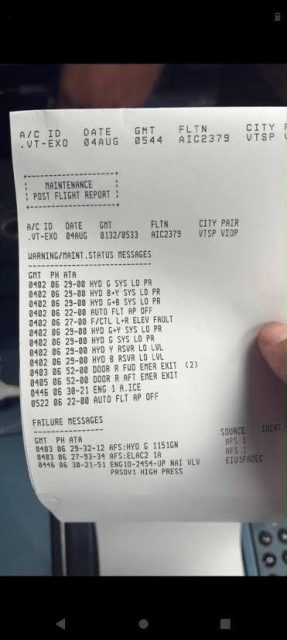
NDTV have a follow-up article today with a headline of “Exclusive: For 4 Seconds, Air India Phuket-Delhi Plane Had No Flight Controls” referring to time that elapsed from the disconnecting of the autopilot to the nose pitching down after the first officer’s input on the side-stick.
This article quotes an Airbus dossier with initial findings:
In its initial report, Airbus linked the emergency on AI-2379 to a possible faulty pressure sensor (a specific hydraulic pressure switch). However, these initial findings did not identify a definitive root cause. Neither did Airbus issue final recommendations.
Reuters also quotes the Airbus analysis with a clearer statement that the hydraulic issue came first:
Airbus’ initial analysis showed the plane registered losses in all three hydraulic systems, which use pressurised fluid to power flight controls and other equipment, in quick succession.
For about four seconds, the pilots were unable to use the elevators and ailerons, movable parts on the wings and tail that control whether the plane points up or down and banks left or right. During that time, the aircraft pitched upward, Airbus said in a communication responding to an Air India request for an assessment.
The first officer applied a full nose-down input, but there was “no direct response” from the flight-control surfaces before the hydraulic systems recovered within seconds.
The assessment did not establish what caused the loss of hydraulic pressure.
Reuters also state that Airbus has asked for specific tests on the aircraft’s hydraulic systems, pressure sensors and switches.
Neither Airbus nor Air India have acknowledged the analysis publicly.
The New Indian Express interviewed the president of the Airline Pilot Association of India who said that the aircraft had suffered a triple hydraulic systems failure.
“The A320 plane was entering Jharsuguda in Odisha around 10.30 pm when the Pilot-in-Command realised the aircraft had a triple hydraulic systems failure.
These systems take care of flight controls and general functioning of the plane. The Flight Captain immediately asked the co-pilot to take the nose down. This took the aircraft down by 300 feet.
Failure of all three is a rare occurrence, he said. “In such situations, the cockpit crew may take the plane down by even up to 800 feet to stabilise it,” he explained.
However, there is no explanation as to how the APA president came to know what happened on board.
Both pilots were tested after the flight and the captain tested positive for “psychoactive substances”, later clarified by the press as marijuana. NDTV reports that in the internal Air India safety report, the captain reported that he had been prescribed medication for insomnia.
I disclose, for completeness, that I had separately been experiencing sleep difficulty over a preceding period, related to personal circumstances, for which I had been prescribed medication by my family doctor.
In a further article, NDTV defends the captain, saying:
However, it is unlikely for a full-fledged commander of an Airbus aircraft in any airline to be irresponsible enough to get into recreational drug use before flying an aircraft, with the lives of over 100 people in his or her hands.
I’m not sure that’s a given, though I appreciate the vote of confidence for the aviation community.
That’s not stopped speculation, including a passenger from the flight telling NDTV that the pilot was “visibly high before the plane took off”.
My brother and I were the last passengers to board the flight and the pilot boarded with us. I spoke to him and asked him whether the flight was on time and whether we were late. He was very slow to respond and his eyes were red. I told my brother then that he seemed high, and you all know what happened after that,
NDTV point out that the passenger and his brother were still happy to board the plane and did not mention their concerns until after the story broke of the drug test. The passenger said that was because it was impossible to be sure.
Quite.
Bloomberg cite an internal email that Air India and Air India Express are testing all of their over 5,000 pilots for psychoactive substances in a one-time action.
The media is making much of the positive test but as far as I can tell, the DGCA test is traditionally a urine screen, which means that a positive result proves recent use, specifically prior exposure in the days and weeks previous. Unlike a breathalyser test for alcohol, a positive result does not prove that the captain was stoned in the cockpit.
Personally, I’m much more concerned about the insomnia. The captain’s statement in the internal airline report said that he reported to duty at 12:10 am for the flight to Phuket and had difficulty getting sleep before then. He was unable to rest during the layover at Phuket and had to be up at 3am IST for the return flight. He said that although the roster duties were legally within rest limits, they were scheduled in such a way that the actual rest was below the minimum required.
The Indian AAIB is investigating, with support from Airbus and the French Bureau d’Enquêtes et d’Analyses (representing the state of manufacturer).








Anxiously awaiting for the Indian AAIB, Airbus, and the Bureau d’Enquêtes et d’Analyses to propose a theory including a causal linkage from a dopey captain to a triple hydraulic failure.
No matter how incapacitated he may have been, he was nowhere near the controls when the incident occurred. Unless the circuit breakers for the hydraulic pumps are next to those for the air conditioners…
This is definitely one to watch!
The dots don’t quite connect?
I mean, even if the pilot was not in good shape, the plane did something unexpected while he wasn’t looking, and they did manage to retrieve the situation. I’d be interested to know about the plane. It’s not even that old, right?
Not that old and no obvious immediate issues. I think the captain’s failed drug test is likely a red herring, unless the flight crew did something unexpected/odd, which is what Harrow is hinting at.
This is going to be a challenging investigation for sure.
The “300 ft” are an artifact of the data, the aircraft gained some altitude before pitching down, for a total drop of something like 600 ft of stall recovery.
Oh, that makes sense. I did think 300 feet seemed like a remarkable recovery by the captain after fighting his way to his seat!
“The captain, still out of his seat at this stage, described watching the first officer … float upward”
This sounds like a big deal. Negative G’s sometimes happen, which is why the seats have harnesses. Apparently the co-pilot didn’t use his. That risks having bodies and limbs thrashing in the air, then random falling onto the controls when G’s go positive again. Meanwhile there’s nobody flying the airplane, which is entering an upset.
The first officer on this flight nearly killed everybody, just because the straps chafe a little.