The Mystery of the Caged Tyres and the Porcupine Who Flew Home
This photograph was posted to r/shittyaskflying, a subreddit dedicated to asking silly questions and giving silly answers. In this case, the photograph is enough to make one wonder what’s going on.
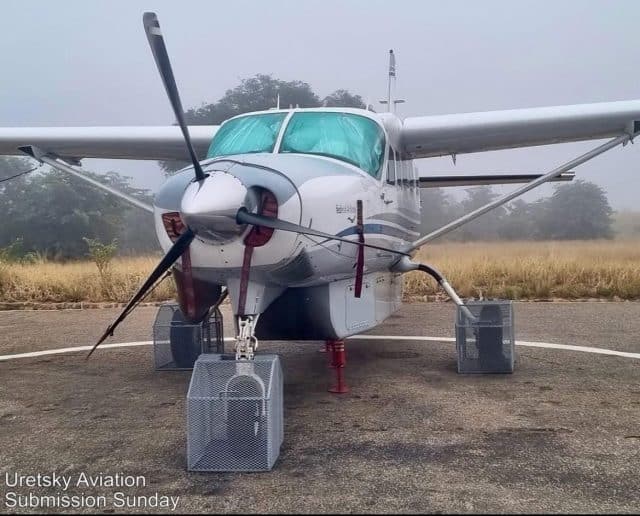
The caption reads:
Why all the wheel chocks? Strong winds?
The answers are predictably hilarious.
No_Mathematician2527 writes:
Stops porcupine from chewing the tires. Why do porcupines eat tires? Because they are super #$@%ing dumb, that’s why.
Stupid #$@%ing brain dead porcupines. I had to walk 2 #$@%ing days to get out of there. And for what? What did it accomplish?
Little #$@%er ate my tires and immediately died like 20 ft away. Just a big #$@% you I suppose. Porcupines can #$@% right off. Stupid needle rat.
And the perfect response from BabyBasher1776
That’s your fault for using such delicious tires.
schenkzoola has a different theory.
Bird cages. Keeps the plane from escaping
But garbagekr implies it’s an anti-theft device:
Flying in Romania be like…
Vegetable-Rooster-50 might be Romanian:
We can still steal your prop.
rover_G sounds a bit embarrassed:
Chastity cages to…you know…
And theogmichaelscott might be a wee bit confused:
Chock cages? My girlfriend was asking if I would wear one for her. Idk what shes on about.
But redit-fan believes the pilot is in trouble:
Unpaid parking tickets
StarzRout thinks the plane might be the one in trouble:
Mafia just went to get the cement to pour before chucking this sucker into the river.
Finally, I think jjs3_1 has the right of it:
That is a Cessna; they have to cage them, or they sneak off and get drunk!
Of course, I couldn’t rest until I had tracked the image down to its source. It was originally posted in 2023 by Uretsky Aviation, a Facebook page and Instagram account by B767 pilot and aviation photographer Brian Uretsky, who explained that he had received it from South African aviation enthusiast raegen.ed.
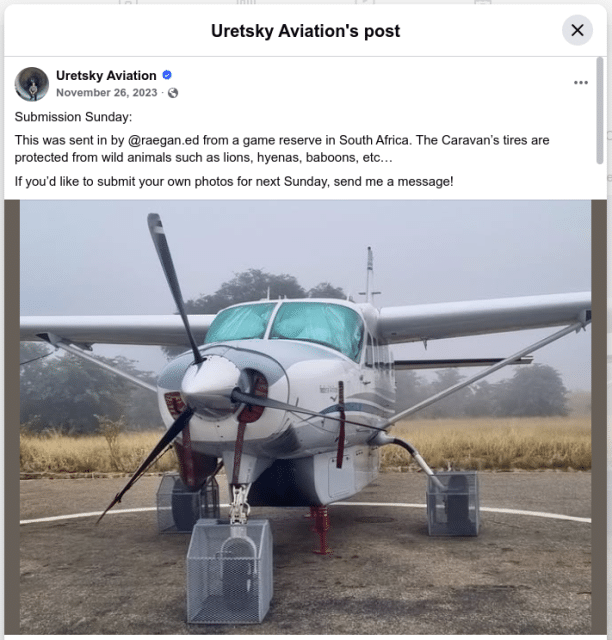
If you’d like to submit your own photos for next Sunday, send me a message!
The person who took the photo is on LinkedIn as a Commercial Student Pilot and a flight dispatcher for a South African airline; clearly the local wildlife didn’t scare them away from aviation.
On Instagram, dave_o3 recognises the aircraft:
I flew this aircraft in South Africa, it’s ZS-DGH. It’s a bush plane that is left overnight on unfenced airfields in the Sabi Sands. That airfield is FAUS. The cages stop the hyenas from chewing the brake lines. Apparently they find them tasty 🤤
So our top comment wasn’t far off, except that no one in South Africa seems all that worried about porcupines. But I discovered that in the US, people actually do wrap their cars in chicken wire to protect the tyres from porcupines!
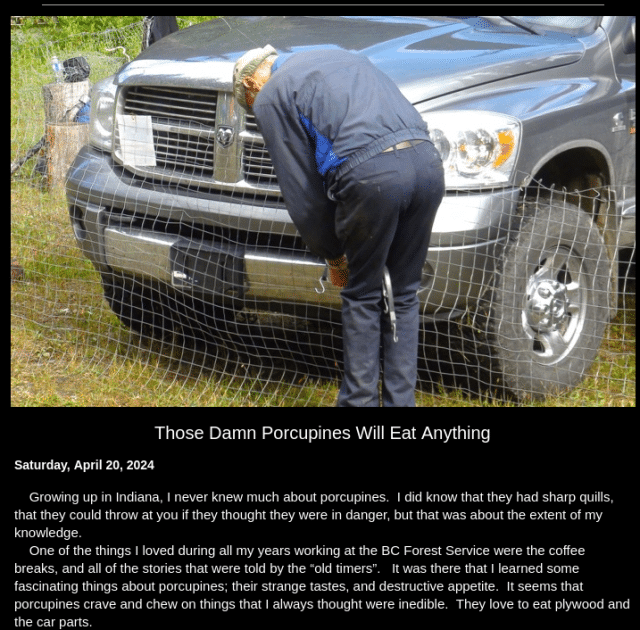
Those Damn Porcupines Will Eat Anything:
The biggest surprise to me about porcupine appetites was their love for tires and the plastic insulation that coated wires. I heard many stories about hikers and hunters who had driven way out in the bush, leaving their trucks parked and alone for several days, as they ventured off into the wilderness. Days later, when they returned, they tried unsuccessfully to start their trucks, only to discover that porcupines had chewed up the vehicle’s wiring or tires.
These events always ended in a very long and unexpected hike back to civilization for help.
I tried to find an instance of porcupines causing aircraft damage but only found this case in the NTSB database:
During a telephone interview with the NTSB investigator in charge on the morning of June 13, 1993, the pilot reported that he made several low passes over the lake to check the condition of the ice and that on one of the passes he bounced one of the main landing gear tires on the ice. During the last 100 feet of the landing rollout, the main landing gear tires began to cut a groove in the ice and the airplane began to sink. The pilot estimated the airplane was submerged in approximately 30 feet of water.
The lake in question is Porcupine Lake in Alaska, although it sure seems like the aircraft was the one doing the damage.
Wildlifehelp.org explains why this might affect cars but not planes:
Porcupines are attracted to anything salty. So winter road salt can attract them to automotive parts and rubber, including brake lines, fuel lines, tires, half-shaft boots, etc. Thoroughly hose off or wipe down vehicles and vehicle parts to remove accumulated salt. If possible, keep vehicles in a garage or erect a temporary fence around vehicles.
Although salt is often used on roads, it is not used on runways, because of salt’s corrosive effect on aluminium. Sand or de-icing chemicals are used instead to avoid the risk of damage to the aircraft parts and engines.
In fact, Pittsburgh International Airport has a video on how they get the sand for their winter operations:
Of course, this means that planes are a lot less tasty than cars, at least if you are a porcupine.
Hyenas, on the other hand, are known to chew on the rubber, much like dogs chew on shoes. jc717 posted a photograph of thorns used to protect an aircraft.
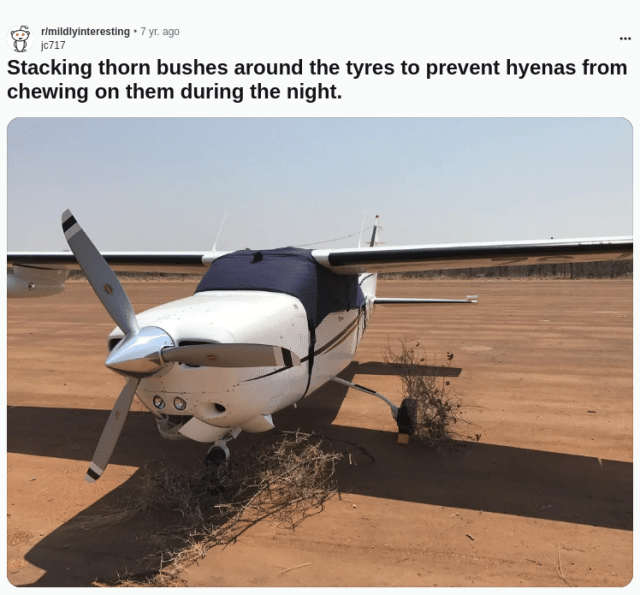
Once upon a time in a faraway place called Limpopo Lipadi, there arrived a Cessna 210 and its pilot. Two American guests were on their first trip to Africa, and had an early flight to another faraway place the following morning.
After a night of chatting around the fire and very excited passengers, the morning soon dawned.
A bumpy drive to the airstrip and some more excited chatter passed before finally arriving, only to turn the two happy Americans into two very pissed off Americans.
The two main gear tyres had been completely torn to shreds, and the culprits tracks were still fresh in the sand. Hyenas are assholes.
I’m bad at telling stories. But there it is.
Which goes to show that porcupines were unfairly maligned in the original comment! As an apology to any porcupine interested in aviation who may feel offended at being called a needle rat, I would like to share the story of Mackenzie the porcupine.
The story starts with a porcupine discovering an aircraft wreck near Mackenzie, in northern British Columbia, Canada. She thought she had herself a cozy new home and moved in, nibbling on the seats and generally feeling quite happy with herself.
Unfortunately for Mackenzie, the wreck was recent. To her shock and horror, a helicopter arrived and airlifted the wrecked aircraft from the remote location with her on board. Aircraft and porcupine were then transported by boat and trailer to a salvage yard over 800 kilometres away. At the yard, workers discovered the porcupine hiding under the pilot’s seat and called Canada’s Interior Wildlife Rehabilitation Society.
Never a dull moment at Interior Wildlife!
We were asked to extract a young female porcupine from a plane wreck. It had hitched a ride during wreck recovery and was accidentally transported by helicopter, boat and trailer from Mackenzie all the way to Kelowna!
Unlike marmots, who are known to hitch car rides in BC – a “porcupine in a plane” was a different displacement story.
This adventurous young animal was hidden below the pilot’s seat and started poking its head out when workers of a local wreck recovery company were going to unload the wreckage from their flat deck trailer in Kelowna.
Usually we don’t have enough resources to capture wild animals ourselves, instead we ask to be contacted before we give instructions on how and when the finder can safely catch/trap and transport wildlife in need to us. In this case however, the animal was hundreds of kilometres away from its home and the possibility of loosing it amongst a lot of aircraft parts in an industrial yard where it would be disoriented, find nothing to eat and crawl into another machine or vehicle was quite real, the workers feared. It was very scared and didn’t make any attempts to leave its hiding spot of the past 3 days. They tried to coax and lure it out once they realized their blind passenger, but to no avail. That’s when the team at Interior Wildlife was asked to assist. With the help of our supporting veterinarian we lightly sedated the porcupine via intramuscular injection into the rear end (the only spot we could get to it was through the small plane window). We then pulled it out gently by the front arms a few minutes later, no quills shed. Safe for the humans involved and the animal itself.
A friendly pilot volunteered to fly her back home to Mackenzie BC in a Cessna 172 loaned for the porcupine’s trip home. The petrol costs were covered by community donations. The pilot said on social media that the Cessna had better range than his aircraft and afterwards said that the 2,000 kilometre round trip was the longest day of flying he’d ever had. Once back at the start, she was safely released into the forest by wildlife workers:
But much more interesting, I thought, was this Instagram post by the pilot with video from the flight. Unfortunately, Instagram embeds don’t always work well so I’m going to ask you to click through to watch this one on bigtotherescue’s Insta.
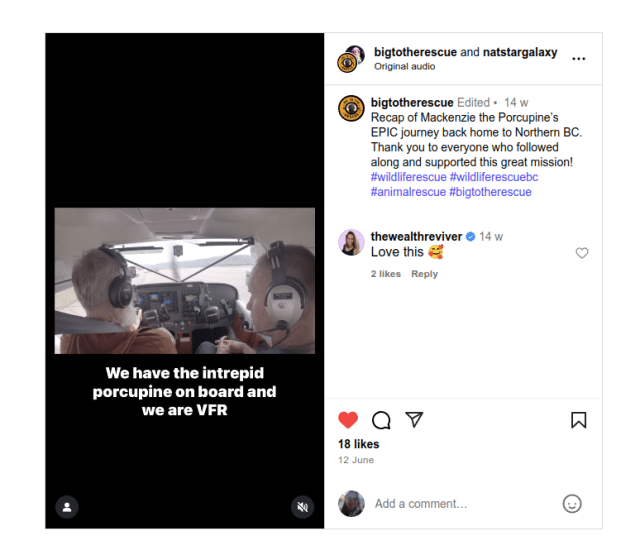
I particularly love how the pilot tells the controller that they have precious cargo on board.
I’m not sure how it got to Friday evening when all I was doing was reading a silly post on Reddit, but sometimes that is how it goes. I hope you enjoyed going down this rabbit hole with me!







Hilarious
Just lovely!
I remember being warned when I was travel-camping by canoe to keep paddles secure at night so porcupines couldn’t gnaw on the parts that had absorbed sweat from our hands. Hyenas going after tires and brake lines is … extreme.
And that’s a great story about the porcupine rescue.
During WWII, while stationed in Greece, my Daddy climbed aboard his Gooney Bird to start it up. To his surprise, a skunk popped out from under his seat. Luckily, it darted off the plane without spraying but unluckily, it headed straight into a hangar
That was a well travelled skunk! They are American animals, with none known in Greece, so it must have climbed on the aircraft in the USA.
We once found a possum (Australian native type) under the bonnet of our car when we stopped on a road trip, but that’s not nearly as impressive.
Knowing my Daddy, he could be misremembering and it could have happened in the states. He just always said Greece. He was also stationed in Italy and England. I don’t know about their skunk situations.
Possums are pretty impressive if they are like their American counterparts. All snarly and hissy and will only begrudgingly move along.
Contrary to the live-action 101 Dalmatians, skunks are found only the in western hemisphere; “stink badgers” are found on some of the islands between Australia and mainland Asia, but none in c.
There is or was a problem with foxes chewing cables on car in the UK. In a part of Glasgow where I worked several instances of brake damage were at first thought to be vandalism until it was established it was young foxes. For some reason mainly Honda CRV cars were targetted in this area.
https://www.pressreader.com/uk/scottish-daily-mail/20141113/281913066403941?srsltid=AfmBOorNV3iBvIqoHyRgmdwocVpawQkI02XrVqmL7PG6AxTGLpEKubWW