How the B-52 Lands in Crosswinds
I’m here, defeated but not yet horizontal, the victim of a relentless summer cold that feels like the universe’s revenge for something I can’t even remember. If I don’t make it, please avenge me by naming a B-52 after me.
I’m thinking about B-52s after watching this one land at the airshow at RAF Fairford, demonstrating why the B-52’s landing gear is one of Boeing’s most ingenious solutions.
A really rare and unique opportunity to see this Boeing B-52H Stratofortress, nicknamed the BUFF (Big Ugly Fat Fella), crabbing sideways on the runway after landing at RAF Fairford. This unique feature of B52 was presented on Sunday 16 July 2023 at the Royal International Air Tatto – RIAT.
The iconic bomber was designed with the ability to swivel its landing gear to balance the effects of crosswinds. This capability allows the B-52 with its narrow wheelbase and large tail to land and crab down the runway in a heavy crosswind conditions.
Fun fact – this crab walk did some damage to the airfield infrastructure, nearly 20 runway lights were destroyed, this may happen when you have an aircraft with large wingspan.
The other day, a speeded up version was posted to Reddit with the title of Didn’t know it could do that.. The comments are full of great information!
Misophonic4000 explains what is happening here:
The ability to counter-crab the landing gear (up to 20° in either direction) is the only way the B-52 can land in any kind of crosswind (without a massive wing/pod strike)
Edit: tidbit of info – the system works by the crew inputting the heading of the runway, and then tracking that heading (within those 20°of steering authority in either direction) compared to the compass heading of the plane
…and later in the same thread:
Wait until you realize it’s staggered so it can retract in that narrow body and also leave room for the bomb bay!
Here’s a cool video showing most of the gear retraction sequence https://youtu.be/riEmAvlrynk
critical_patch offers an explanation as to why:
The BUFF has such poor rudder authority that it has to compensate for crosswind in other ways. Like the comment above you says, there would be great risk of a wingtip hitting the ground if it tried to make up for having no rudder with ailerons or body roll, etc. plus not having the landing gear pointing under you anymore. The most practical solution was to make the gear swivel so pilots could land the fucker sideways while using engine thrust to counteract the force of the crosswind.
But Pubics_Cube reassures us that this doesn’t mean the B-52 is hard to land.
The B-52 doesn’t have ailerons, only spoilers; but to answer your question, it’s pretty responsive in the landing configuration. You can scrape a pod pretty easily if you’re not level, but there are outrigger gear on the wingtips that provide a little bit of protection. The wing flex actually works in your favor on landing, because the wing tips are up off the ground as long as they’re producing lift. Once the plane settles in on the runway, they’ll come back down.
The weirdest part about landing with a ton of crab in is looking out the side windows for your aimpoint.
Have you ever noticed that older images of the B-52 never show the landing gear? Macromonster explains why:
The crabbing feature was considered so Top Secret that photographs of the first public rollout either covered up the landing gear or used angles that didn’t show the interesting bits.
Although m00ph points out that Hollywood spilled the beans.
It’s been used as a joke in a few movies where you see a passenger jet take off, and then an underside shot of the very distinctive B-52 gear retracting.
Further along, critical_patch chimes in again with another effect of the small rudder.
Another fun fact, that itsy bitsy rudder is also why the upgrade to B-52J has to keep the 8 engines in the doubled up pods. The plane has to stay steerable through engine failure scenarios—but if the plane had four modern engines (like the configuration on a 747 or A380) the rudder is too small to compensate for a power loss on one of the outboard engines. The differential thrust would be too great for the rudder to stop the plane from yawing to that side!
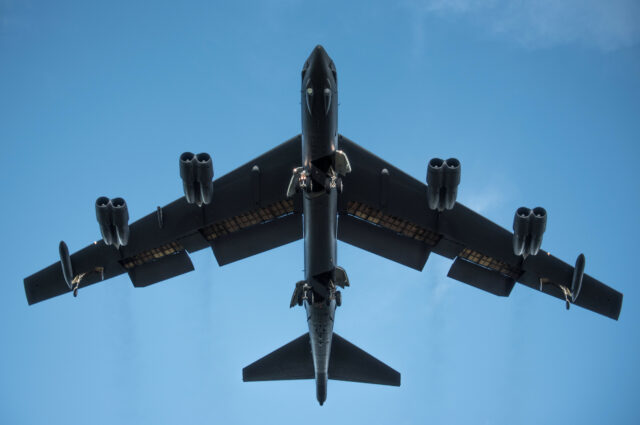
If you want to know even more about the B-52, HumpyPocock has you covered.
AOPA article below is great, and explains many of the finer points, also included a couple of videos of takeoff and landing in the crab, plus a photo from right underneath showing the landing gear bays are oriented opposite directions fore-to-aft, into which the port and starboard gear retract, as you noted elsewhere.
Article via AOPA incl rather wonderful minutiae (or PDF)
NB here’s an extra photo of the CRAB CONTROL
BUFF Nethers (Port Gear ⟶ Fore / Stbd Gear ⟶ Aft)
Photos via @HEADDANCER7
Port Three Quarter and Starboard Fore
Head On BUFF and a Tiny BUFF Butt (Wheel)
Fun Fact ⟶ they’re called Quadricycle Landing Gear
Takeoff in the Crab and Landing in the Crab incl. Rollout
PS oh and a neat size comparison…
There. That should keep you busy for a while.
I’m going back to bed. If I don’t make it, tell the B-52 community I went out with honour and Sudafed.









Best I can do with a relationship with you and Boeing is with our relative Jack Parsons … Aerojet (co-founded by Parsons) eventually became part of Aerojet Rocketdyne, a major rocket engine manufacturer.
Aerojet Rocketdyne has supplied engines used by NASA and Boeing for various space missions.
I say yes! Honour Sylvia, Boeing! It will make her feel better. Rest, fluids and nutrition.
Hope you feel better soon Sylvia! I find whisky Mac’s (whisky and green ginger wine) are better than Sudofed and even my go-to Hot Lemons. Two of them, hand poured without my glasses on, always help me find the will to live in the direst of situations.
However, just in case of your unexpected demise, I came up with Snorty McSnot Face for ‘your’ B52.
On reflection, I will of course completely understand if you block me from making any more comments.
Get better soon… and ain’t that B52 just beautiful!!!
BTW, the first episodes of Hawaii 5-0 used to show the undercarriage retracting during the opening music / credits.
The crosswind capability of the B52 leads to some spectacular images.
For pilots not used to this technique it must be a very strange way to land an aircraft. No doubt it will require a good amount of training.
BTW: I am sure that the news is already filtering through. Apparently there was nothing essentially wrong with the Air India 171 Boeing 787.
Preliminary findings of the FDR ands CVR have been released that strongly suggest that the fuel supply to the engines – both of them – was switched off immediately after take-off.
A picture was showing two “Run” and “Stop” rotary switches at the back of the pedestal, behind and below the power levers.
According to the newsreader, these switches are indeed used on the ground tp allow the engines to be started, or stopped.
They apparently can also be used to turn off the fuel supply to an engine in case of an emergency. Obviously not meant to turn them both off in flight.
In the aircraft that I have flown the engine cut-off procedure is to bring the power lever all the way to idle, then lift them over a gate.
Another way, of course, is to activate the engine fire switch or lever.
Activation of the fire switch usually is irreversible, the engine can not be restarted. But in theory it can be restarted by using the in-flight engine restart procedure (checklist).
I don’t know why Boeing installed this switch in the B787, but the finding that there was nothing basically wrong with the aircraft will no doubt lead to a very heavy sigh of relief
Activations of the cut-off by pulling the power levers in the cut-off detent, or emergency fire cut-off are very obvious and cannot really be missed by either cockpit crew member.
Previous aircraft had a start master switch usually mounted in the overhead panel. The “run-stop” switches – sorry I don’t know the official name – would require what I consider a very deliberate act of either pilot, who has to move his/her hand to the back of the pedestal. I guess that this can be done surreptitiously. The other pilot might not even notice.
In the Air India case, it seems that they were both turned off.
This of course opens a very scary possibility, one that is virtuously unthinkable..
Sorry if I deviated from the interesting B52 crabbing landing gear story.
Hi Sylvia,
I second the recommendation of whiskey macs but not the naming suggestion.
Did you notice the 747 in the comparison picture is not just a passenger plane but one of the two Shuttle Transport aircraft. I’m just not knowledgeable right to tell if it is the 100 or SP variant although I suspect 100.
Get wells soon, Martin
A cold in summer just doesn’t seem fair. Hope you’re feeling better soon.
Those are impressive videos.
At first I was surprised by the report that runway lights were destroyed by the crab; landing at any angle would reduce the effective wingspan wrt the width of the runway. OTOH, if the pilot doesn’t correctly estimate how far off the centerline the nose of the plane should be, the downwind wing (which would take up more of the width of the runway in a crab) could reach past the edge of the runway — and those drooping wings and their outriggers could do damage. (Wikipedia tells me that the C-5 has 37 feet more wingspan than the B-52, but it doesn’t look like the wings droop so much.)
No, I haven’t landed a B52. Nor even flown in one. But I spent some time in the driver’s seat of the one in Darwin. Strangely, it’s not in the least awe-inspiring. If you’re familiar with the Hercules, the cockpit is damn near identical until you start counting engine gauges and throttle levers. The feeling I got is that I wouldn’t mind flying the thing, but I’d get someone else to taxi it.
Get well soon, Sylvia.