Five Aircraft in Two (Three?) Days
Earlier this month, as a result of personal circumstances and bad timing, I ended up needing to fly in five different aircraft over the course of a few days, trying to get from Buenos Aires to Tallinn to El Paso (not to mention three buses, two trains and a taxi). “It’s a good thing you like planes,” said a friend after hearing about my schedule. I do like planes. I like looking at planes. I like reading about planes. I like flying planes. I’m not sure I like being in planes, sitting in the cabin.
At each airport, I took photographs of the next aircraft waiting for me to board and then amused myself by looking up each registration and finding out the aircraft’s history. I hope you will enjoy what I found.
Boeing 747-830
Registration D-ABYO Saarland
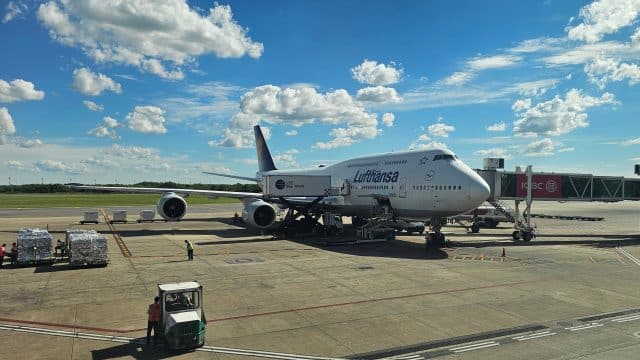
My journey started on the 2nd of December with a 13-hour flight from Buenos Aires to Frankfurt in a Boeing 747-8. D-ABYO is one of Lufthansa’s nineteen Boeing 747-8 Intercontinental aircraft, making Lufthansa the largest operator of the passenger variant worldwide. There’s a great article and video on Flightradar24 documenting Lufthansa’s nineteen Boeing 747-8 Intercontinental aircraft. The 747-8 represents the final evolution of Boeing’s “Queen of the Skies”. Lufthansa took possession of D-ABYO on the 30th of April 2014 and named it after the German federal state of Saarland. Its five minutes of fame took place during the 2014 FIFA World Cup in Brazil, when Lufthansa created the “Fanhansa” special livery, sporting a logo of a football/soccer ball and the German flag. Lufthansa applied the livery on D-ABYO and sister aircraft D-ABYI Potsdam. This was the first time in Lufthansa’s 60-year history that the airline altered its name on aircraft fuselages for a promotional campaign.
The ten-year-old Boeing experienced its only notable safety event on the 22nd of February 2018. According to AeroInside, flight LH-401 from New York JFK to Frankfurt “departed JFK’s runway 31L but had to return after the crew reported an engine problem about 20 minutes into the flight at FL200.” The report notes that “passengers reported hearing a loud bang and observing flames from the left outboard engine” and that the Boeing 747-8 “landed safely back on JFK’s runway 04L about 40 minutes after departure” with “127 passengers on board.” No injuries occurred.
Airbus A321-131
Registration D-AIRL Kulmbach
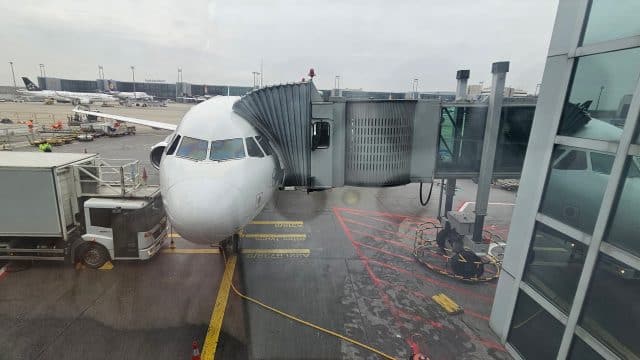
My next flight was a Lufthansa A321 for the hop from Frankfurt to Tallinn. This aircraft was quite a bit smaller and quite a bit older. Lufthansa was the launch customer for the A321 in 1994 and D-AIRL was the tenth A321 delivery, in September 1994. Less than ninety A321-100s were ever built and most airlines have since retired them. At just over 30 years old, D-AIRL is one of the six oldest aircraft in Lufthansa’s entire fleet. German news outlet Wiesentbote explains that the city of Kulmbach has maintained an “aircraft sponsorship” (Flugzeug-Patenschaft) with Lufthansa since 1990, with D-AIRL being “christened” for the city. The same article reports D-AIRL specifically has visited completed nearly 50,000 flights to 135 different destinations, carrying approximately 5.2 million passengers as of this year. I like to think that I was passenger number 5.2 million and one.
AVSpotters says that D-AIRL was originally configured with 190 economy seats but in 2011 it was reconfigured to 205 economy seats, which explains why we were all squished in like sardines.
Following this flight, I spent eleven hours at home, most of which were spent sleeping.
ATR 72-500 (ATR 72-212A)
Registration OH-ATP
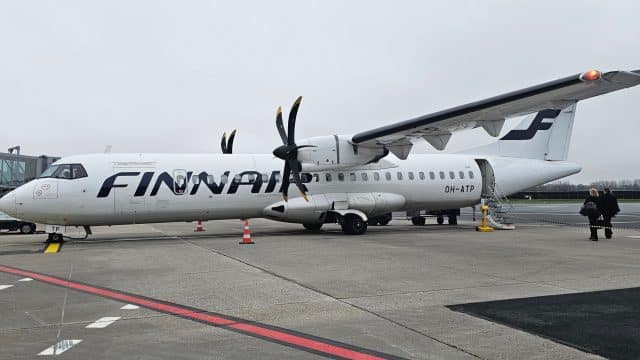
On the 4th of December I got up at an ungodly hour to catch the early morning flight from Tallinn to Helsinki in what was unquestionably the cutest of the five aircraft. Finnair say that they like the ATR 72 because it has a reverse gear and own stairs, meaning that it doesn’t need any equipment from the airport, and that it is amazingly fuel-efficient for these short hops, consuming less fuel per hundred passenger kilometers than most cars.
This ATR 72-500 seems to have gone through some interesting times before settling down with Finnair. OH-ATP was originally delivered to Flybe Nordic in 2012, a joint venture between Flybe and Finnair. Three years later, Flybe sold its 60% stake to Finnair for one euro, and Flybe Nordic was rebranded as Nordic Regional Airlines (NORRA).
In June 2019, the ATR-72-500 fleet transferred to Finnair’s fleet, with NORRA operating it on contract. Finnair’s fleet manager remembers the cabin renovation and painting project carried out in Tallinn over 2019-2020.
The first modified aircraft arrived from Tallinn to Helsinki in the dark of the night and it was brought straight inside the hangar. We had managed to keep the modification project a secret, and no pictures of it had been published in advance. The flight arrived in Helsinki later than planned, but thanks to that, our own staff was the first to see the plane.”
There’s an amusing side-story about the registration. If the registration were in Russian cyrillic, он-атр reads as ON-ATR. In Russian, “on” means “he”, so this literally reads “He (is) ATR”; amused plane spotters have commented that this could be read as the plane registration showing that the aircraft self-identifies as an ATR, but only in Russian.
Airbus A350-941
Registration: OH-LWC
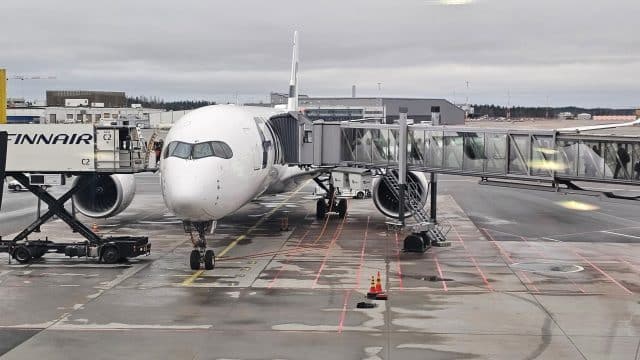
At Helsinki, I boarded a much larger and classier aircraft. OH-LWC as manufactured in November 2015 under the serial number 20. It was delivered to Finnair on the 31st of December 2015 and flew its first flight three days later. Finnair’s Director of Fleet Management explained in a company interview that Finnair ordered the A350 in 2006, long before it was even in its testing phase. It was meant to be like an A330neo but at the request of the airlines, the A350 was redesigned from scratch.
However, OH-LWC was among the nine Finnair A350s with issues with the cabin. FlightGlobal reported in June 2017 that Finnair CEO Pekka Vauramo stated “the only thing we don’t like is the finish of the cabin,” citing issues with the seats, lavatories and kitchens. In June 2017, Airbus agreed to redo the interiors during the first major maintenance round.
FlyerTalk forum members documented the resolution: “In June 2017 it was announced that Airbus has accepted responsibility for the quality issues and will replace every seat on every plane delivered until that point in time (9 birds). The refurbish will take place during the first round of major maintenance round.”
OH-LWC is currently configured with 46 business class seats, 43 premium economy seats and 208 economy seats. I like to think that some travel god had noticed my travels and felt sorry for me, as I was lucky enough to get upgraded to business class, which was marvelous. I even slept for a few hours.
Airbus A321-211
Registration N170US
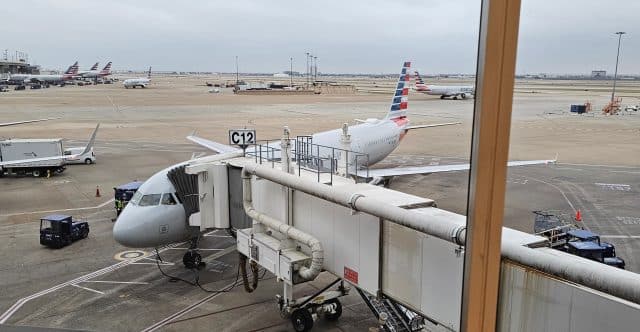
My last flight was an American Airways A321 for the short hop from Dallas to El Paso; at one hour forty minutes, it was the kind of short hop that reminds you just how big Texas is. N170US was delivered new to US Airways in May 2001. During the pandemic, it was parked in Philadelphia and then Tulsa before returning to service in December 2020.
N170US has a notable incident a few years ago. On the 12th of February 2022, the A321 was departing Cancun for a passenger flight to Charlotte, North Carolina. As it was climbing away, the aircraft struck several birds. After checking systems, the pilots decided to continue their flight. They landed safely and N170US suffered only minor damage, which was repaired at Charlotte. The aircraft was back to work just two hours later.
I departed Buenos Aires in the late afternoon of the 2nd of December.
I landed in El Paso in the early evening of the 4th of December.
So it certainly felt like two days travel, with a brief break in the middle in which I spent six hours in my own bed, but technically, I guess it counts as three days if I shifted all the timezones into UTC. I make it 30 hours in the air, which isn’t really a big enough number for what it felt like, if you ask me.
I shared my journey with 30-year-old narrowbodies still flying reliably, 13-year-old regional turboprops at mid-life, 10-year-old jumbo jets representing the twilight of the four-engine era, and modern composite widebodies defining the future of long-haul travel.
The only bright side was that I didn’t seem to suffer from as much jetlag as I usually do. I suspect that the truth is that my circadian rhythm was beyond wrecked, having been dragged behind passenger aircraft across three continents before I was finally dumped in a Texas terminal like mishandled luggage.










It’s funny… I like being in new places, I just hate traveling there. Is that unusual?
My own air travel stories have been weird. In 1982, I flew from Orlando, FL to Atari Computer Camp in Asheville, NC. I was only 15 at the time, and flew by myself. We changed to a much smaller plane to land at Asheville Regional, which is basically a runway on a flat spot bulldozed off the side of a mountain. I remember the plane having to follow quite a few S-curves through the valley until we went through a slot in the mountains, and there was a runway!
The airport had two gates, which tells you how small it was. The air stairs weren’t even powered. They were manhandled into place by a dozen employees.
In 1987, I had to fly back from Miami to Orlando, after visiting a friend during Christmas break at college. We (all 12 of us) got in a very large plane. I remember the basically empty jumbo jet leaping off the runway into what felt like a vertical climb.
In 1998, I went flying with my boss in his PA-28. I had “wunna dem newfangled GPS things” – it was a Lowrance Eagle which was about the size of a shoe with a tiny LCD that displayed coordinates, altitude, speed, and fix quality, and that was it. The problem was that no maps (aside from aviation maps) had coordinates, so it was basically useless. And my boss though it was a joke. While we were in the air he asked “where does your shoe say we are?” and he was impressed that it matched perfectly with his navigation.
In 2002, I was sent from Orlando to Colorado Springs to install Oracle at the Oracle Support Center (wait, what?) – the wrinkle being we were installing it on Linux, not Solaris, and I was about the only person in the company that knew Linux. The other wrinkle was “we’re sending Rich to do an install” and Rich was like “I need Gene” and they were like “no you don’t” so they argued right up to the flight and finally decided to send me. However, there were no more economy seats, so I had to go “business VIP” as that was all that was left.
I had fun waving at Rich as I passed through the cattle car seating to business class.
We landed at Denver and switched to a much smaller plane for the 90 mile hop over the mountain to Colorado Springs. Which was quite a bit more aerobatic than usual. I remember seeing the wing tip up at a 45 degree angle and went “wheee!” and looked over to Rich, who was quite green!
That was my last flight, as I refuse to deal with the TSA. My trips are now either by rail (Autotrain!!) or motorcycle. And yes, I’ve gotten into quite a few arguments with my bosses over my “sure, I’ll fly there, but I refuse to go through TSA” policy.
I love your getting the business VIP flight while Rich sat in the back having argued for you to come along the entire time. I looked at th e “pre-check” options for TSA and found that the idea was to charge me a substantial amount for them to do their jobs. No, thank you.
If you wanted to be \technical//, it was ~2.4 days (4-5 timezones plus the ~few hours between “late afternoon” and “early evening”. In any case it was a monster trip; I’m surprised you were able to move at the end of it. That is indeed an interesting variety of aircraft; I hadn’t known that the current generation of banana-shaped propellers made planes so efficient.
Haha I couldn’t face trying to work out all the timezones so I’m glad you did. The range of aircraft did make it more interesting but yeah, I was bit wrecked by the time I got here.
Nice one, but can you beat my “four different airplanes in one day”?
No, not as a passenger. I was based at Shannon Airport, Ireland.
Returning from a charter flight from Inverness, Scotland as captain of an Aerospatiale SN601 “Corvette”, my F/O and I were asked to take over a scheduled flight to Dublin, the aircraft was a Metroliner 2. The rostered crew had not shown up and the standby crew could not be reached either, This was in the 1980s, mobile phones had been invented but they were bulky, heavy even and very expensive. Not yet for the general public.
The Metro was already at boarding time, so we switched from a jet to a turboprop and flew to Dublin, There, the Metroliner was quickly converted to cargo configuration for a late night cargo operation from Dublin to Luton and back in the early hours. After which the seats would be put back for the early commuter run to Shannon. The flight was just within duty hours for a crew starting the scheduled commuter flight, but would exceed the time for a crew taking the commuter flight after a flight with a jet before. Worse, the cargo flight was single crew, departing hours after arriving at Dublin Airport. My F/O had parents living near Dublin so he went home.
I had to refuse the cargo flight, it would be a gross violation of my duty time, but in the meantime the original captain had been located and was told to take a Piper Aztec to position to Dublin. I was reassigned another aircraft: A Shorts Skyvan leaving at once for a mail run to Liverpool and back. So I took the Skyvan (also single pilot, night), did the postal run and took the Aztec to fly myself back to Shannon.
A demonstration about how rules and regulations have tightened since !!!
Yeah, flying four different airplanes in one day definitely takes the prize!
Perhaps you were wondering if an old guy jetting all over the world in an ancient sleigh is safe, the FAA has got you covered:
https://youtu.be/5f6wP4CkxUk
May the holidays light a spark of brightness in the darkness of winter!
Thanks for both of these, which I’ve included in today’s roundup.
Irish Air Corps Christmas Movie 2025
https://youtu.be/fRSqRRCvaF4