Pilot Departs Aircraft Without a Parachute
Last week, an NTSB preliminary report was released about a tragic accident that already had the aviation world wondering what on earth had happened.
On the 29th of July 2022, an air traffic controller received a bewildering call.
“My co-pilot just ran out the back of the plane.”
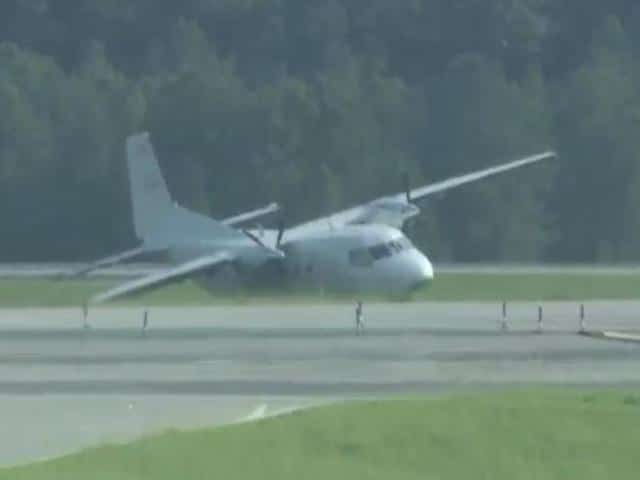
The aircraft was a CASA 212-200, a Spanish-made twin-engine cargo aircraft with a rear drop ramp which can be lowered in flight, which makes it a popular aircraft for skydiving and parachute training. The operator of the CASA 212, registration N497CA, is a military contractor which offers training both commercially and to the United States Department of Defense and US Army airborne units.
That day, there were two pilots on board flying skydiving runs. They were returning to Raeford West Airport in North Carolina to pick up a group of skydivers for their third run of the day.
The first officer (SIC) was the Pilot Flying for the approach to a “dirt military runway” near the airfield. The approach was normal and stabilised, said the captain; however, as they descended below the tree line, the CASA 212 sunk unexpectedly. Both pilots called for a go-around, but the first officer wasn’t able to arrest the sink rate in time and the right main landing gear struck the runway.
The first officer contacted ATC, explaining that they had lost the right landing gear wheel after a hard landing. The pilot asked for help to route to Raleigh-Durham for an emergency landing and confirmed that there were two souls on board. The flight was under the call-sign Shady Zero Two. You can listen to the ATC recording on the LiveATC archive (40 minutes). Here’s my transcript:
ATC: How do you intend to land at Raleigh-Durham?
Shady-02: As slow as we can and then I guess we’re going to put it on the belly.
About 14:30 local time, flying at approximately 3,850 feet, the airport passed over Fuquay-Varina. Around that time, ATC received another call from the aircraft, this time from the captain who was also the pilot flying.
Captain: Raleigh Approach, Shady 02.
Raleigh Approach: Shady 02, Raleigh
Captain: My co-pilot just ran out the back of the plane.
Raleigh Approach: Shady 02, what now?
Captain: He just ran out the back of the plane.
Raleigh Approach: So, you don’t have a co-pilot on you, sir?
Captain: No, he just jumped out the back of the plane.
Raleigh Approach: Uh, roger.
Captain: Would you like me to circle where he leapt out?
Raleigh Approach: Say that again?
Captain: Would you like me to circle where he got out at, or you got me on track?
Raleigh Approach: We’ve still got you on track, but did you need something?
Captain: No. The dude literally jumped out the back of the plane without a parachute.
There is a very long pause.
Raleigh Approach: Shady 02, did you need to do something else, circle or someting, or…
Captain: No, I need to land. I’m just making you aware that you’re going to have a dead body out where I just called you at. He just jumped out the back of the plane.
Raleigh Approach: Roger. Continue on your heading 050.
Captain: Roger, 050.
An edited clip of just this audio has been posted as a 1:15 video on Reddit.
An employee at the control centre then called emergency services on 911.
This is Raleigh Airport. We have a pilot who is inbound to the field. His co-pilot jumped out of the aircraft. He made impact to the ground and here are the coordinates.
The New York Post released an excerpt of the call to the emergency services.
The phone call lasted over 13 minutes.
The aircraft landed in Raleigh-Durham about twenty minutes after the call with substantial damage to the fuselage and minor injuries to the pilot, who was taken to hospital.
This news video includes some footage of the landing.
The search for the missing pilot spanned over four hours, with several law enforcement agencies combing the area. The body was found in an unoccupied backyard after a neighbour saw the police search party and reported that they had heard a suspicious thud but were unable to see what had caused it.
Initially, media reports assumed that the pilot had fallen out of the back of the aircraft while leaning to check the state of the landing gear; however, it is clear from the previous radio call that the flight crew already knew that the right landing gear wheel had been broken.
In the NTSB report, the captain said he took control of the flight after they had climbed away from the hard landing. He did a low pass over the runway and spoke to ground crew who agreed that the gear was damaged. Later, airfield personnel called the aircraft to say that they had recovered the fractured landing gear from the runway.
The captain asked the first officer to declare an emergency and request a diversion to Raleigh-Durham. The first officer continued to speak to ATC to coordinate the diversion while the captain remained as Pilot Flying.
The captain said that the first officer conducted the approach and emergency briefings but then became visibly upset about the hard landing. The first officer acknowledged a course heading from ATC and then opened his side cockpit window. The captain believed that he may have vomited out of the window. The captain took over radio operations.
The first officer lowered the ramp at the rear of the aircraft and said something to the effect that he was going to be sick and needed air. He got up from his seat and removed his headset. Then he apologised and “departed the airplane” out the ramp door.
The captain said there was a bar about six feet above the ramp for occupants to hold onto when the door was open. But, he said, he never saw the first officer grab the bar as he went out the ramp.
The captain reported to ATC that his co-pilot had left the plane. This communication took place about 90 seconds after the first officer’s last call acknowledging the heading instruction.
It seems that on aviation forums, this case is generally being described as a suicide. The popular theory is that the first officer was “badly rattled” after the damage done to the aircraft and might have been lectured by the captain. The company that they both worked for as a reputation for “tough military talk” and a company policy defending profanity and brash conduct as not hostile or indelicate “in the real world of the military”, warning that employees may be subject to a “rough, hewn, and brash” work environment.
The first officer, 23 years of age, was very proud when he started flying with the operator in April 2022. His flight time has not yet been released although it’s clear that he was not a completely inexperienced pilot either; he was a certified flight instructor. It takes patience and tolerance to fly with new pilots. It seems unlikely that a hard landing would upset him so greatly unless there were some much larger issue that he was suffering with.
Equally, there doesn’t seem to be any reason why the first officer would have leaned out to check the landing gear. They already knew that the landing gear was broken and, more importantly, that the wheel assembly had been recovered off the runway. There seems very little reason to lean out of the flying aircraft to check the gear visually.
The captain described moderate turbulence during the flight and that the first officer had reported “feeling sick” and needing air. Having opened the side window, it seems to me that it is quite possible that he was heading towards the ramp hoping for relief from the nausea and fell out of the aircraft.
However, countering that is the captain’s clear description to ATC that he “jumped out of the back of the plane,” a phrase he used three times. So in the moment, at least, the captain believed that the first officer had done so intentionally.
The preliminary report makes no mention of the Cockpit Voice Recorder although as the police were at the scene after the emergency call, I’d hope that someone would have ensured that the fuse was pulled and the data saved. The aircraft landed about twenty minutes after the call that the co-pilot had jumped out of the aircraft, so it seems the data from the time of the incident may have been saved.
In addition, the report does not mention any results of toxicology testing on the first officer, which surely must have been considered as of critical importance once the body was recovered.
Initially, the FAA said they would be leading the investigation but a few days later, the NTSB stated they were taking over the investigation, followed by the release of the preliminary report for ERA22LA348. We’ll have to keep an eye out for an update but I wonder what it might mean that the FAA has stepped back other than that there’s no further clear information for them follow up on.
It’s quite possible that we’ll never know what happened in that aircraft.





I grew up with a guy that did those kinds of things. His last name was Black, we all called him “Bailout Blackie”.
Whenever things got hot, Bailout, bailed out. I had a Corvair convertible. One day we had picked up a carload of Beer in Louisiana to sell at the High School Football game. {Mississippi was still Dry I picked up a few bucks selling Beer to the Dads in the grandstands.}
Bailout said, “There is a cop following us”, So I left the highway for a dirt road. In a tight turn, the Corvair slid into the ditch coming to a rest against some fence post.
I crawled out of the car, could not find Bailout. How far could he be thrown from the car?
Farmer John pulled me out of the ditch, I got home just in time to get to the ball game.
When I got there, Bailout was already in the stands with his Father, the Methodist Preacher, looking like he had spent the afternoon in the Library.
Bailout Blackie grew up to be 1st a Lawyer, 2nd a Methodist Minister. I do not think the Copilot of this incident had the same connections.
Told with sarcasm but Bailout Blackie is 100% a true person, we’ve all known one.
Sad story, very curious, I wonder if we’ll ever know more. I would like to hear interviews of people who were close to the co-pilot, regarding his state of mind.
His family have said that he was excited about the job and had no signs of depression or that he was unhappy. I’m sure the NTSB will investigate this angle further.
Few people jump out of aircraft without having made provisions for a safe landing. The aircraft and his parachute burning, Nicholas Alkemade parted from an Avro Lancaster above German territory and lived to the ripe old age of 64, thanks to a stand of pines and a snowdrift that broke his fall while unconscious. More at https://www.rafmuseum.org.uk/blog/the-indestructible-alkemade/
The pilot who departed the CASA 212-200 a month ago was not so lucky.
If the first officer was suffering from nausea then it might have affected his balance. In that case, he might well have slipped or tripped while rushing towards the open ramp to get some relief, and his momentum then carried him over the edge before he could grab hold of anything. This would probably have looked like a deliberate act to the captain because it would have happened so fast.
Of course, this is probably one of those cases where we’ll never know for sure why it happened.
The benefit to reading through old posts is that sometimes the final report has been filed in the interim. The FAA posted a final report for this incident, and while they concluded there was not enought evidence to determine whether he jumped or fell, it did contain some additional interesting pieces of information- specifically overreacting in a previous incident when he thought he lost a fuel card, and that he had Kratom in his system.
“Although the PIC and operator reported that the SIC’s departure from the airplane was an intentional act, there was insufficient information to support that assertion. No family or company personnel shared concerns about the SIC’s state of mind or behavior until the events
that resulted in his departure from the aircraft; however, a company pilot shared an event during which the SIC had seemed to have a disproportionate, intense emotional and physical reaction upon becoming worried that he had lost a fuel payment card. The operator and family also indicated that the SIC felt that the accident flight with the PIC, who was also the chief pilot for the operator, was very important. This would have added to the SIC’s stress and emotional response after the hard landing, during which he was the pilot flying. In the 20 minutes of flight while serving as the monitoring pilot, the SIC was actively engaged in communicating with ATC, reviewing emergency procedures, and providing recommendations to the PIC on the landing runway at the diversion airport. In his initial statement to authorities, the PIC stated that, before departing the airplane, the SIC became visibly upset and apologetic, and reported feeling sick. His actions to increase ventilation in the cabin, which included opening the window and lowering the ramp, as well as his hurried departure from his seat, are consistent with an attempt to address increasing nausea symptoms and a desire to not throw up in the cockpit. However, the SIC made an unsafe decision to run to the rear of the cabin with the ramp in a fully lowered position, as he likely had not previously been in the cabin in flight with the ramp down. It is possible in his haste he lost his footing when encountering the area of the ramp and inadvertently fell from the airplane. Weather sounding and radar data supported the potential for windshear and
turbulence activity, and the PIC reported that there had been moderate turbulence during the flight.
The postaccident toxicological finding of mitragynine in the SIC’s liver tissue and urine indicated that he had used a kratom product, which had the potential to cause impairment. Notably, anxiety control was a common motivation for kratom use, and anxiety itself may predispose people to heightened physiological responses to stress, which sometimes manifest with nausea, dizziness, or feeling hot or smothered. Although it is possible that effects of kratom may have contributed to nausea or to some dizziness or perceptual
impairment that may have increased his risk of falling, there is insufficient evidence to determine whether effects of the SIC’s kratom use contributed to the accident.”
Oh interesting! Thank you – I would have missed this otherwise.