LATAM 767 Hard Landing at Atlanta
On Tuesday evening, a routine commercial passenger flight touched down at Atlanta’s Hartsfield-Jackson airport. All eight main landing gear tyres exploded on impact.
The aircraft, a Boeing 767-316ER, registered in Chile as CC-CXF, was operating as LATAM flight 2482, a commercial flight from Lima, Peru to Atlanta, Georgia US. They departed Lima at 12:14 local time with 221 passengers on board. The seven-hour flight to Atlanta was uneventful and they were actually almost twenty minutes early.
As they came in to land at 26R, passengers commented that it was very turbulent. The aircraft touched down. There was the sound of multiple loud bangs. In the cabin, the touchdown felt extremely rough and was quickly followed by violent vibrations. The flight crew reported that they were unable to taxi and that they had an indication that the right main gear was not down. Emergency services raced to the runway and surrounded the aircraft. Initially, they reported that the two right main tyres had burst. A few minutes later, they reported that all of the main tyres had blown.
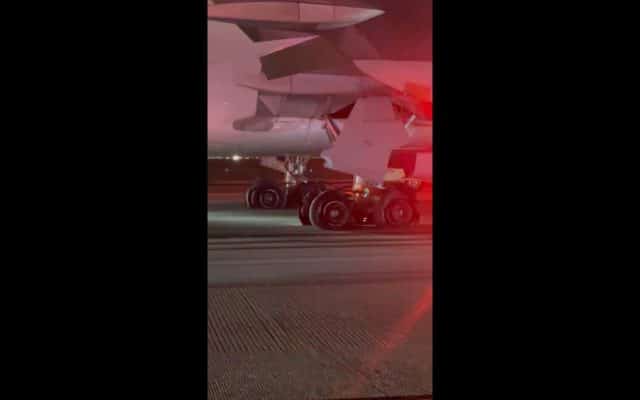
Inside the cabin, the ceiling panels were dislodged and the overhead bins had sprung open. A bathroom door had broken off its hinges. The passengers were evacuated onto the runway using mobile stairs. Some passengers said that they were left in the plane for almost two hours before buses arrived to shuttle them to the terminal. However, AVHerald reported that the aircraft was towed off the runway about an hour after landing. In any event, the runway was inspected for foreign object debris and remained closed for several hours.
The Boeing 767 is still in Atlanta where it will need to undergo testing, not only for system faults but also for structural damage. The risk is that the force of landing travelled through the landing gear into the aircraft structure, causing the aircraft’s skin or internal structures to deform or buckle. Even though the aircraft looks normal from the outside, metal may have been creased on what they call “structural wrinkling”.
Eight main tyres all failing at once is extremely unusual: something must have affected them all, not just one wheel or one side.
Option 1: Very hard landing
The vertical impact force at touchdown exceeded what the tyres could handle; all eight tyres hit the runway hard enough to damage and burst them.
Option 2: Locked wheels during landing roll
The wheels stopped rotating (locked) while the aircraft was still moving forward on the runway. The tyres skidded along the tarmac, building up massive friction and heat until they shredded. This could be caused by the anti-skid system failing, a pilot holding the brakes too hard, or some other brake system malfunction.
Option 3: Both
The hard landing damaged the landing gear on impact, then locked brakes or heavy braking destroyed what was left as the aircraft rolled down the runway.
The crew’s report that they had an indication about the right main gear was likely caused by the hard impact; if they’d seen the indication before landing, they would have gone around. The passengers reported an extremely rough touchdown, multiple loud bangs and violent vibrations, along with one reference to feeling like the wheels were “rattling on the tarmac” for a long time. The rough touchdown and initial bangs support a hard landing. The interior damage (doors off hinges, panels falling) may mean that the G-forces on landing were significant or that they were shaken loose from the violent vibrations of the landing roll. The violent vibrations and rattling on the tarmac could have been running on rims or caused by braking issues. Right now, I am leaning heavily towards option three.
The flight data recorder will answer this question by telling us if the brake pressure was modulated.
When the anti-skid is working, the FDR trace for brake pressure looks like a jagged saw-tooth wave (pressure rising, wheel slows, pressure dumps, wheel spins up, pressure rises again). You can stand on the brake pedals with both feet, screaming in panic, and the wheels will not lock. The computer will fight you.
If the FDR trace just flatlines at max pressure while the speed drops, it means the wheels locked up and the system didn’t do its job to release the brakes. If the heavy impact broke something in the system, then that malfunction could have caused the wheels to lock up. Or equally, it could simply be that the startled pilots slammed the brakes, expecting the anti-skid system to modulate that braking for them.
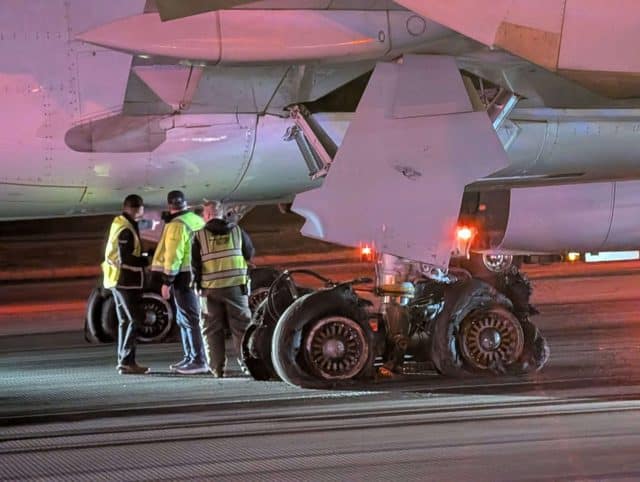
The National Transportation Safety Board (NTSB) will lead the investigation joined by the Chilean authorities (DGAC) as the aircraft was registered in Chile. Their primary goal will be to analyse the flight data and determine exactly which systems failed and when. For now, the Boeing 767 remains grounded in Atlanta, not because of the tyres, which can be swapped in an afternoon, but to see if the airframe survived the G-forces of the impact without permanent structural deformation. If the impact caused critical structural damage, this landing may have been the 767’s last.





Talk about timing: I just got back from the repair shop a 15.6-year-old car that had a trouble light on the anti-lock brake system; what I was told was that worn bearings were affecting the sensors that determined whether the wheels were starting to lock up. In my case the system apparently thought the wheels were locking when they weren’t; it sounds like this airplane may have had the opposite problem, causing the wheels to lock when the pilots stood on the brakes (which is what drivers are told to do in a skidding situation — trying to judge how much brake to apply when the system is also judging is … confusing).
Wikipedia’s description of the 767-300ER says they were first delivered in 1988, with no outstanding orders as of 2017. (The article doesn’t list the -316ER separately.) This suggests the plane was at least 8 years old, and possibly much older — and possibly very … well-used. It will be interesting to see how the investigation unfolds: “black-box” records, number of cycles, maintenance done fully or hastily and any writeups, …
I see you don’t report any injuries, which seems fortunate given the number of objects flying around.
Looks like 17½ years. https://www.planespotters.net/airframe/boeing-767-300-cc-cxf-latam-airlines-chile/rq1z6d lists it delivered in July 2008.
Anti-skid in aircraft has been refined since I last was an active pilot. Although the systems on aircraft and cars share systems and technology I am sure that there are subtle differences, so there is not much that I can comment on in that respect..
Much of my flying was on different aircraft, the largest one was the BAC 1-11, most of the jets that I flew were business jets. like Corvette, Citations and Learjet..
But one thing that struck me: there is mention that it was “very turbulent” on approach.
When an aircraft encounters a downdraft immediately before touchdown, the pilot of a smaller jet can save the day by adding power, it can cushion the touchdown; that can result in either a longer landing, or a go-around. But in most cases for a small jet that is not critical. During my very first Citation checkride, the examiner gave me a wave-off from landing position, followed by an engine failure.
Not in the curriculum. It was even done in the aircraft.
Landing position, about 50 feet if I remember correctly, full flaps and a simulated engine failure. The examiner explained that he had been accused of releasing Thurman Munson, a very low-time basketball player who killed himself in an accident when practising touch-and-goes. The investigators concluded that Munson had not been ready to operate a jet, certainly no as single pilot.. And the examiner was under investigation for passing his type rating prematurely.
Anyway, I mention this to illustrate that a (much) smaller aircraft than a heavy jet. It has more leeway in a situation when at very low speed, at or even below V ref, near or below 50 feet, the “heavy” suddenly encounters a sudden downdraft. The 767 has a lot more inertia.
When the GPWS calls “Retard”, the pilots close the throttles and the engines are spooling down. There is virtually nothing they can do without risk: a gp-around is no longer an option, nor is a ‘burst of power’ going to soften the touch-down. the engines need time to deliver power and even if they manage to arrest the excessive sink rate, this may well use up a critical amount of runway.
A go-around will not be possible: too much drag with flaps in the landing position, too much time needed to spool up, too much inertia of a heavy airframe to make a difference.
No, I have no idea what exactly caused the extremely hard landing, but a sudden, very strong downdraft, of even a large decrease in wind speed can cause a very hard landing.
In my scenario, there would be nothing left that the pilots could have done.
Fortunately, there were no serious casualties and this occurrence would be exceedingly rare.
“the pilot of a smaller jet can save the day by adding power”: do smaller jet engines spool up faster? I wouldn’t have assumed this as all turbojets depend on a molasses-man feedback loop (needing to spin faster in order to get more air in to burn more fuel to spin faster to…), but I don’t know the specifics.
PS: s/basketball/baseball/