It’s clear, but just barely: Ground collision at Seattle
There was light snow and congestion on the morning at Seattle-Tacoma International Airport on the 5th of February 2025. Visibility was good but the temperatures hovered just above freezing and the ramp was slippery with a mix of light snowfall and de-icing fluid.
Delta Airlines flight 1921 was a Boeing 737-832 registered in the US as N3737C and bound for Puerto Vallarta. Once the six crew and 144 passengers were on board, the flight crew prepared to start their journey from gate A11. The frequency was very congested and they had to wait over ten minutes before they got their pushback clearance. But just as they were finally cleared, the pushback clearance changed, causing further delays. Finally, they pushed back and started a slow taxi. Their instructions were to taxi to spot 88, turn left on taxiway Whiskey and then hold short of spot 99 to sequence for the south de-icing pad. Neither of the flight crew had ever de-iced at Seattle before.
When they reached the de-icing area, all three de-icing spots suitable for the Boeing 737 were occupied. The captain stopped the aircraft abeam spot 1 in the South Ramp, wanting a safe distance from the Airbus A220 ahead of them in the de-icing queue. They set the parking brake and left the engines running. There were no holding points identified on the ramp or the charts.
The Port of Seattle’s regulations were that no aircraft should taxi in this area without ground support from a ground marshal and sufficient wing walkers.
A ground marshal is the person on the ramp who guides the aircraft with hand signals, supported by wing walkers who are positioned at each wingtip to watch for obstacles and ensure clearance. They are necessary support in busy airports with not a lot of clearance.
There were no marshallers in sight.
The captain was stuck. It wasn’t safe to move the Boeing 737. They waited. The first officer monitored the de-icing frequency while both pilots scanned their surroundings in the congested ramp area.
Meanwhile, Japan Airlines 68, a Boeing 787-9 registered in Japan as JA868J, had just completed the long flight from Narita with 185 people on board. They landed on runway 16L and were trying to taxi to gate S8, except that they’d now been informed that gate S8 was occupied. The ramp controller’s instructions kept changing as the crew tried to navigate the congested terminal area, stopping repeatedly to wait for traffic to clear. Initially, they were cleared to S8 via spot 99. But as they drew nearer, a ground crew member raised their arms and crossed them in an X-shaped signal, which means to stop immediately. The flight crew stopped and reported to the controller. The controller then rerouted them to spot 88. After waiting for an aircraft in front of them, they finally got clearance to proceed via taxiway B and spot 99, essentially a U-turn back to where they’d started.
As they re-entered the ramp from spot 99, heading back towards gate S8, the JAL captain, who was the Pilot Flying, saw the Delta 737. It was right in their path.
The JAL flight crew stared. “It’s close,” the captain said aloud. The first officer agreed.
“I’ll move a bit to the left,” said the JAL captain, who was the pilot flying. He offset slightly left of centerline and crept forward at 2 knots (walking speed). He asked the first officer to check that the wingtip was clear. The first officer checked from the No. 2 window and said, “it’s clear, but just barely.”
The captain heard “clear” and continued.
Meanwhile, in the parked Delta aircraft, the first officer suddenly saw the JAL 787 approaching, with the wing worryingly close to the tail. He immediately alerted the captain, saying that they needed to move forward and out of the way.
But there was nowhere to pull forward to, no marshal to confirm that they were clear, and de-icing trucks everywhere.
The first officer remembered it clearly.
“The captain looked ahead and saw deice trucks moving in and out of the safety area. So he told me ‘I’m unable to move forward’.”
“Seconds later, our aircraft was struck from behind by Japan Airlines aircraft.
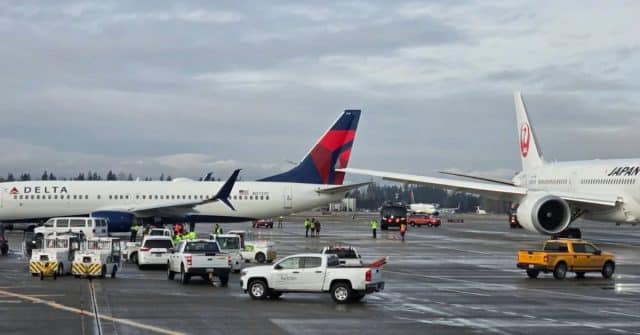
In the JAL cockpit, the observer riding in the jump seat had also grown concerned about the spacing. He thought the left winglet of the B737 looked close and moved to check the right window. That’s when the right wingtip of the JAL 787-9 struck the tail of the parked Delta 737.
Meanwhile, in the Delta cockpit, the captain was completely disoriented. “After the collision, I was shocked. I wasn’t sure what had happened. It could have been anything: an external explosion as we were adjacent maintenance facilities, a tire explosion, a catastrophic engine failure, anything.”
He never saw the Japan Airlines aircraft. “I remember looking carefully to see that both engines were operating normally and that we had no warnings or cautions.”
The first officer called ramp control and said they needed fire crews on the de-ice pad. Another aircraft on the frequency reassured him that they couldn’t see any fire.
They called back to the cabin to confirm that everything was OK. Then the captain made a public address. “[I] said that I thought the aircraft had been in a collision with another aircraft and to remain seated with seatbelts fastened.”
Someone on the ground, a maintenance worker, was trying to get the captain’s attention. “With no radio contact he was signaling me to cut engines. I pulled open the side window and I asked, why? He said that there was fuel leaking out of the aircraft wing that had struck us and that both planes were stuck together at the tail.”
The JAL crew shut down both engines after receiving an engine stop signal from Delta ground staff. The first officer called JAL operations on the company radio. Both crews worked through their emergency checklists. Aircraft Rescue and Fire Fighting (ARFF) responded and confirmed that there was no fire, paying special attention to the fuel leaking from the wing tip.
No one was hurt or even injured. But the Delta aircraft had sustained substantial damage to the entire tail section. The JAL aircraft was slightly better off, with only minor damage to the tip of the wing.
@Delta @Japanairlines @fox13seattle @KIRO7Seattle Both planes bump to each other at SeaTac Airport Now! What's going on with Aviation? pic.twitter.com/R5Bh8UMtB7
— FelipeOFFICiAL (@FelipeLeos) February 5, 2025
The NTSB‘s conclusion is straightforward:
Probable Cause
The Japan Airlines flight crew’s failure to maintain adequate clearance from the parked Delta Air Lines aircraft while taxiing in congested ramp conditions.
Based on the videos and allowing for perspective, the Delta 737’s tail was clearly sticking out into the taxiway. However, as the Delta was parked and the JAL 787-9 was moving, obvioiusly the JAL aircraft has to be considered at fault.
But I have some sympathy with the JAL flight crew. They’d been flying for nine hours just to be routed almost to their gate and back again. The JAL captain remembered that they had passed this way without issues the first time and assumed there was enough clearance to pass through again. Yes, they should have done the same as the Delta 737: stopped the aircraft and waited for a marshal and wing walkers to help them navigate the congested area. But they must have felt the pressure to just get to their gate and finish.
Falsely reassured by what he thought was the first officer telling him that they were already clear of the 737, the captain continued forward, causing the crash. And that was the real error: he asked for a clearance check and heard the word “clear” in the response. Worse, the first officer was wrong.
The Delta 737 sat there, engines running, because the captain knew that the conditions were unsafe to navigate alone. He was right. But there was no sign of any ground support coming. Neither crew saw any signs of marshals or wing walkers that might soon come to their aid.
Both crews handled the emergency professionally. Nobody was hurt, which is what mattered most. But it’s hard to shake the feeling that the flight crews shouldn’t have been left to navigate a congested area alone, making clearance calls through side windows at walking speed, hoping it would be enough.
References:




All that data filling the final report, and all the NTSB can do is fault the JAL captain? (Yes, I see the claim at the bottom that the NTSB doesn’t find fault; on the basis of the NTSB’s language in this report, I call bulls**t.) No discussion of the lack of marshals in an area where aircraft can’t move without them, not even as a secondary cause? Ordinarily I’d cut the NTSB some slack; under this administration, I have to wonder whether there was pressure to blame a foreigner rather than addressing local failures.
I don’t understand why ground control cleared JAL for a path that was obstructed. Seattle has Airport Surface Detection Equipment. I did find a 2018 article that said that ASDE outages are not uncommon, but that’s why the tower is high up, right?
Many Japanese people are very polite, and when they get told to do something, they’ll try to do it. They really shouldn’t have been told.
If ASDE is needed, the tower being high may make matters worse in a failure because the cab will be above mist/fog/…. In this case we’re told there was light snow but visibility was good, which sounds contradictory; the videos I’ve seen of deicing operations show some misting (not all of the spray hits the aircraft), but I don’t know whether the mist would have obscured the view of a plane waiting for a deicing spot. The tower might not have been able to see exactly where the Delta plane was — or they might have erred, as you suggest. That’s another reason to wonder about the very brief finding in the NTSB report.