The Anatomy of an A350–CRJ Collision at Atlanta
On the 10th of September 2024, an Airbus A350 took the tail off of a Bombardier CRJ at Hartsfield-Jackson Atlanta International Airport in Georgia, USA.
Delta Air Lines flight 295 was a scheduled international service from Atlanta to Haneda Airport in Tokyo, Japan being flown that day by an Airbus A350-941 registered in the US as N503DN. There were 15 crew members and 221 passengers on board.
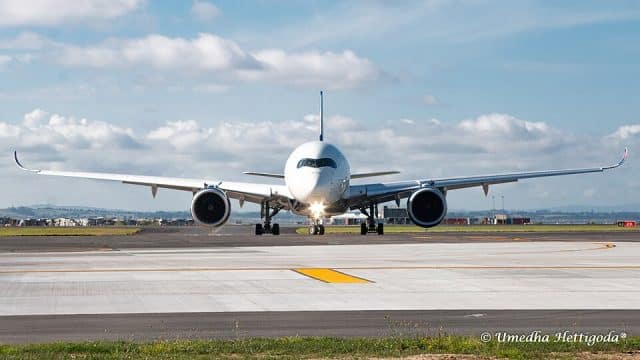
The Airbus A350 is a long-range wide-body twin-engine airliner that weighs about 255,000 pounds (~115,700 kilos) empty. Its most distinctive feature is a black windshield mask around the cockpit window frame, which I can’t help but think of as slutty eyeliner (in a good way). It also has really big wings.
Delta Connection flight 5526, operated by Endeavor Air, was a scheduled domestic service from Atlanta to Lafayette Regional Airport in Louisiana, being flown that day by a Bombardier CL-600-2D24 (CRJ-900) registered in the US as N302PQ. There were three crew and 56 passengers on board.
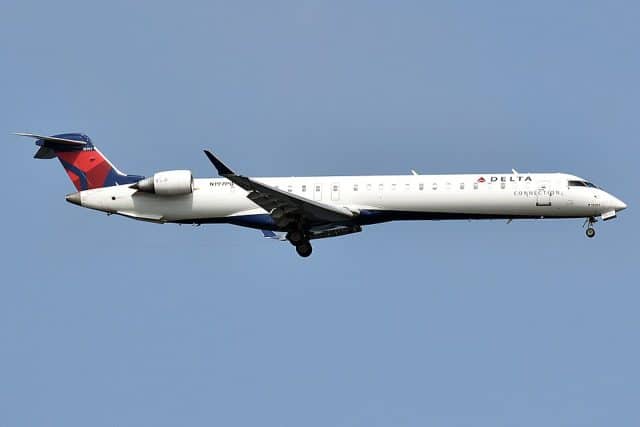
The CRJ-900 is a twin-engine, short-to-medium-haul regional airliner that weighs about 48,000 pounds (~21,800 kilos) empty. The most distinctive feature of the CRJ is a tall T-shaped tail, like an oversized spoiler bolted onto a Honda Civic.
Needless to say, it was hardly a fair fight.
There are five parallel runways at Atlanta, all of which run east-west to allow for simultaneous takeoffs and landings. Atlanta’s control tower is the tallest in the US in order to allow the air traffic controllers to oversee the entire length of all five runways. Atlanta Ground is responsible for all ground movements with the exception of the active runways. Atlanta Tower is responsible for all inbound and outbound flights and thus controls access to the active runways.
The CRJ had a relatively short route: They needed to travel north from the apron to Taxiway F to join Taxiway E, which is parallel to the runways. On Taxiway E, the CRJ would turn into Taxiway H which runs along the bottom of runways 8 Right and 8 Left, and immediately hold short (wait for clearance before entering) for their departure from runway 8R.
Normally, larger aircraft such as the Airbus A350 would take off from the longest runway, 9L/27R with 12,390 feet of concrete (3,776 metres) on the south side of the airfield. But 9 Left was closed for construction and so the flight was departing instead from the next longest runway, 8 Right, on the north side of the airfield; the same runway as the CRJ was waiting to enter.
The Airbus pushed back from the gate early and the crew got the all clear to taxi north towards the runways. The captain thought about how odd it was to be back at the north side of the airfield, as he hadn’t been there since he’d started flying the A350. He warned the first officer that taxi operations on the north side feel a bit different and that if there were any questions or issues, just say so and they would stop the aircraft and figure it out.
The ground controller told them to continue to Taxiway G and hold short of Taxiway F for the CRJ.
At this point, the CRJ was on the far end of the airfield, on Taxiway F. The CRJ entered Taxiway E, the one which runs parallel to the runway, and was asked to hold short at Taxiway H and switch frequency to Tower.
The captain commented later that it was a slightly awkward routing because there was a Frontier aircraft in the way. “They don’t usually make us jig and jag that big airplane around.” The Airbus was cleared to enter Taxiway F, where they also turned onto Taxiway E. The controller told the flight crew to follow the CRJ on Taxiway E and monitor the Tower frequency. The CRJ was so far ahead of them, neither pilot considered it to be a factor.
At that moment, the crew of the Airbus noticed a navigational alert message. They weren’t sure it was important but they needed to find out before embarking on that long trip to Tokyo. The first officer called Ground to say that they needed to stop and speak to maintenance. The controller confirmed that they should stay on the Ground frequency but told them that they could not stop there; they should continue straight, past the intersection to Taxiway H, and then they could hold short at the entrance to Taxiway V where they would be out of the way.
This navigation isn’t really as complicated as it sounds; here’s a top-down view of the routes with the CRJ in orange and the Airbus in blue.
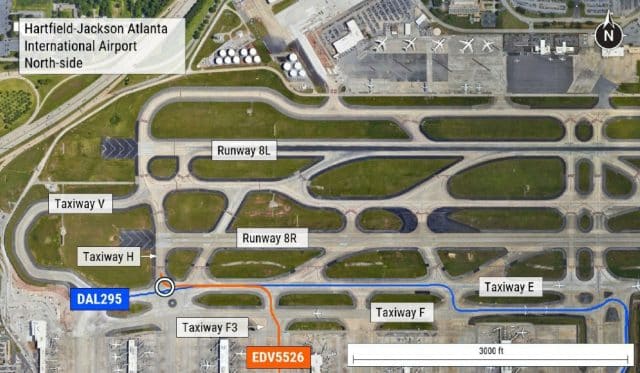
The CRJ turned at the intersection for Taxiway H and stopped at the hold short line, or actually, about 56 feet short of the hold short line.
The captain taxied the aircraft towards the end of Taxiway E. He wasn’t too worried about the alert. “We’re going to Tokyo, we had a 14-hour flight, the five or ten minutes it’s going to take to deal with maintenance is not an issue with me.”
He remembered that it could get tight at the end of Taxiway E and that aircraft could come quite quickly around the corner from the opposite direction, from Taxiway V to Taxiway F. “I all of a sudden started going well, how far down there can I get before the left wing starts to be a problem for ripping around the corner…and when I say rip around the corner, people come around that corner pretty fast. They come up over that hill and because it’s a hill, they got the power up and they get up and they don’t get it back and they’re — I mean, they’re doing a good 15-20 knots coming around that corner, most times, Southwest even faster.”
(I laughed at that little jab at Southwest Airlines)
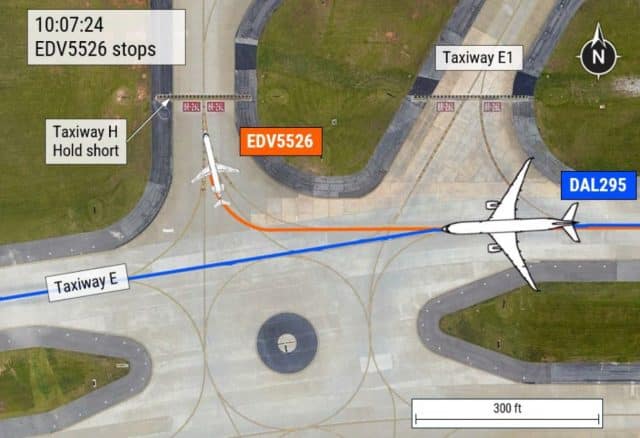
So the captain was watching their position, making sure that their left wingtip wouldn’t be in the way of any oncoming aircraft. I should note that the flight crew can’t actually see the wingtips from their seats in the cockpit. Even if they got up and looked out of the rearmost windows, they would struggle to see if the wingtip was clear of any obstructions, so it’s important to be positioned correctly on the centreline, especially on a small taxiway. “The basic fact is I became so worried about my left wingtip, I forgot about the right wingtip.”
The first officer was staring at the navigational display but Taxiway V was not displayed. The first officer remembers trying to figure out exactly what their clearance was, and then spotted the taxiway on the moving map.
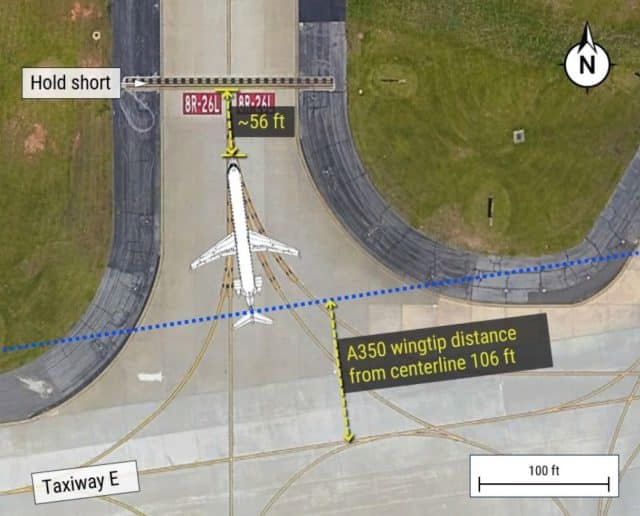
With the captain looking towards the left and the first officer checking their navigation, neither pilot noticed as they passed behind the waiting CRJ until the Airbus right wingtip smashed into the CRJ’s tail.
The first officer of the CRJ remembered that there was some sort of vibration, which he compared to the start of wake turbulence, and then there was a jolt and the sound of multiple warnings and dings in the cockpit.
At the same time, Tower called them to line up and wait on the runway.
The CRJ captain told the first officer to decline the clearance.
The first officer, unsure what had just happened, asked Tower to standby. Both pilots stared at the cockpit displays and a series of hydraulic system caution messages, still not sure what had happened, even while someone on the radio started to talk about a collision.
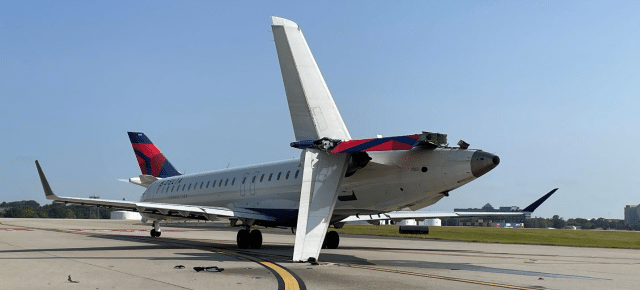
The first officer remembered the moment. “I think it was another aircraft asking Tower what they were going to do about the collision and we’re just sitting there, we know something happened. And at that point we realised, okay, we’re the ones involved in that collision.”
The Airbus first officer said of the impact, “I thought either the gear collapsed or we had run over something.”
The Airbus captain was a bit less prosaic. “Felt the thump, thump, thump, thump and went oh, shit –excuse my French–and stopped the airplane, set the parking brake and told the co-pilot, we got to call ground.” He seemed to be the only one who immediately understood that they’d collided into something.
None of the passengers were injured; however, the cabin crew member in the CRJ suffered a minor injury.
## Probable Cause and Findings
The National Transportation Safety Board determines the probable cause(s) of this accident to be:
Delta Air Lines flight crew’s loss of situation awareness of the clearance between their right wingtip and the empennage of an Endeavor Air airplane holding on a perpendicular taxiway, resulting in their wingtip colliding with the other airplane’s empennage. Contributing to the collision was the Endeavor Air flight crew stopping too far from the hold short line, resulting in insufficient clearance for the Delta Air Lines airplane to pass.
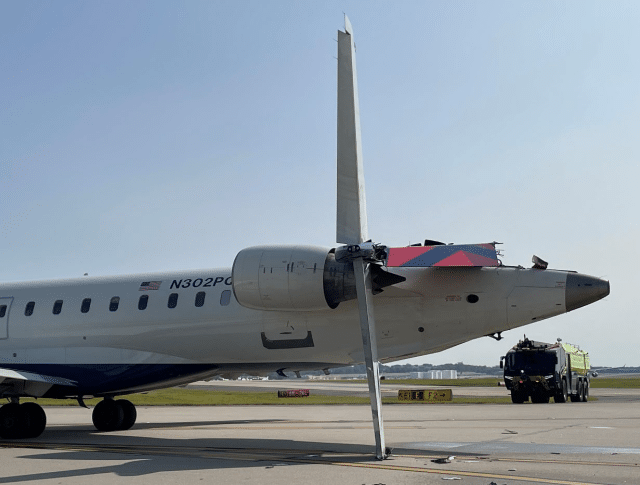
The CRJ-900 was substantially damaged. The report describes it as “the separation of the vertical stabilizer” which sounds very clinical. In actuality, the Airbus wing literally severed the CRJ’s tail, which hung there attached by the flight control cables, wiring, and a strip of skin.
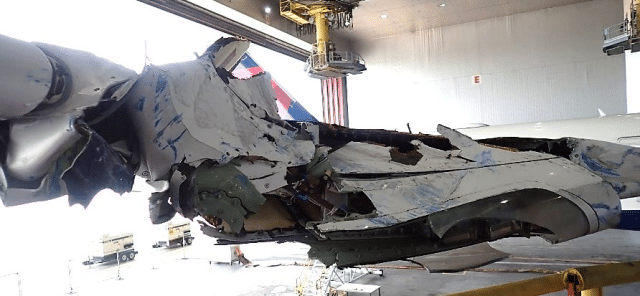
The A350 was said to have suffered only minor damage; though that looks pretty bad to me, not to mention the embarrassment of the blue paint scrapes and pieces of the CRJ found in the wing when they extended the flaps.
You can find the full report on the Aviation Investigation page for DCA24FA299, or go directly to the pdf.




I have to admit I loved this mocked up photo of the A350 posted to PPRuNe
Oops . . .
There was a fad for putting cameras in the top of the fins a few years ago so crews could get a better view of the wingtips, etc. Does that still happen at all?
I remember the seatback video screen on a flight offering the view from that camera; don’t remember seeing it offered on other recent flights. The camera seems like a good idea given the size of modern airplanes.
“Loss of situation awareness” — how are they supposed to be aware of something they can’t see with either their own eyes or instruments? Grow antennae like My Favorite Martian, maybe?
The link has only the summary that you quote and the basic statistics about the incident. ISTM that a detailed report should mention the failure of Ground to tell the CRJ to tuck in its tuppenny; this could have happened to a standard-size airplane that wasn’t as far from the hold line, or maybe an A-380 trying to pass (if I read Wikipedia correctly, the A-350 has a significantly larger wingspan than the 747, but is smaller than the 80-meter maximum that was set by airports some years ago), so teaching controllers to pay attention to this would be a Good Thing.
There’s a link to the report and the docket on the same page, or this might work: https://data.ntsb.gov/carol-repgen/api/Aviation/ReportMain/GenerateNewestReport/195092/pdf
I checked the docket, actually, and they don’t have the transcript between ATC and the CRJ, just a summary from the pilot’s recollection. They were with Tower before they stopped, so could be a case of Ground wasn’t watching them anymore and Tower wasn’t watching them yet.
That is the question…it’s true that the pilots of neither airplane had the necessary situational awareness to avoid the incident. But that’s sort of like saying “the patient died of heart failure” and then stopping and never analyzing WHY their heart stopped beating.
What’s the lesson for other pilots here? “Be more careful” is the facile conclusion, but it misses the systemic causes, I think. The larger issue is aircraft movements at an extremely busy airport needing to be choreographed to adequately account for spacing between aircraft on the airport surface. I’m not sure the solution to that problem, but I’d think both pilots and ATC have a role there. I wish the NTSB’s analysis had considered that issue.
“…if I read Wikipedia correctly, the A-350 has a significantly larger wingspan than the 747…”
They’re all (747-400, 787, A330, A350, whatever) similar at around 64 metres wingspan to fit within the ICAO category E which has a 65m limit, amongst other considerations [¹]. For normal commercial airport traffic, only the A380 is significantly bigger at 80m for which category F was introduced. (I had to modify some software I was working on related to airport safeguarding to take account of this at the time. Not thought about the matter much since, though.)
From what’s said here I doubt an A380 would be allowed this side of the airport, if it can go to the airport at all; there are only a few airports where it is allowed. It might have changed now but IIRC there was a time when the A380 could only use one of the two runways at Heathrow.
You might have been looking at the old 747-200s which were a bit smaller, just under 60m.
[¹] I can’t remember the details but it’s more complicated than just the wingspan as it takes into account things like the position of the undercarriage for how the wingtips track as the aircraft turns.
You’re right that at ATL the A380 can’t go on the north side. It has to use the south complex (though there hasn’t been scheduled 380 service in years… Korean Air flew for a few years as did Air France for maybe a year… but they do get diversions). There’s one gate that can accommodate the A380 and basically just one taxi route and requires the plane to be towed once it enters the terminal ramp. Also can’t taxi without airport ops vehicles escorting it.
Thanks for that – it’s nice to get details from someone who knows the airport!
Assuming the diagrams in the NTSB report are to scale, it looks to me like even had the CRJ’s nose been right at the hold-short line, the clearance from the A350’s wingtip would have been pretty marginal. You can only make the slices in the Swiss cheese so thin, after all. I wonder how much it cost to return the CRJ to an airworthy state…
It’s barely touched on in the report but from the diagrams and the interview with the Airbus captain, it seems pretty clear that the design of the north side really doesn’t accommodate large aircraft well. One thing I wondered was how long the southside runway had been out of service – could it also be that the controllers for the domestic flights weren’t used to dealing with aircraft that needed every centimetre of space?
Sounds very possible indeed, especially with the Airbus captain’s remark about ‘jerking this big jet around’. Jon
Atlanta has ASDE-X, but it’s apparently not designed to catch conflicts like these. It would be nice if it could.
I’ve looked at the “full” report, which AFAICT doesn’t say anything about a possible gap in responsibility between Ground and Tower. I note with amusement that the end of the report claims that NTSB “does not assign fault or blame” — but it does find “probable causes”, which I suspect weighs heavily on any subsequent proceeding that actually assigns fault or blame. I suppose that under better circumstances the copilot would have been watching out his side and might have said “That CRJ is too close” by eyeballing the positions (even though he couldn’t reliably see the wing tip on his side) — but the pilot could have said ~”we’re passing another aircraft on your side; will we clear it?”, to pull the co-pilot’s attention away from a maintenance problem that didn’t require an immediate halt-in-place and back to the immediate issue. (This is getting into the weeds of CRM; I’d love to hear from anyone with two-pilot experience on how plausible this is.)
As I examine the details, I also see that the co-pilot had been received his “initial type rating” for this aircraft 6 years before this incident (5 years before the commander!) but had ZERO command experience even at age 59. Is this not atypical? Do some pilots settle for a lifetime of second-in-command positions, or get that settled on them because their employer judges them unfit for command? IIUC, the US military has an up-or-out policy — someone who fails promotion a certain number of times is discharged — but I’ve also read that there’s a shortage of pilots, such that this policy wouldn’t work for airlines.
The detailed report also lists two other very experienced (~20,000 hours) “flight crew”, belted in (“3-point restraint”) in “rear” seats. Would these be expected to pay any attention to what was happening, or would they be transferring (or vacationing) to Haneda and expected to say/do nothing if not requested by the pilot? One of them \might/ have been able to see the developing hazard (especially if the co-pilot had announced that he wasn’t looking outside, as mentioned in the subsequent Delta newsletter (p.9 of the report)) — or might not, depending on how far back the “rear” seats were wrt the cockpit windows.
Speaking of airline internal newsletters, can anyone comment on how substantive they are? Would pilots have to dig through fluff about long-term service awards, etc., to find the points mentioned in the NTSB report, or would the advice have been at least foregrounded?
As a rule, the NTSB only assigns probable causes. It is not a regulatory body nor enforcement agency. Thus the current Chairwoman’s very justified and public frustration with the FAA for not enacting many of its recommendations.
Having a first officer of that age and seniority is not uncommon in the US. Given the union nature of the role and the quality of life that comes from seniority, it is really not uncommon to have 20 year pilots as first officers on widebody equipment. Taking a promotion to Captain would put them back to the bottom, on a smaller aircraft flying domestic routes with more frequent trips and lower credit per flight. Many stay at the top of the first officer list where the pay is still very high and they have pick of their trips and whatever quality of life they want. It’s the difference between going to work 3-4 times a month and flying round trips to Asia with 15-20 days off a month or going back to a 737 and flying three day, 8 segment trips with 10 days off. Same reason many pilots stay at a regional for lower pay their whole career.
The other two pilots would be the relief crew (or augmented crew) to take over at some point in cruise flight while the original crew goes to rest for 5-6 hours. They would be positioned in the jumpseat which are in the aft of the flight deck. Their view is really good forward and up (so viewing traffic in the air) but they can’t really see the ground below the glareshield and certainly not out toward the sides.
Clearly a lack of situational awareness by those taxiing the plane and doing so while dealing with another situation.
On the ATC front, there is often no positive handoff between ground and local tower. In ATL (I’ve been in the tower myself for a few hours), they stand about 20 feet apart. Generally aircraft are given taxi instructions and then at a point when they approach the hold point they monitor tower and await to be called. Many large airports have signage at the taxiways stating “monitor tower on….” around this point.
An A350 in this area of the airport is not horribly common for departure. It is tight. There is also, unfortunately or not, the expectation that the pilots know what they’re doing and where they are going…. especially Delta at ATL.