At All Costs
On the 11th of December 2024, the passenger in the right seat of a 1973 Grumman AA-5 was recording a video as they approached Pearland Regional Airport in Texas. The passenger shared later how things started to go wrong.
“First the headsets went out, then the radio, then the avionics,” they wrote. “We knew we had to get down quickly.”
The video shows the runway ahead and the aircraft descending towards it. Without a radio to coordinate with other traffic and without flaps to slow down the approach, the pilot followed a Cessna 182 to the runway. The prop is spinning and the engine is running normally.
“Fortunately our pilot with 20+ years experience was able to set us down,” the passenger wrote.
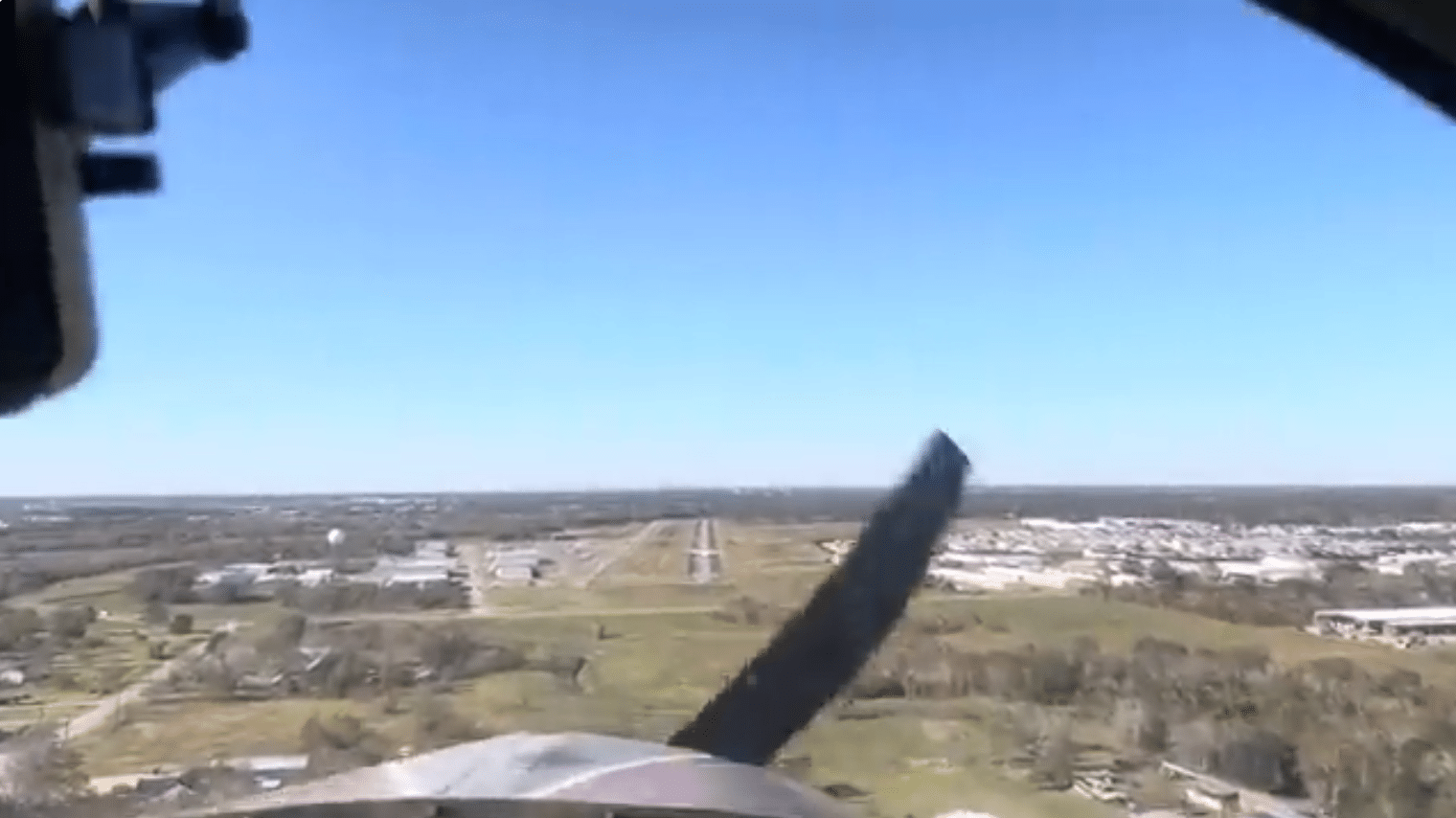
We’ll watch the video shortly but first, let’s look at what happened leading up to this point.
It was a good flying day at Pearland Regional Airport, Texas. The skies were blue and the wind was relatively light.
A young commercial pilot was operating a 2003 Cessna 182T for local aerial observation work. Once his work was complete, he returned to Pearland to land on runway 32. He had about 250 flight hours, all on this aircraft make and model.
Another aircraft was holding short of the runway as the Cessna 182 approached. The pilot of the waiting aircraft called on the radio to let the Cessna 182 know that there was another aircraft on final approach following close behind.
That other aircraft was the Grumman AA-5, registered in the US as N5450L. It had started at Galveston, Texas. The pilot held his PPL with some medical waivers/limitations. He may have been a pilot for over twenty years, as the passenger claimed, but he had only 455 hours in total, with 79 on type. Earlier that day, he had arrived at Galveston with two passengers for a private flight. But when they got there, they discovered that the Grumman AA-5 wouldn’t start. The pilot got a jump start and they departed Galveston at 13:50 local time.
About five minutes after take-off, the Grumman lost all electrical power. The pilot quickly used his iPad with ForeFlight software to navigate to Pearland. They reached the airport quickly and the pilot saw the Cessna 182T in the traffic pattern. He couldn’t extend the flaps to configure the aircraft for landing. With no radio, he couldn’t call to explain he was in an emergency or announce his intentions. They were about a quarter to a half mile behind the Cessna. He decided to silently follow the Cessna to runway 32 to land.
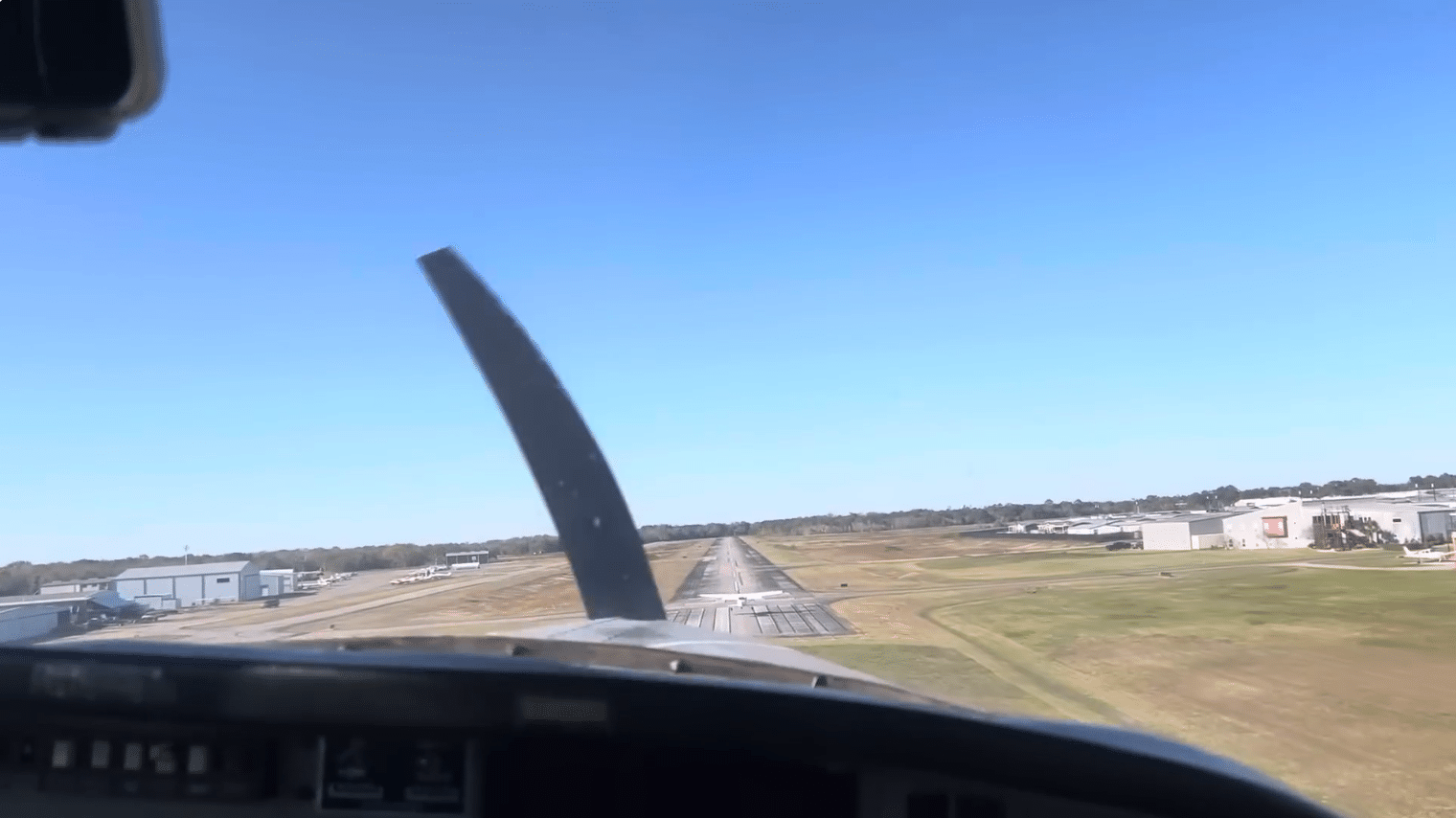
This was when the pilot on the ground, still holding short of the runway, called out on the radio that there was a second aircraft following the Cessna to the runway. That pilot later described the Grumman’s approach as unstable.
The Cessna pilot acknowledged the call as he landed on the concrete runway. The pilot tried to hurry to clear the runway, so that it would be free for the aircraft behind.
The pilot of the Grumman landed on the runway with a bounce. He realised that the Cessna was slowing down faster than he had expected.
The pilot waiting at the threshold watched in horror, helpless to intervene. He called on the radio again, telling the Cessna that he was about to be hit. The Cessna pilot did not have time to acknowledge.
The Grumman veered left, towards the taxiway, trying to avoid rear-ending the Cessna.
The Cessna pilot turned off the runway at taxiway A3 as the Grumman plowed into him from behind.
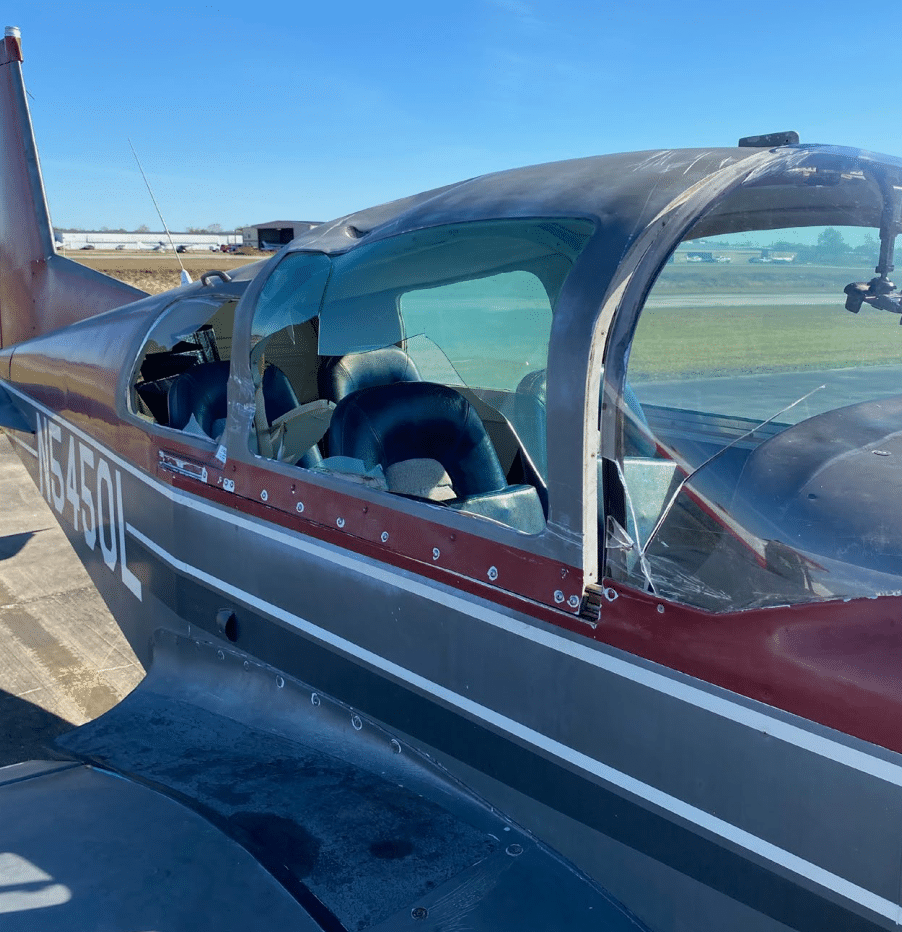
The passenger in the Grumman wrote, “With our flaps not operational, we couldn’t slow fast enough and plowed into his plane as he turned. The prop tore a hole in the left side of his fuselage and destroyed the side of his aircraft. Thankfully he had no passenger on the backseat or it would have been fatal. In our aircraft, the impact was devastating with aluminum crumpling and glass exploding everywhere. My shoulder pushed through the window and I sustained slight external injuries. But thankfully everyone was ok. The planes not so much, both are likely totaled. This video captures the moment.”
When I first watched it, I had no context for what had happened. I left myself a reminder to check for the final accident report. My note to myself said simply “What the hell did I just watch?”
This is the passenger video:
The witness confirmed what we can see in the video. The Grumman pilot, the witness told investigators, did not appear to make an attempt to perform a go-around or avoid the 182T while rolling on the runway.
The NTSB final report cites the probable cause as the pilot’s failure to maintain separation:
The AA-5 pilot’s failure to maintain separation from the 182T during approach and landing, which resulted in a ground collision during the landing roll. Contributing to the accident was the failure of the AA-5’s electrical system, which prevented the AA-5 pilot from communicating with other aircraft in the traffic pattern, and the AA-5 pilot’s poor judgement that the electrical system failure required an expedited landing when a preceding airplane occupied the runway.
But reading the pilot’s statement to investigators reveals a more specific root cause: a mindset that turned an urgency into a crisis.
The pilot told investigators that when the electrical system failed, he believed he had to get the airplane on the ground “at all costs.”
“At all costs” is a terrifying phrase in aviation. It implies that the alternative is death. But here, the alternative was simply flying the airplane.
The engine was running normally. The weather was clear.
When the pilot arrived at the airport, he could have simply flown a standard pattern, rocking his wings to signal a radio failure. The loss of electrical power meant they had no radio and no flaps, but the Grumman AA-5 flies just fine without electricity. It wasn’t falling out of the sky.
Instead, the perceived pressure of the electrical failure narrowed his focus until the only thing that mattered was the runway threshold. He traded a manageable abnormal situation for a rushed, unstable approach that ended in bent metal.
An inspector examined the electrical system after the accident. The alternator, voltage regulator, battery, drive belt and wiring were all fine. Maybe I’m reading between the lines but I noticed that the report doesn’t use the standard language to say that the cause of the failure was unknown.
The inspector found no anomalies that would have precluded normal operation.
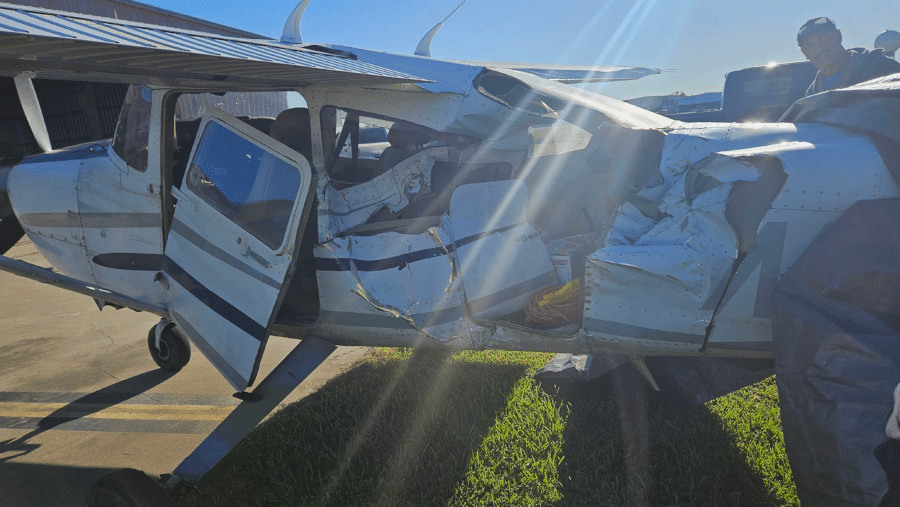
The findings make it very clear that the pilot of the Cessna 182 was not to blame. A1 is the poor Cessna and A2 is the Grumman.
NTSB Findings
- Personnel issues (A1) – Lack of action – Pilot of other aircraft
- Personnel issues (A1) – Decision making/judgment – Pilot of other aircraft
- Personnel issues (A2) – Lack of action – Pilot
- Aircraft (A2) – (general) – Failure
- Personnel issues (A2) – Decision making/judgment – Pilot
Both the Cessna 182 and the Grumman AA-5 suffered substantial damage in the crash. There is no evidence of either aircraft flying since the accident.





There is not really lot of solid information to base more than a guess about what happened on. And what can be added is already said:
The pilot turned a perfectly salvageable situation into a “fender bender”.
Only, the damage was substantial and looking at the photo, the Cessna was probably a write-off.
No injuries, that is the good thing.
I may have flown a Grumman similar to this, but I can’t remember if it had a retractable or a fixed undercarriage. Probably fixed.
But judging from what I read here, there was absolutely nor reason for panic. As already in the comment, the aircraft was perfectly controllable, no burning smells or smoke, a fully functioning engine. A long runway, good weather conditions.
I fully agree with the comment: why did the pilot feel the need to push the situation into a hurried, unstable approach without taking the time – which was not an issue – to review and evaluate the predicament and make a plan?
This, yes, should have been to enter the traffic pattern, fly low over the runway rocking the wings to attract attention, stay in the pattern and make a controlled landing.. In my earlier career when I was the captain of a Corvette, a French-built executive jet, we had a recurrent problem with the flap system. Before the problem was rectified – it was due to moisture in the flap asymmetry sensors – we became experts at operating the aircraft zero flap. We did not have thrust reversers, it was nearly routine. For a light aircraft on a long, paved runway this should not have been more than a slight inconvenience.
Did anyone on board have a cellphone? Could they have called ATC, or as last resort 911 and ask the operator to inform the airport?
The “jump start” may have been a clue. Was the master switch accidentally left in the ON position? If not, why did the battery drain?
Did the pilot even try to switch it OFF and back ON again?
No guarantee, but it might have helped.
Switching everything off, and then turn the master switch back on, next if that seems OK turn all systems that require electrical power back on, one by one. That sometimes can help to identify the faulty system.
This pilot might take a deep breath and ask himself the question: “Do I have the right mindset to be responsible for a light aircraft and its occupants?”
Because, judging from what I read here – and of course, that is not much – I wonder if this pilot “has what it takes”.
He lost all awareness, violated the “Avigate, Navigate and Communicate”, he did not really fly the aircraft in a coordinated manner, he was in a blind panic over a minor problem, he did not navigate to properly join a traffic pattern and he could have communicated by waggling the wings. Therefore turning a minor problem into a potential catastrophe. What would have happened if they had encountered bad weather, or another unforeseen problem? He was already fully overloaded to the extent that he was no longer evaluating and coping.
I have read about student pilots on their first solo who dealt with worse, like a girl who was unable to extend one leg of the landing gear but made a textbook approach and landing.
This guy had 455 hours total time. Not really all that much, but still a respectable amount of experience.
Well, all said: Prince (now King) Charles once messed up a landing in a BAE 146 of the Royal Flight. It overran the runway and was damaged. He was man enough to accept that flying was not for him…
The most obvious alternative option was not to have crashed (UNNECESSARILY) into the back of the Cessna, but to have landed in the acres of open space on the airfield rather the the runway!
The problem is that there may be ditches. The pilot reported that there’s a ditch on the right side of the runway, which is why he didn’t swerve right. Instead, he tried to go left for the same taxiway that the Cessna was also going for.
This accident reminds me of the recent Greg Biffle crash: an electrical problem was all it took for the pilot to fall behind the aircraft. It’s just not a good state of mind to be flying in.
By the way, the post-crash inspection of the electrical system was only visual. There could’ve still been something wrong.
The Google Maps view appears to show a substantial depression between the runway and the taxiway — possibly to hold runoff if there’s rain? There are also several crossings connecting the two; running head-on into one of those in a tricycle aircraft could have led to not just an abrupt stop but also a forward flip. Even a pilot in more control of himself might not have thought that going off the runway was an option.
True but with a little bit of airmanship the pilot could have landed safely on the runway
Where would he have gotten that “little bit of airmanship”? There’s a wide gap between someone who logs a thousand flight hours a year — and (these days) probably simulator training on emergencies as well — and someone who has \averaged// <40 hours a year, with nothing more than biennial flight reviews to make sure he’s safe for basic flying. I wonder how many other private pilots that far past their licensing tests would have made the same mistake, versus how many think regularly about all the things that could go wrong and what to do about them. ISTM there’s a distinct sense of “airplane=freedom” in the US, with many not understanding how little margin there is for failure in something that is a piece of flying tinfoil compared to an automobile.
Electric failure 5 minutes out of KGLS is still 15+ min to KLVJ. The runway much longer, towered and class D airspace.
KLVJ has substantial drainage areas on the side of the runway, so yes, not an option.
What’s the beeping in the cockpit after the crash, ELT? Instrument warning when the master is cut?