A Preventable Collision on Runway 4
On the 22nd of March 2026, a landing jet struck a fire truck that a controller had cleared onto the active runway at LaGuardia Airport in New York, the first fatal accident at LaGuardia in 34 years. Somewhat bizarrely, the previous accident, when USAir flight 405 crashed on take-off after ice buildup on the wings, occurred 34 years ago to the day, on the 22nd of March 1992.
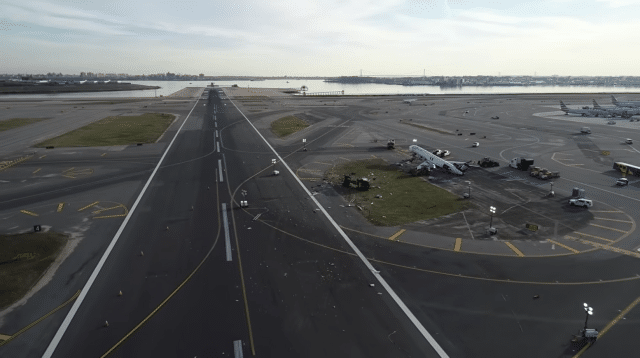
There are still many questions; however, let’s look at the sequence of events as known so far.
Air Canada Express flight 8646, a CRJ-900LR registered in Canada as C-GNJZ, departs Montréal-Trudeau International Airport over two hours late for its scheduled flight to LaGuardia. There are four crew members (two flight crew, two cabin crew) and 72 passengers on board. As it approaches its destination, LaGuardia is struggling with a number of late flights and a lack of available gates. The weather is poor: heavy rain with limited visibility.
As the Air Canada flight is approaching, a Boeing 737 MAX 8 operating as United Airlines flight 2384 (a scheduled flight from LaGuardia to Chicago O’Hare airport), has just aborted their take-off run after their anti-ice warning lights came on. They have already rejected a take-off earlier this evening, seemingly for a related issue.
After the second aborted take-off, the cabin crew notices “a foul odour” in the cabin. The captain asks to return to the gate, but there is no gate available. The captain repeats that they have an unidentified odour and that they are in need of assistance from firefighters. The controller manages the escalating situation, calmly, arranging a fire response and instructing the flight crew to move to another taxiway, out of the way.
The Boeing 737-8 crew make a wrong turn, leading to a different taxiway. The controller takes it in stride, saying he’ll send the fire trucks to the aircraft’s new location. Meanwhile, cabin crew report to the captain that they are feeling ill as a result of the fumes. The captain declares an emergency, asking for any available gate.
The controller looks again for a free gate, with no success. The controller tells the captain that there still is nothing available but he’s sending a stair truck over with the fire trucks, so they can evacuate if needed.
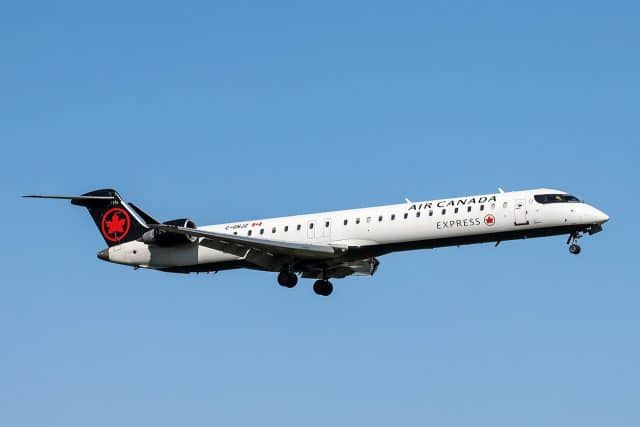
About 90 seconds later, the same controller clears Air Canada Express flight 8646 to land on runway 4, as number two for landing, which means another aircraft will be landing first and the Air Canada Express flight is cleared to land after that aircraft vacates the runway.
The Air Canada Express flight will land in about two minutes. The flight crew lowers the gears and confirms the landing checklist is complete. There is no further communication between the pilots and the tower.
There are two controllers in the tower: the local controller and a controller-in-charge. Both have been on shift for about an hour. The controller-in-charge was handling clearances. There are reports that either the controller-in-charge or the local controller was also dealing with ground control (managing vehicle movements on taxiways); however, the NTSB have said this isn’t clear. Apparently the tower logs have inconsistent dates and times, so this isn’t as easy to confirm as it should be.
Truck 1, a 35-ton 28-tonne/31-ton aircraft rescue and firefighting vehicle with two on board, is the lead vehicle of the convoy making its way to the Boeing 737-8. There’s a transmission to the tower at 23:36:22 by an airport vehicle, likely Truck 1 asking to cross the runway, but the transmission is blocked (stepped on) by another transmission. The controller clearly hears something as he then calls blind. “Is there a vehicle that needed to cross the runway?”
The controller would have been expecting the truck to call, and maybe could see the vehicles on the taxiway. Now again, it’s still unclear who was dealing with ground control that night, but this call is unrelated: Entering the active runway always requires clearance from the Tower controller.
But it’s also true that LaGuardia Airport is particularly complicated in this respect. There are two 7,002-foot runways, 4/22 and 13/31, which intersect as an X. Any vehicle or aircraft that is moving around the ramp areas and runway ends must cross an active runway. According to CBS news, who went over the data collected by the FAA and NASA, there are frequent issues, with 132 logged incursions in the past 25 years.
Truck 1 is stopped at the Delta taxiway. One of the occupants responds to the controller.”Truck 1 and company, LaGuardia Tower, requesting to cross [runway] 4 at Delta.”
The controller clears the truck. “Truck 1 and company, cross 4 at Delta.”
Air Canada Express flight 8646 is on short final, about 100 feet above the ground. The First Officer is the Pilot Flying.
Truck 1 reads back the clearance. The fire truck prepares to enter the runway. In the cockpit of flight 8646, the Ground Proximity Warning System sounds: Fifty feet.
The controller appears to notice that something is wrong and goes on frequency: “Sorry, Truck 1…” A second later, his voice has gone from calm to frantic as he realises what’s happening. “Stop. Stop. Stop. Stop Truck 1. Stop. Stop. Stop. Stop.”
The LiveATC recording is harrowing to listen to:
Air Canada Express flight 8646 touches down. The First Officer immediately transfers control to the Captain, presumably seeing the fire truck on the runway.
The controller is still calling. “Stop Truck 1. Stop. Stop Truck 1. Stop.”
Flightradar24 data shows the aircraft deviating to the right of the centre line just before the impact, suggesting an attempted evasive manoeuvre.
There is an alarm in the cockpit and then the Cockpit Voice Recorder stops recording.
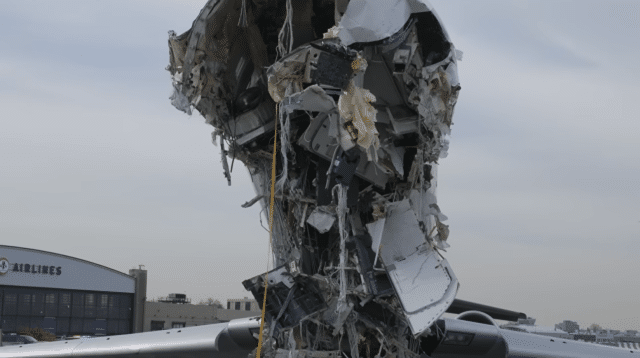
The CRJ-900 was travelling at about 81-91 knots (150-168 km/h) when it crashed into the 35-ton fire truck. The aircraft nose was sheared off, with the cockpit and forward galley destroyed. Both pilots were killed on impact. The fire truck was destroyed, with wreckage strewn across the runway. Both firefighters survived with injuries. Onboard the aircraft, 41 were hospitalised, including a cabin crew member who was found still strapped to her seat 328 feet from the aircraft.
There were multiple systems that could, or should, have intervened.
First of all, Airport Surface Detection Equipment, Model X (ASDE-X) is installed at LaGuardia to track ground movements and alert controllers to runway conflicts. It did not generate an alert.
None of the aircraft rescue and firefighting vehicles at LaGuardia have transponders, which would have allowed ASDE-X to track them clearly. Instead, the system sees only an ambiguous radar return, with multiple vehicles showing as indistinct blobs. The National Transportation Safety Board (NTSB) notes that transponders are standard on fire trucks at other US airports. In fact, ten months before the crash, the FAA had recommended that all 35 ASDE-X airports equip ground vehicles with Vehicle Movement Area Transmitters, with federal funding available for up to 200 transmitters per airport. LaGuardia did not take part.
The NTSB believes that the ASDE-X failed to generate an alert because of the close proximity of the vehicles near the runway. When investigators replayed the data, they saw “two blobs of traffic” on the taxiway, but never saw one blob separating to move onto the active runway.
There are runway status lights which shine red when a runway is occupied. These appear to have been functioning at the time of the collision. It isn’t yet clear if the firefighters in the truck saw the red lights or if they heard the controller’s call to stop.
It’s standard practice to check for inbound aircraft before entering the runway. But at night, in the rain, it’s likely that the driver of the truck would not have been able to see the CRJ-900 on short final.
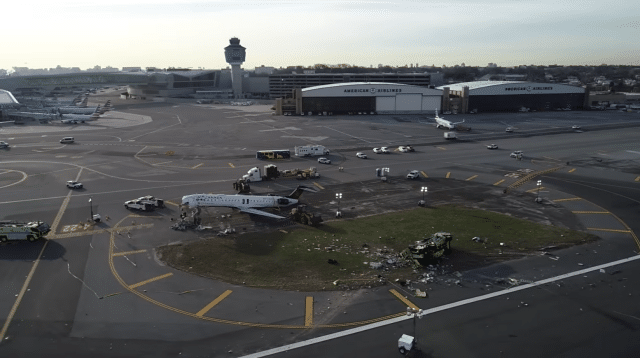
There’s also the point that the aircraft’s clearance to land was given two minutes before the truck was cleared to enter the runway. This is specifically a US phenomenon, where controllers give clearance at high density airports based on expected runway availability, such as in this case, number two to land, rather than because the runway is clear. I’m not sure about the rest of the world, but in Europe, the Air Canada flight would not have been given clearance to land until after the number one aircraft had landed and cleared the runway. In this case, that call could have reminded ATC of their position on short final. Instead, it seems very possible that the two-minute gap, combined with the complications of dealing with the Boeing 737 MAX 8 emergency, caused the controller to lose situational awareness.
The Aviation Law Group point out that there have been several serious runway and surface conflicts in the US in recent years, underscoring an ongoing concern within an air traffic system that is operating under increasing pressure.
The issue is not simply whether the system works most of the time. The question is whether the margins for error at busy airports have become too thin as traffic volume, controller workload, surface movements, and timing pressures continue to converge. LaGuardia, with its density, physical limitations, and operational complexity, is precisely the type of environment where those margins matter most.
Normally, if an accident occurs, the air traffic controller involved is removed from active duty as quickly as possible, as it is a highly stressful environment. However, the same controller can be heard continuing to direct traffic after the event, the distress still clear in his voice. This underscores ATC staffing issues at LaGuardia and across the US. A study last year reported that staffing levels have been declining for 15 years. Nearly a third of FAA facilities are over 10% below their adequate staffing levels.
The Air Traffic Controller Workforce Imperative:
Between FYs 2013 and 2023, FAA experienced a series of constraints on hiring that were mostly externally imposed, including two government shutdowns and disruptions from the COVID-19 pandemic. These constraints led to hiring levels that did not keep pace with attrition, leading to reduced staffing at many facilities, including several facilities that serve the country’s busiest airports and have an outsized effect on flight delays across the national airspace. Overall, FAA’s controller workforce declined by almost 2,000 FTEs (–13%) between 2010 and 2024. Nineteen of the largest ATC facilities have controller staffing levels that are more than 15% below the staffing targets determined by FAA staffing models. While representing only 6% of facilities, these large, understaffed facilities serve about 27% of the country’s commercial operations and account for about 40% of system delays.
As of this time last year, FAA listings of ATC staffing show that the New York TRACON (N90) ,which controls approach and departure for all three major NYC airports, is staffed at roughly 55% of the target for adequate staffing. Compared to many, LaGuardia Tower is much better staffed, with 32 of their target for 34 controllers.
However, it was the midnight shift, with only the local controller and the controller-in-charge handling tower duties and possibly ground duties, which caused an issue when the airport remained more active than usual because of multiple flight delays.
In a media briefing, the NTSB chair conceded that two controllers working combined positions during the midnight shift is standard operating procedure nationally but questioned whether this makes sense at LaGuardia, which handles approximately 900 flights daily through its intersecting-runway configuration.
This video released by the NTSB shows the wreckage and runway as the NTSB began their investigation. The footage is disturbing and doesn’t need to be viewed to understand the accident, but I’m including it as it does give context for the airport and area.
The NTSB investigation (DCA26MA161) has already deployed 25 investigators. The Transportation Safety Board (TSB) of Canada, the airline, the port authority, the FAA and the aircraft manufacturer are all participating.
The NTSB’s preliminary report is expected around the 21st of April. The probable cause determination will likely take 12 to 18 months. In the meantime, Runway 4 reopened on 28 March.
Eighteen minutes after the collision, the controller was still on frequency. A pilot said: “That wasn’t good to watch.” The controller replied: “Yeah, I know. We were dealing with an emergency earlier. I messed up.” The pilot responded: “Nah, man, you did the best you could.” This quote is being used as proof that the controller is to blame. I see it as proof that the controller shouldn’t have still been on frequency.




All collisions are preventable. Not just this one.
I’ve read a lot of reports about this tragedy and watched several videos. All of them place far too much emphasis on the controller to the apparent exclusion of other factors. He was the last weak link in the Swiss cheese model. I guarantee there will be many other failures along the line, not least fire truck driver lookout. I do wish observers would refrain from focusing blame prematurely before all the facts are known.
Yes, it’s the easy link to point at.
God, I feel for that controller. I’m sure he’s going through mental hell, and I hope he gets the help he needs. Which is not a given.
There should have been another controller. The one local controller was handling both air and ground as you can hear him give instructions to planes on the air and on the ground, and the controller-in-charge is nowhere in sight.
The lone local controller keeps having to switch between handling ground and air, and he loses situational awareness for just the moment and that’s all it took.
Unfortunately, when he sees the situation, he’s trying to get the words out and goes “Stop. Stop. Stop. Stop Truck 1. Stop. Stop. Stop. Stop.” and if you follow the sequence of events, you would think he’s still talking to an aircraft on a taxiway, not the fire truck.
Personally, I think if they don’t have enough controllers, THEY SHOULD CLOSE THE GODDAMNED TOWER and not try to soldier on. Put out a schedule that the airport will be closed 3rd shift, so no redeyes for you. That would escalate things and make visible the fact we don’t have enough controllers. Rant over.
Also, personally, I think that truck driver has a lot of blame to shoulder. They should have been eyeballs-out in an especially dangerous location, instead of giving in to get-there-itis.
I agree but in this case, it’s a little more difficult. They had (they thought) enough controllers for the midnight shift. Then a bunch of flights ran late, including the United flight with the emergency and the inbound Air Canada, both of which were running over two hours late. So not quite as simple as shutting down a shift in advance.
Another thing is that the truck was responsible for his movements. I watched the Mover & Gonky show (2 ex-fighter pilots that are now airline pilots) and they mention that controllers are known to be human and make mistakes. They talked about times they’ve been given clearances/instructions and gone “nope, that’s not a good idea” and not accepted them.
People say the lighting was confusing and probably obscured the incoming aircraft, and it’s going to be interesting to hear what the surviving firefighters say.
The ATC system in the US has been under stress ever since the idiots running PATCO endorsed Reagan, expecting he’d return the favor by not coming down hard on them when they struck. All of the fired controllers would have been long retired by this point, but the loss of capacity to teach new controllers is still causing problems — there aren’t enough teachers to make enough new controllers, and taking a controller out of active duty to teach makes the current stress worse. (I’ve also read discussions of the boot-camp process of teaching, saying that it’s not designed to filter for people who can cope with traffic stress rather than abusive bulls**t.)
wrt Gene’s comment: are rescue truck teams taught and equipped to monitor both ground and tower frequencies? ISTM they should be, to at least put another layer of cheese between operations and disasters, but I don’t know that they are.
nit: “35-ton … vehicle”? The weight limit for a tractor-trailer truck is 24 tons in the eastern US (26.5 tons in some areas); I’ve seen a low-res video of the crash (taken roughly facing the truck) in which the truck looks bigger than the local pumpers but nowhere near the size of a semi. “3.5-ton”, maybe?
Hmmm. Agree that 35 isn’t correct but it’s not that far off. https://www.siddons-martin.com/wp-content/uploads/Striker-4×4.pdf has it at 68,000 pounds which is 31 US tons or 28 tonnes.
Interesting — must be fun moving such beasts from the factory to the airport, but I suppose that once they’re on airport property they stay.
And today there was a report of a United 737 inbound to John Wayne Airport having a Blackhawk crossing its flight path, forcing it to take evasive action. The next collision is a matter of when, not if.
A good 500 feet of vertical separation, with all parties aware of each other. They’d never have collided.
While true they had the required separation, the fact of the matter with the SNA incident is that SoCal Approach violated the FAA’s own recently amended procedure prohibiting a helicopter from utilizing visual separation only when transiting an airports arrival/departure path. The SNA tower controller picked up on that in asking if the United flight had gotten an amended altitude restriction from approach. They had not.
The reason they were aware of each other was an air traffic controller ordering the United flight to level off from decent as their paths would have intersected otherwise. And 500 feet in an aircraft flying at normal speeds is too close
Quoting from the FAA’s Aeronautical Information Manual (AIM):
ATC had advised both aircraft of each other well before they became proximate, and had instructed the jet to level off at 2000 ft. Thus, ATC ensured the required 500 feet vertical separation. I doubt any regulations were broken.
You would have been correct until 3/18/26 when GENOT RWA 26/14 was issued:
[quote] SUBJECT: INTERIM HELICOPTER SEPARATION PROCEDURES
THIS GENOT REVISES FAA ORDER JO 7110.65, AIR TRAFFIC CONTROL,
PARAGRAPH 7–2–1 IN RESPONSE TO CONCERNS ABOUT HELICOPTER OR
POWERED-LIFT AIRCRAFT TRANSITING ACROSS THE FLIGHT PATHS OF
ARRIVING AND DEPARTING AIRCRAFT. VISUAL SEPARATION MUST CEASE
BETWEEN HELICOPTER OR POWERED-LIFT AIRCRAFT CROSSING THE
ARRIVAL OR DEPARTURE PATHS OF THESE AIRCRAFT
FAA ORDER JO 7110.65, AIR TRAFFIC CONTROL, PARAGRAPH 7–2–1
VISUAL SEPARATION IS CHANGED TO READ AS FOLLOWS:
7–2–1. VISUAL SEPARATION
TITLE THROUGH REFERENCE – NO CHANGE
a. TERMINAL. EXCEPT FOR HELICOPTER OR POWERED-LIFT
AIRCRAFT CROSSING THE FLIGHT PATH OF ARRIVING OR DEPARTING
AIRCRAFT WITHIN CLASS B, CLASS C, OR TRSA AIRSPACE, VISUAL
SEPARATION MAY BE APPLIED BETWEEN AIRCRAFT UP TO BUT NOT
INCLUDING FL180, UNDER THE FOLLOWING CONDITIONS:
NO FURTHER CHANGES TO PARAGRAPH [/quote]
They didn’t apply visual separation. ATC successfully applied 500 ft vertical separation by instructing the jet to level off at 2000 feet.
See section 6-6-1 in the 7110.65BB.
Actually the Tracon controller instructed the helicopter and United with visual separation. They did not issue the stop descent. Once changing over to SNA tower, the tower controller told United to stop at 2000 feet for the helicopter who was crossing and under someone else’s control (Tracon). That’s the violation there. Tracon issued visual separations. A different controller only talking to one then gave an amendment and just to one aircraft. The initial clearance to United was invalid as was the clearance the helicopter was operating under throughout.
Sylvia, it seems to me that the controller in charge was handling the United Airlines flight 2384 emergency, as well as ground movements and clearances for departures, while the local controller was doing tower and ground movements for arrivals (“stay with me” meaning “don’t switch frequencies, I’m going to give you taxi instructions). Because of this, the local controller kept instructing aircraft for a full 18 minutes after the collision, when he ought to have been relieved immediately.
I’m not sure that the fire truck that entered the runway actually stopped. Clearance to cross had been requested 20 seconds in advance, pretty much as soon as they got going, so their plan must’ve been to cross the runway without stopping.
The controller’s plan, on the other hand, was to let the aircraft land, which is why he only tried to stop the truck and did not have AC646 go around. That’s similar to the accident in Rio de Janeiro last year, where an aircraft on its takeoff roll hit a service vehicle: when the controller recognized the conflict, he adressed only the vehicle and not the aircraft.
The control handover on the CRJ had probably nothing to do with the tiller. At high speeds, the nose wheel is controlled with the rudder pedals, because if you turn it too far, the nosewheel tires lose traction and start skidding.
I guess the question is whether the stepped on transmission was the fire truck who then was waiting for permission to cross or asked for access while still en route and drove right on. I think the instinct must have been to undo the last thing he’d said, hence telling the truck to stop rather than the aircraft to go around.
Very fair point about the tiller; I remembered the fact that on the CRJ it was on the captain’s side, but yeah, it was not useful at that moment. I’ve added strikethrough.
In Rio, the last thing the controller said was the take-off clearance. I think the mental subconscious plan is “let the aircraft use the runway”, and the fact that the ATC actions were aimed at the vehicles support that. Plan continuation bias prevents us humans to think “that won’t work, let’s try something else” as long as we see a chance to make it work.
This is why, on the pilot side, stable approach criteria and MDAs were introduced. Too many pilots thought, “I can still make this work”, and continued an unsafe approach, which they were able to make work until they weren’t. ATC must be trained to issue a go-around whenever there’s a runway intrusion, but in the US, with the “number 2” landing clearance (where the runway can’t be clear because the preceding aircraft is going to use it) and the dangerous situations when intersecting runways are used for arrivals and departures and one of the aircraft is slow to get going, runways are often not really as clear as they should (and as they are in Europe). Why? “Traffic volume.”
I didn’t make anything of the stepped-on transmission, it happened too early to have an impact on the sequence of events. The NTSB report will tell.
https://www.nytimes.com/2026/03/27/nyregion/laguardia-crash-air-canada-truck.html has some more detail, including a second-by-second layout of movements.