Dangerous Take Off in Guyana
On the 6th November 2025, the residents of a small Indigenous community in Guyana’s South Rupununi looked up from their errands to see a Cessna Grand Caravan landing on the road bside their brand-new secondary school.
The Caravan, registered in Guyana as 8R-THR and operated by Air Services Limited, had departed normally from Eugene F. Correia International Airport (near Georgetown, Guyana) for a flight to Lumid Pau Airport. The pilot was a Brazilian national; his experience in the local area is not yet clear. The passengers were government officials who were being flown to an inspection site. The routing was difficult: reports claim that the pilot was using a combination of GPS, verbal directions and a folded paper map. As they entered the final approach for Lumid Pau airport, a freshly graded road leading to the new school came into view, looking broad and level. The pilot mistook this for the airport runway.
Remote strips in Guyana vary widely in appearance and state of maintenance. In this case, the newly graded road looked much more like a runway than the actual runway. However, they were still a kilometre away from the airport.
The pilot, presumably not new to bush flying, landed safely and came to a halt next to the Lumidpau primary school. The passengers disembarked without issue. This probably would have been a minor local news story and a little embarrassing.
However, the pilot, presumably wanting to reposition to the actual airport, decided that the best course of action, having landed on the road, was to simply take off again.
Now it is a truism in aviation that you can land on any runway that you can take off from. But the reverse is not true and beyond that, a dirt road is not a runway. It has no declared length, no obstacle survey, no surface inspection. An aircraft’s take-off performance tables assume a prepared surface.
This video was posted to r/aviation without attribution:
In the video, the aircraft accelerates along the dirt road. The nose lifts rapidly and the Caravan flies unsteadily towards the school’s perimeter fence. The lack of clearance is not a question of perspective: one wheel can be seen to clip the top of the fence. The aircraft goes into a shallow climb and the video ends. The plane landed safely at an actual airport with Starbroek News reporting damage to the fence and possible to the aircraft’s wing tip.
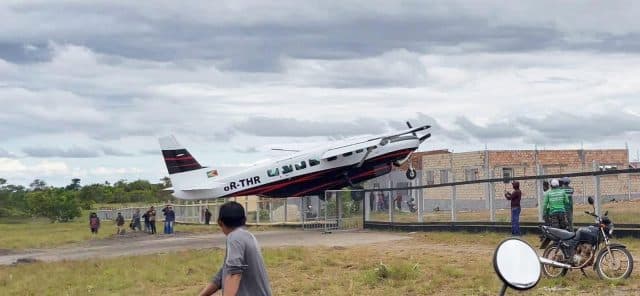
When the Guyana Civil Aviation Authority (GCAA) saw the footage, they moved immediately. The aircraft was grounded. The pilot was suspended. Air Services Limited received written notice that a formal investigation was underway.
Stabroek News quotes the Director General as describing the pilot’s actions as “reckless and unprofessional”. The investigation will look into the pilot’s flight history and experience, especially local experience. They will also examine whether the GPS was functioning and whether the pilot had current briefing materials.





He was less than a foot from disaster. I love Caravans; they are flying F-150’s. They take off from rough airfields in short distances so often that pilots forget that like a pickup truck, there’s limits to what it can do
“However, the pilot, presumably wanting to reposition to the actual airport, decided that the best course of action, having landed on the road, was to simply take off again.” He may have wanted to take advantage of being a few hundred pounds lighter; my recollection of the procedure for soft-field takeoffs is to get just barely into the air as quickly as possible, relying on ground effect to keep the plane up until it’s moving fast enough to climb. (Tailwheel planes might have a different procedure, but the Caravan has a nosewheel like the C-150 I learned on.) If he’d tried to do this with passengers the result might have been much worse. (Would the GCAA have wanted everybody to walk to the airport and have the plane lifted out with a heavy helicopter?) But the flight overall sounds like a real goat-roping; the GCAA should look at the support the pilot got from his employer, not just his own actions.
Yes, of course it would be much worse if he’d attempted this with passengers on board! Solutions would include a taxi to a longer/safer stretch of road or even a tow to the airstrip. The operator is at least being looked into for flight preparation but I agree, I would hope for a focus on systemic issues and support.
Sometimes caution wins.
I remember the excitement when a Grumman Gulfstream II landed at a racecourse in Mallow, Ireland. No, not a course for racing cars, but for racehorses.
Now I must consult Moodle: It was in April 1983. The captain was a Mexican national, Capt. Ocana. In those days, even these top of the line business jets did not nearly have the same range that they have now. The destination, Shannon Airport was shrouded fog. Unusual, but the crew had no option but to divert to Cork. About 30 minutes flying, but they just did not have the fuel left to make it.
Quick thinking of the air traffic controllers. One apparently had an intimate knowledge of the area and guided the crew to Mallow and guided the aircraft to that location. When they broke cloud, they were able to identify the race course. And made a safe landing. The aircraft was completely undamaged, nobody hurt. It must have been a great feeling of relief, and of pride by all involved, not least ATC.
It was an incredible demonstration of skill and coordination between ATC and the crew.
What caused the fuel emergency? Was their flight planning deficient? No, let’s not sling mud. Maybe they had an unexpectedly strong headwind. The weather predictions over such a long stretch of water was not yet as well developed. The outcome was what mattered.
The racecourse is right beside the main road from Kerry. I did not visit it, but it must have been a stir to see a large bizjet parked there.
The Gulfstream would have represented a value of about $ 12 million, even then, and the insurance company were worried that it would have to be scrapped, dismantled for parts. Capt. Ocana had a good look at the racecourse, the ground was solid. After all, it had been firm enough to support the weight of the Gulfstream to land safely. He decided that it should have been possible to get a bowser from Cork Airport, load the minimum amount of fuel to make it safely and take off.
Here is where the similarity and difference with the Caravan incident came in: they did not take off, the Irish Aviation Authorities forbade it.
No official survey of the proposed runway, its length or strength nor obstacle clearance in case of an engine failure. So the aircraft was condemned to end its life there. Maybe transformed into a fancy club lounge? Or just sold for its aluminium?
But the insurance brokers did not give up.
They calculated that it would be worthwhile to build a runway.
After consultations with the authorities, obstacles were mapped, performance calculations were made and… the insurance built a runway at their expense that would be approved for one single take-off only.
Capt. Ocana and his crew stayed in Mallow for more than 5 weeks and were celebrated gusts of the community. They had the time of their life.
When the runway was ready and the authorities were satisfied the Gulfstream departed.
The runway ? most of it is still there, now used as a car park.
A few years ago, in 2023, the daughter of the late Capt. Ocana was invited to visit Mallow in commemoration of this feat.