Air India flight 132 Fuel Switch Problem Doesn’t Solve the Mystery of Flight 171
On the 2nd of February 2026, Air India flight 132 departed London Heathrow for a scheduled passenger flight to Kempegowda International Airport.
The 9 hour 45 minute flight in the Boeing 787 Dreamliner was uneventful and landed safely at Bengaluru (Bangalore) at 11:54 local time the following day.

The eventful part happened before the flight, documented in the report filed after the flight, which has opened up discussion on the fatal 2025 crash of Air India flight 171 again.
At London Heathrow, during engine start, the flight crew moved both fuel control switches to the RUN position. Both fuel switches were correctly set.
The flight crew then rechecked the switches by gently touching them. The left switch slipped to the CUTOFF position.
The crew moved the left switch back to RUN and touched it again. The switch slipped to CUTOFF again.
They tried a third time. This time, the left switch remained in the RUN position.
After confirming that the switch was latched, they decided to continue. The flight departed 35 minutes late, at 19:19 local time.
Once they had landed in Bengaluru, the captain documented the defect in the maintenance log.
LEFT FUEL CONTROL SWITCH SLIPS FROM RUN TO CUTOFF WHEN PUSHED DOWN SLIGHTLY, IT DOES NOT LOCK IN ITS POSITION
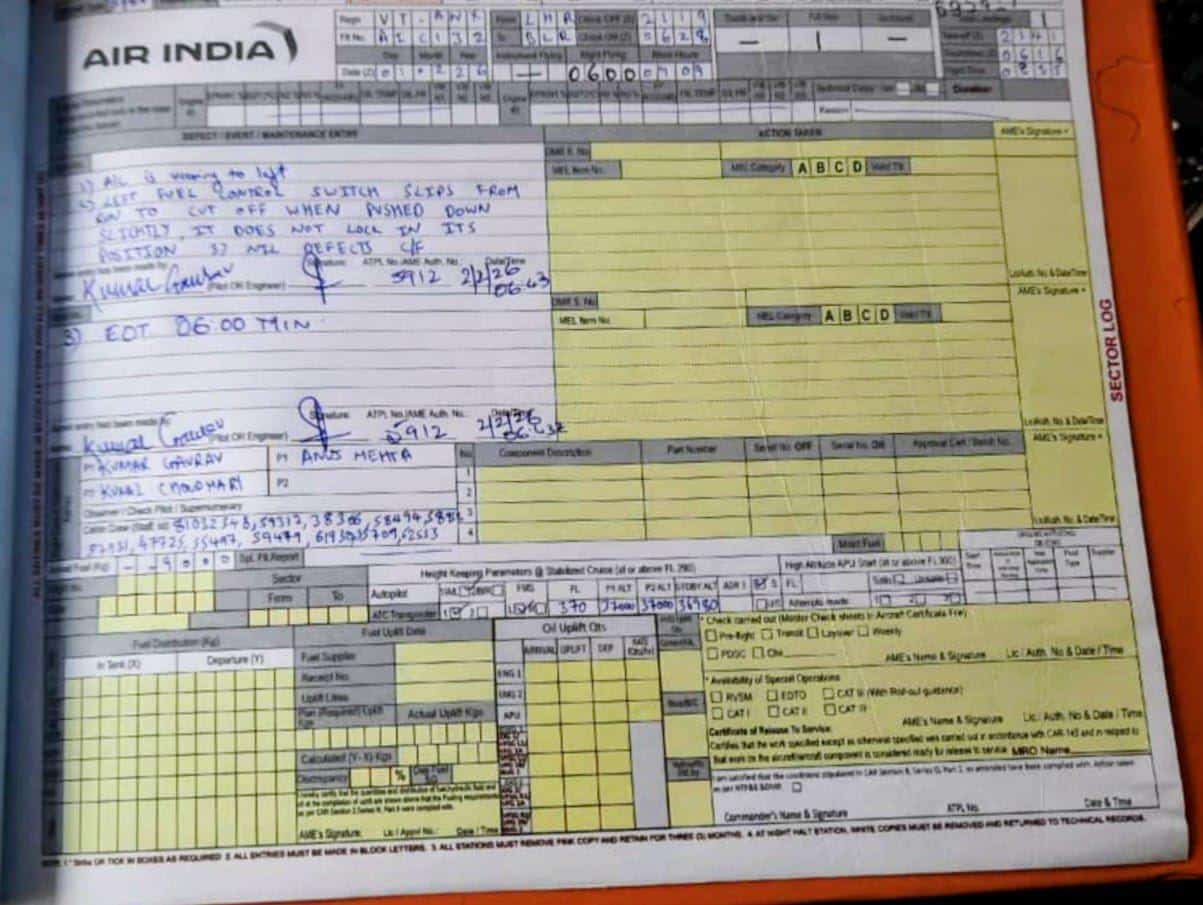
Air India grounded the aircraft.
We are aware that one of our pilots has reported a possible defect on the fuel control switch of a Boeing 787-8 aircraft. After receiving this initial information, we have grounded the said aircraft and are involving the OEM to get the pilot’s concerns checked on a priority basis. The matter has been communicated to the aviation regulator, DGCA.
Why is this news? Because of Air India flight 171, which crashed shortly after takeoff from Ahmedabad last June. DGCA’s preliminary report stated that both engine fuel control switches were moved from RUN to CUTOFF within a second of CC BY-SA 2.0each other. The preliminary report does not draw any conclusions as to the cause. However, the evidence suggests that one of the pilots moved the switches, either in a very bizarre and unlikely mistake or intentionally, intending to crash the aircraft in a suicide/murder.
I wrote about it here: Air India 171 Crash Triggered by Fuel Cutoff
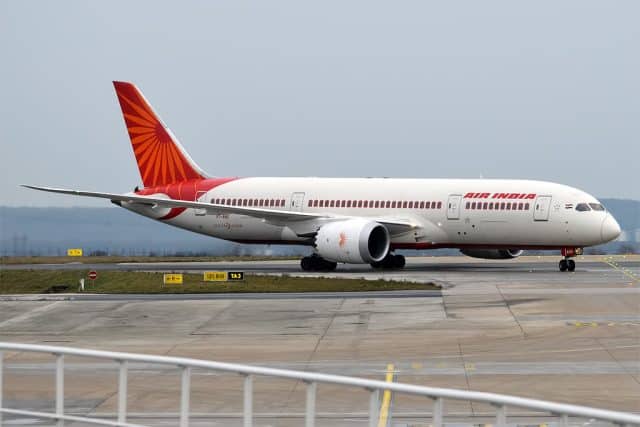
That aircraft was also a Boeing 787 Dreamliner.
This is why the issue with Air India flight 132 made aviation headlines. If there is an issue with the fuel switches being able to move to CUT-OFF on their own, that would change everything.
This is exactly the angle of the Federation of Indian Pilots (FIP), who have argued that the 787’s move to a “more electric aircraft” has introduced a digital failure mode that didn’t exist in older Boeings. They have used this new incident to frame a public statement last Tuesday, as reported in ANI News: All B-787 must be grounded, checked for electrical faults: FIP President CS Randhawa
From day one after the AI-171 crash, we have been insisting that all B-787s be checked for electrical systems. We have gone on record in the media and written letters to the Ministry of Civil Aviation (MoCA) and the DGCA that fuel control switches may have moved automatically due to electrical malfunctions of TCMA in the AI-171 crash.
On a Boeing 737, the fuel control switch is a physical lever that traditionally has a mechanical or hardwired electrical link to the fuel spar valves. On the 787, the switches provide electrical inputs to the aircraft’s central computers, which then command the Full Authority Digital Engine Control (FADEC) to open or cut fuel.
The Federation of Indian Pilots are arguing that water seepage into the main electronic bay of the aircraft could trigger a sensor error and cause a logical cut-off, killing the engines electronically regardless of the settings of the physical switches.
Air India flight 132’s log report seems to be considered proof that it is possible for a switch to physically move without the pilot pulling to unlock the switch. If this is true, then it contradicts the preliminary report which argued that as the switches were mechanically sound, a person must have moved the switches.
Air India responded the same day with an email to all of their B787 pilots, which was published by NDTV news:
“Following the reported defect involving a Fuel Control Switch on one of our B787 aircraft, Engineering has escalated the matter to Boeing for priority evaluation,” [the VP for flight operations] wrote. “In the interim, while we await Boeing’s response, our engineers, out of abundance of caution, have initiated precautionary fleet-wide re-inspection of the Fuel Control Switch (FCS) latch to verify normal operations. To date, no adverse findings have been reported on the aircraft for which this re-inspection is completed.”
“We would also like to remind all crew to promptly report any defects observed during operations and to ensure that all required actions are completed prior to accepting the aircraft,” he added.
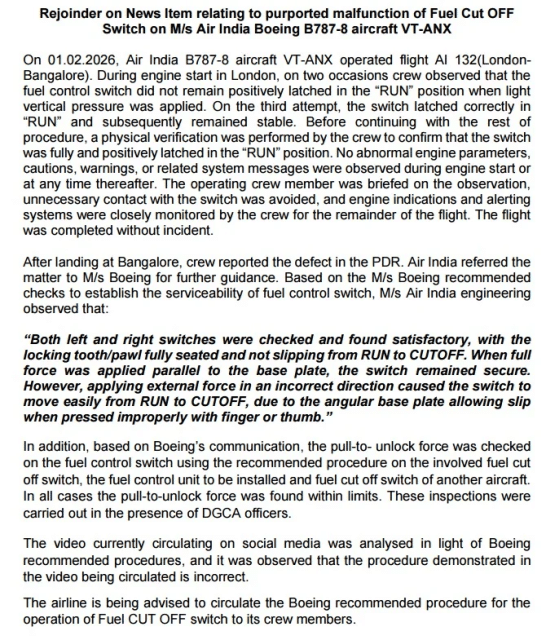
Boeing assessed the aircraft in question, registered in India as VT-ANX, and found that there was no problem. The DGCA summarised Boeing’s findings in a statement.
Both left and right switches were checked and found satisfactory, with the locking tooth/pawl fully seated and not slipping from RUN to CUTOFF. When full force was applied parallel to the base plate, the switch remained secure. However, applying external force in an incorrect direction caused the switch to move easily from RUN to CUTOFF, due to the angular base plate allowing slip when pressed improperly with finger or thumb.
But of course, our faith in Boeing isn’t what it once was.
Further, they refer to a video which shows the switches disengaging.
The video currently circulating on social media was analysed in light of Boeing recommended procedures, and it was observed that the procedure demonstrated in the video being circulated is incorrect.
The airline is being advised to circulate the Boeing recommended procedure for the operation of Fuel CUTOFF switch to its crew members.
Pilot error. And the unspoken issue: if it is easy for a pilot to mistakenly move the fuel switches from RUN to CUTOFF, then that is a problem that needs dealing with. Is it?
I have not seen the video in question. One viewer claims that the switch on the video has been deliberately tampered with, rotated in order to disable the locking. If anyone has seen this video, perhaps they will weigh in.
Nevertheless, the argument that this explains what happened on Air India flight 171 is spurious. The fuel switch issues reported by the crew of Air India flight 132 are not related to faulty electronics arguments made by the Federation of Indian Pilots, despite their attempts to connect this flight to the crash of 171.
A design flaw that allows a fuel switch to move to CUT-OFF with only light pressure doesn’t explain what happened on Air India flight 171. The left and right fuel switches both moved to CUT-OFF one second apart, without anyone noticing that they were repeatedly touching the switches after takeoff.
On Wednesday, Air India reported that they completed their inspection of their 28 Boeing 787s. Air India Completes Precautionary Checks On Boeing 787 Fuel Control Switches, Finds No Issues. They agreed that they would circulate the recommended operating procedures for the fuel switches to all crew members, in line with DGCA’s guidance.
That same day, the UK Civil Aviation Authority weighed in, expressing “serious concern” over why the aircraft departed Heathrow despite the reported fuel control switch issue during pre-flight checks. They have asked Air India to explain how the aircraft was cleared for takeoff, requesting a “…detailed account of all maintenance actions performed to ensure the continued airworthiness of the aircraft and to support its release to service [for Bengaluru].” They also asked for a comprehensive root-cause analysis (how did the failure happen; current answer is just a shrug) and a preventative action plan, to stop it happening again. The CAA warned of enforcement measures for incomplete or late responses.
This is a fair take: the fuel switch moving to CUT-OFF is a serious malfunction. Deciding to embark on a nine-hour passenger flight because the switch stayed in position on the third try is extremely questionable. If the switch is faulty and the crew don’t know what caused it to slip, then they should not continue with the flight.
This story is not over. Air India has one week to respond to the UK CAA’s questions about flight 132. Meanwhile, the DGCA’s investigation into flight 171 continues.








I wonder whether the plane returned to India with a problem because of a policy that service had to be done at a home base? I wouldn’t be surprised if this were a general issue — that airlines aren’t sure service will be well done, or done in a way that won’t make it less familiar for whoever works on the plane next, or cost more than a suit thinks it should, or done in the way that suits how the plane was customized for that airline(*), or properly documented in the company files, or or or…. Not that even a base is guaranteed to service properly — I remember being held up in DTW many years ago because my Northwest flight needed a part that had to come from MSP — but I wonder whether the suits assume — or actually know — that work at a home base is more reliable. It will be interesting to see what UK CAA concludes.
Meanwhile, the year-old puzzle and arguments continue….
(*) (I don’t know how much modern airliners are customized beyond the paint job or the seat placement. I assume it’s not as severe as it once was in steam locomotives, where a leading company built hundreds of different models in a typical year because each railroad had its own ideas about the right mix of power and support wheels, but it could still be significant.)
The crew decided to perform the flight because they saw that the switch was now securely locked—and the subsequent investigation confirmed it was.
The possibility that both switches were moved accidentally has now become slightly more likely.
But nothing has moved the needle on “the switches moved by themselves” (unlikely to happen in the same second), or any kind of electrical fault (unlikely to affect all connections on both switches simultaneously).
There is enough credible information leaked to know without a doubt the Captain pulled the switches intentionally. Just one tidbit leaked from the American side is that in the final seconds the Captain remained calm and did not pull up the yoke as a last effort to save the plane, which the FO did until impact. Does anyone really need to learn anything else? All this other stuff circulating from the Indian side is noise, they are hoping somehow that they can manufacture the final report to be inconclusive. On a side note, remember the China Airlines 737 that nosedived into the ground? The US side leaked that it was intentional, human input of the yoke to go nose down. Mt good friend, living in China at the time told me that the Chinese will acknowledge nothing and just let time pass until people forget about it. That’s exactly what has happened. Not another word. India wishes they could do the same but they can’t so they will admit it and deal with the shame and embarrassment if they can’t get away with issuing an final report that is “inconclusive”.
The FO was the pilot flying, there is no need for the Captain to pull on the yoke. And besides, that wouldn’t have saved the aircraft. They glided it as best they could, slowing it down as much as possible, to the point where pitching it up or banking the aircraft would have stalled it. That means loss of lift and the aircraft falling down.
The only thing that would have helped them climb was for the engines to produce thrust, and they didn’t have enough time for it, sadly.
I don’t think that we can rule out an inadvertant shut-off at this point.
“credible information” and “leaked” don’t often fit in the same sentence; care to share sources?
There is no evidence that the pilot operated the fuel cutoff switches at all. That scenario does not fit the known timeline. The RAT was deployed before the recorded time of switch operation. The only way that can happen is if the hot battery bus is compromised. The loss of the hot battery bus will immediately result in the fuel spar valves turning off. This scenario fits perfectly with known data. It is already known that there have been serious failures with both battery diode modules and lithium batteries. The power system design on the 787 has a single point of failure built in. They should not be flying.
The original perpetrator of this idea is Jeremy John Thompson, with a Youtube video titled “How Air India AI171 B787 crashed – Lithium Battery Diode Module Failure” positing that the battery diode module failed, the battery overcharged and short-circuited, and disaster ensued. This was half a year ago.
Yes, there is. The FDR did record the switch movement, and the engines powered down. The circuits for this are separate, and wired to separate sets of contacts on each switch. It is Thompson who provides no evidence that his scenario is even possible.
The requirements say that the RAT must provide power and hydraulic pressure within 6 seconds. At low altitude, the air is denser, so the RAT spins up faster.
This is false. The valves are solenoids that require power to operate. If the power fails, the valves stay in the state they are in, and the aircraft keeps flying. Any other design would be unsafe.
We have no data that shows the hot battery bus failing. This should be very obvious to everyone with access to the FDR data.
And none of these failures led to engine shutdown. In fact, an early 787 landed with the battery on fire before the batteries were redesigned. I haven’t heard of diode module failures.
The FAA has certified that it does not. Generally, any parts of the power system that fail get isolated from the rest of the system. Redundant systems make this possible.
No actual aviation expert is taking Thompson’s theories seriously. That should tell you something.
Garbage. The FDR does not monitor the position of the switches. It merely monitors the 28v dc from the HBB via the switches to the opto isolators. Lose the bus and it is recorded falsely as the switches being moved. The proof is that the RAT deploys before the engines spool down, due to the loss of the HBB.
More garbage. The RAT can take up to 10 seconds to supply electrical power, and the speed at the time was less than half normal cruise speed.
The spar valves are failsafe CLOSED. The loss of HBB will immediately close them.
The battery diode module is a SINGLE POINT OF FAILURE. It is the only item protecting the main battery. It can be subjected to high loads and fail short circuit. This subjects the main battery to dangerous voltage and current which can cause it to go thermal runaway, also going short circuit and bringing down the hot battery bus. There is NO redundancy.
I don’t know where you got your information from. It contradicts what the knowledgeable folks at PPRuNe have been saying.
Specifically, the aircraft is going to keep flying just fine without the battery/with the battery isolated from the system. My evidence is the 787 that landed just fine with the battery on fire. The diode module is not a single point of failure. If it failed, then the battery would also need to overcharge and then fail, which didn’t happen all that often on the early 787s, and they changed the batteries, I think? And then the power system would need to fail to isolate the battery from the active power buses. That’s 3 failures, not a single point. Very unlikely to happen seconds into the flight.
You’re correct on the RAT, we’re talking about hydraulic power only.
If the battery diode module fails short circuit it can go on unnoticed. The lithium battery could then be exposed to excessive voltage and charging current. This easily causes the battery to go thermal runaway and short circuit. The battery is wired to the hot battery bus and captain instrument bus. A short circuit happens in microseconds and will bring down the bus. The diode is effectively a single point of failure because it will not be noticed and will cause the battery to fail
You: “the spar valves are failsafe closed”. No idea where you got that misinformation. For the valve to close requires both power to its actuator and the circuit of either the fuel control or fire handle to be placed in the close configuration. In the 2008 LHR B777 accident one of the spar valves remained open (a wire being cut by the collapsing gear) because they are not designed to “failsafe closed”. It even has a dedicated emergency battery to ensure it can be closed after loss of primary power.
You: “the RAT was deployed before the recorded time of switch operation”. The only direct observational evidence for timing of RAT deployment is the preliminary report where it says it began supplying hydraulic pressure about 5 seconds after the switches moved. That is totally plausible and I know Jeremy John Thompson thinks it is impossible but his reasoning is faulty. Two scenarios are consistent with that timeline: firstly the RAT is triggered as soon as N2 drops to minimum idle on both (about 75%). Secondly, the RAT is triggered by all generators going offline commanded by the fuel control switch. Neither requires the N2 to drop to 50% followed by another 15 second delay which is the ludicrous idea Thompson keeps asserting for his timeline, having gone into denial of conclusive information to the contrary when it has been provided.
You: “if the battery diode module fails short circuit it can go unnoticed”. That is a bonkers opinion and it is not even part of Thompson’s crazy hypothesis. He alleges the diode fails in reverse bias not short circuit.
You: “it is the only item protecting the battery”. Apart from the 4 BMUs and contactor built into the battery case, the BPCUs, the MBR, and the battery charger.
Something to think about when it comes to air accidents:
https://www.westernjournal.com/affirmative-action-quotas-question-female-minority-pilots-caused-half-pilot-error-crashes/
The guy who wrote this isn’t an aviation expert, he’s a former Trump lawyer with a DEI axe to grind. He doesn’t say how he found the 8 crashes; the NY Post article only lists the “DEI” examples. Note that in all of these examples, the minority pilot was not the pilot in command; a white male was in charge. For a stark example of how this can work out in practice, read https://fearoflanding.com/i-learned-from-that/navigating-instrument-failure-at-10000-feet/ .
So we now get only 4 out of 16 pilots in these crashes were minorities, provided the number 8 is true. And none were in command.
But then he counts things like the DCA mid-air, where the trainee pilot wasn’t the one who accepted visual separation without having the traffic in sight. He tries to make the crash her fault when the white male army instructor actually messed up.
And there’s a common thread in these 4 accidents: bad communication in the cockpit. Maybe having an old white man in the left seat who won’t bother to communicate when the other crew is anything but another white man is the real problem? Having no respect for their FO means CRM breaks down, and we know that’s a danger.
Assume that everyone with an ATPL can actually fly—regardless of gender or skin color. Leaving it to the old white men can’t be the solution.
Not to mention even if the analysis made sense, the small sample size means that any findings would be meaningless.
This sort of thing is click bait for the gullible.
What about the article by Simon Hradecky; Aviation Herald, published & then updated on July 31, a little over a month after the crash, that stated that the pilots may have been trying to RESCUE the aircraft in accordance with memory checklist items for dual engine failure – following published Boeing procedure for dual engine failure? I believe he quoted that procedure as stating to deliberately cutoff both switches, wait 10 seconds, then turn them back on… like a reboot of the circuit. Click–>https://avherald.com/h?article=52b0a800&opt=0
While it’s true the B787 first step of the “Dual Eng Fail/Stall” checklist is to select the fuel control switches to cutoff then back to run, there is no requirement to wait for 10 seconds.
Ok but to me, the narrative is being chopped-off short because ‘malace intent’ is being superimposed on the public. Let’s review:
1. Were the fuel switches moved to cutoff by the pilot? Yes.
2. Did he do it on purpose? Yes.
Now here’s the Whopper Question…
3. Did he do it to save the aircraft or to destroy it? I believe he was trying to save it.
We are being led to assume malace intent where the truth might actually be heroic intent. The article that I linked-to above, from the Aviation Herald, by Simon Hradecky, on July 31st is making a good arguement for ‘heroic’ intent.
The fuel switches weren’t touched at all. The battery hot bus power was lost, the FDR simply recorded the disappearance of the run signal. The scenario where a pilot turned the switches off doesn’t fit the facts. The RAT had deployed BEFORE the FRD recorded time of switch movement.
You think the fuel control switches weren’t moved, and that a complicated series of failures happened that resulted in a double engine failure, and unless you’ve seen evidence that I haven’t (YouTube videos aren’t evidence) nowhere does it say the RAT deployed before the engines failed, whereas it does say the fuel control switches transitioned from run to cut off. Clearly you also think that the NTSB, Boeing, GE, the AAIB and many other parties are happy to cover up a fault and leave 1200+ 787s flying every day with this potentially fatal flaw.
My reading of the evidence thus far is different from yours. I don’t know what happened, but I think the simplest explanation is the most likely but until the final report is published nobody knows for sure.
The video evidence shows the RAT was deployed at a few seconds after liftoff, if not before, if the engines had spooled down enough for it to deploy because of engine failure it could not have gone as far as it did.
Yes, Boeing would certainly muddy the water to avoid liability, and let more crash. That’s exactly what the did with the 737Max.
The engines do not need to spool down for the RAT to deploy. The 787 is smart enough to know it’s going to need the need the RAT the moment the second engine is switched off, so it deploys the RAT right away.
Boeing is not writing the report.
Nobody knows who flipped the switch, and nobody knows the intent. For example, it’s possible that that pilot wanted to retract the gear, but was distracted thinking about something else, and instead performed the “engine shutdown” sequence by rote memory, as they’d do after every flight. This is called an “action slip”, and it happens.
@MikeWaco Simon Hradecky also believes the German Wings pilot did not fly his aircraft into the mountain intentionally, but the technical explanation he came up with is contradicted by his own evidence. The same is happening here: when “cycling both fuel control switches [..] during a dual engine failure to reset both EECs” you wouldn’t wait for the engines to spool down; there is zero evidence that this happened; and in fact the reported CVR conversation contradicts it as well. So those are paranoid conspiracy theories.
The fact is the RAT deployed BEFORE the switches were ‘moved’.
There is no evidence that the switches were moved at all.
The pilots could not have caused this crash. The timeline proves that.
The fact is the RAT deployed BEFORE the switches were ‘moved’.
There is no evidence that the switches were moved at all.
The pilots could not have caused this crash. The timeline proves that.
Where are you getting this “evidence” from, I’ve not seen it from any reliable source.
Mendel: Why the innuendo’d namecalling (conspiracy theorist) toward Hradecky? Big co’s cheat, lie, steel, bribe & blackmail to protect their interests. They sue and legally bankrupt those who callout their misdeeds. They namecall to deflect & shutdown open discussion. Simon cited a number of facts in his article, yet you slight him? I’ve worked in smaller co’s and have seen despicable decisions with little concern for ethics – with the only worry being to have good cover to not get caught. In some countries, bribery is not considered wrong, but rather necessary to get things done. Bureaucrats in those same countries hold similar values. It aint a pure world. People can be bought if the price is right.
I’m sorry if it came across as namecalling, it’s really not. If you have no real evidence to back up your theory, and it is only viable if several nations are involved in a coverup (that you also have no evidence for), then your theory is a conspiracy theory. That’s just a fact.
Michael Brimson’s last post contradicts the preliminary report with every sentence. It’s a conspiracy theory, too.
Note also that the AI171 investigation is not conducted by a “company”, it is conducted by the accident investigation agencies of several nations, and we know they have a good track record of pointing out aircraft problems if they can identify them.
It’s not ok to slander someone because you know somebody else who did something bad, so that other person “probably does it too”, even though you have zero evidence. I really hate it when people do that.
The fact everyone is talking about the fuel switches is because there is a record on the flight data recorder. The pilot deliberately or accidentally turning off the engines is inconceivable, but one Boeing would like to see. The flight data recorder does not actually monitor the position of those switches, it just monitors a voltage from them. That voltage obviously doesn’t originate in the switches but in the hot battery bus.
The fuel spar valves and relays rely on the run signal from those switches to stay open, again this voltage originates from the hot battery bus. If, for any reason, the hot battery bus was suddenly short circuited, the run signal would instantly vanish, the FDR would record that the switches were turned off and the valves would close. The RAT would also deploy because power to the instrument bus would be lost.
Evidence from the video is that the RAT was deployed while the engines had not spooled down. If the RAT had deployed only after the engines had spooled down enough to stop providing electrical power then the aircraft would not be able to fly as far as it did. This is my opinion based on information available. The main point is all those blaming the pilots are doing so without any valid evidence.
Yes!
No, it isn’t. This is a fallacy called “argument from incredility”: you don’t want to believe it, therefore it did not happen.
True, but irrelevant. Boeing did not create the FDR record.
Yes, it does.
The remote data concentrator sends current through dedicated on and off poles of the switch, and monitors whether the circuit is open or closed. The state of the circuit is sent to the EAFR via the Common Data Network.
No, it does not. 28V DC for the left and right buses and both instrument buses originate with the generators.
No they do not. The fuel valves are solenoids, they do not change state unless power is applied. If there is no signal/no power, they stay open or closed.
This voltage originates from the FADEC’s own generator that is directly connected to its turbine. As long as the turbine rotates, the FADEC has power, which it uses to read the thrust lever angle resolvers and the fuel switches, and to operate the fuel valves. The switches are read via a separate set of contacts.
This is not in evidence, and would certainly have been apparent to the investigators, and included in the preliminary report. It wasn’t.
If the 28V bus lost power, the remote data concentrator would stop working, and could not send data to the EAFR. If it was working, it could read the switch correctly. The valves would not be affected, as their operation is ‘analog’ and does not involve the data network.
The instrument bus would automatically be separated from the battery bus, and powered via the generators. It would not lose power.
Yes. This is because the RAT deploys when both engines get switched off. Which the EAFR recorded, so the RAT deployment is expected.
But it didn’t do that. In fact, there was no break in electrical power, because there was no battery fault.
Your opinion is not based on the available information, specifically it is contradicted by the preliminary report and properly sourced electrical diagrams.
You set out the evidence in the first line of your message.
The fuel switches were switched to CUT OFF, and it is highly likely that a pilot was involved.
We do not know which pilot, and we do not know why.
We know the fuel switches were switched because a) the flight recorder recorded it, b) the engines spooled down, c) the aircraft lost speed. Note that the engine shutdown does not involve the battery bus in any way. It explains why the RAT was deployed. It explains why the switches were recorded as being switched back on eventually. It explains why the flight recorder did not record any unexpected power loss.
I stated my post was my opinion based on publicly available evidence. However I must disagree. The FDR isn’t directly monitoring the POSITION of the switches. On takeoff the instrument panels are simultaneously fed from more than one source. The captains instrument bus is fed from the Hot Battery Bus and from generators. A short circuit could bring down ALL power to the instrument bus.
The most crucial evidence is the timeline. CCTV and FDR information suggest the RAT deployed at 08:08:40, the Engine 1 Cutoff at 08:08:43. Explain why the RAT deployed BEFORE the switches moved. The pilot initiating the crash doesn’t fit.
The spar valve has its own battery, so the gross misunderstanding under which you are labouring is moot. Nonetheless, you are repeating bad information you have sucked up from the internet, because you are certainly not getting it from the official engineering literature.
The supply (but not the control) to spar valve actuators does AFAIK come from the HBB. But the bad information you repeat is they are “failsafe closed”. You evidently lack the familiarity with aeronautics to filter out this obvious fake news.
If you think both spar valves close upon loss of power to the HBB – which you do – it wouldn’t take an obscure battery/diode failure hypothesis to fail both engines. Any loss of power to the HBB would do it, and never meet with airworthiness approval. Furthermore, this particular battery has a protective contactor inside it. By the “failsafe closed” spar valve fallacy you are pushing, this battery protection alone would result in both engines failing anytime the BMU activated it! It’s a crazy opinion and very dumb.
It is also based on fantasy and imagination, and ignores whatever actual evidence does not fit.
Yes. I explained that above. The EAFR records the position, it’s a recorder. The monitoring is done via the remote data concentrator. If the RDC had no power, then the EAFR would record the position as invalid. But it didn’t, therefore the RDC had power, and was able to correctly determine the state of the switch monitoring circuits.
Ask yourself this: is current flowing into the battery, or out of it? If the theory is that the battery was overcharging, then current is flowing into it, and it does not feed any buses. If there is current flowing out of it, the voltage is higher than 28V, and the equipment will work.
The diode module prevents current from flowing into the battery except through the charger. That also means a short circuit of the battery can not power down the instrument bus, because the diode module prevents power from the bus from “escaping”. Diodes are passive elements, quite robust and not prone to failure.
We regularly see in aircraft investigations that the flight recorder clock is a few seconds out of sync, and must be synchronized via common events (e.g. a CVR would be synced with a tower tape via a specific transmission). However, I do not concur that CCTV and FDR suggest the RAT deployed at 8:08:40. The preliminary report certainly does not.
If the battery goes thermal runaway short circuit due to a failed short circuit BDM, it will bring down the HBB and captain instrument buss immediately. The logic will try to restore power to that buss by connecting it to the F.O. Instrument buss, which would then fail too. That is what most likely happened. The two components with known previous failures caused the crash.
The RAT must have deployed BEFORE the so called switch movement. The RAT takes at least six seconds to spin up, the aircraft was at a relatively slow speed and electric power won’t be provided until it reaches a minimum rpm.
That’s not how it works. The diode module ensures it doesn’t, for one.
“The logic” would isolate the failed power source from the bus. These isolation relays are all over the power circuitry, and make the design safe. This has been standard engineering practice for decades.
There was no previous failure like you described. 787 battery failures were never catastrophic and did not affect the engines even before they were redesigned. I have explained this above, but I seem to not be getting through to you.
The RAT takes at most six second to spin up to produce hydraulic power, and conditions were favorable because the air is dense at ground level. I have explained that, too.
The RAT can take up to 10 seconds to supply electrical power. The scenario I stated the BDM had already failed and didn’t protect the HBB from a short circuit Battery. You seem to ignore all the fault conditions in the 30 minutes before takeoff, which indicate various electrical problems that could well be associated with the state of the HBB.
RAT deployment: FADEC sets a SURGE flag msg immediately upon fuel chop at high power, based on N2 decel rate detected to be much faster than a normal, throttle-controlled decel. FADEC interprets the condition as a surge. This will be detected about 0.1 sec after fuel-off. The SURGE flag is used internally by the FADEC to reset other control factors to maximize the opportunity for the engine to reciover.
However if the airplane is in TO mode, and both engines transmit SURGE flag, the airplane – which is reading both FADEC output data streams – will immediately initiate RAT deployment. So in 171’s case, RAT deploy would be started 0.1 sec after No 2 engine fuel control switch was set to cutoff.