The Man in the Right Seat at Prestwick
On the 23rd of April 2024, a Piper Archer II crashed in South Ayrshire, Scotland, after losing power. There were two on board. Both suffered serious injuries and the light aircraft, a 48-year old PA-28 registered in the UK as G-BVNS, will never fly again. The AAIB report makes a clear case for carburettor icing as the cause of the engine failure, but honestly, that’s the least interesting part of this incident.
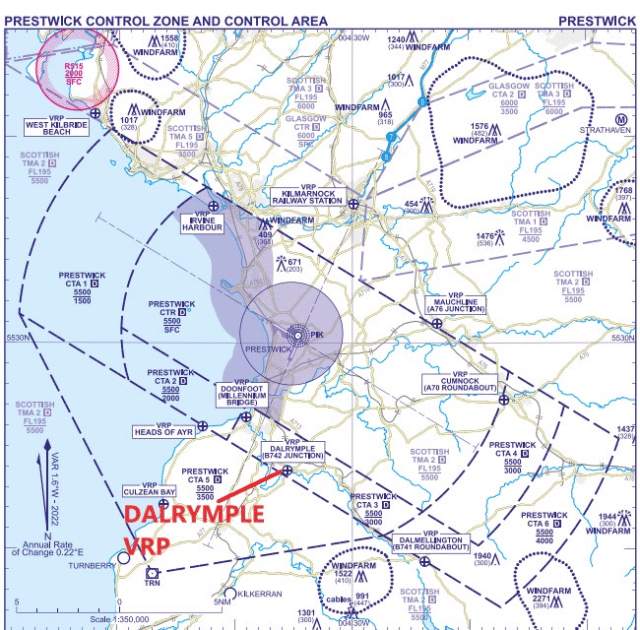
The crash happened on approach to Glasgow Prestwick Airport, which serves the west of Scotland with two long asphalt runways. The primary runway is 12/30 with 2,986 metres, the longest commercial runway in Scotland. Curious about the use of “commercial” as a qualifier, I searched to discover that there is a longer military runway at Campbeltown (Machrihanish), 3,049 metres, built to handle large military aircraft as well as act as an emergency landing site for the NASA Space Shuttle. Although Campbeltown Airport is now commercial, the current operational length is 1,750 metres making Prestwick the longest runway in Scotland, no qualifier needed. There is a second perpendicular runway, cited in the report and on the chart as 03/21 with 1,905 metres . A month after the accident the runway was updated to 02/20.
The Piper Archer II was owned by a local flying club and had a full engine overhaul just over a year ago, in January 2023, accumulating about 150 operating hours on the new engine.
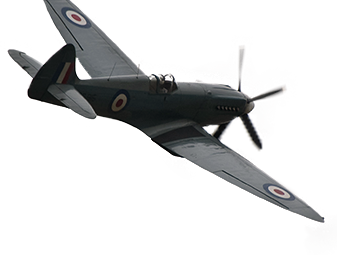
Here’s a video of the aircraft in better days:
The pilot had a total of 307 hours, of which 101 were on type. His most recent flight had been in November 2023. The flying club at Prestwick requires pilots have at least one flight every 62 days, so the pilot scheduled a flight with the club’s Chief Flying Instructor. This is standard practice: the instructor is there as a safety pilot and, presuming all goes well, signs off the pilot as safe to fly.
The pilot’s PPL rating for single engine planes had lapsed in July 2023. However, he also held a Light Aircraft Pilot’s Licence (LAPL) which has slightly different recency requirements: 12 hours in the last two years including an hour with an instructor. The pilot believed that he could continue flying on the LAPL even without a type rating as long as he did an hour with an instructor.
The AAIB makes a big fuss about how confusing the rules are if you hold both a PPL and an LAPL, saying that “the existence of an LAPL and a PPL confused the situation with regards to the validity of ratings.” However, I disagree: the pilot understood the two licences and as far as I can see, was correct in that a flight with an instructor could meet the requirements of the LAPL, which would allow him to continue flying small planes in the UK.
The Chief Flying Instructor (CFI) at the flying club, who was also the Head of Training, did not have a current CAA medical certificate. The CFI claimed later that he had explained this to the pilot. The effect of this was that the CFI could not fly as an instructor: for the purposes of this flight, he was simply a passenger.
He’d noticed some worrying symptoms in September 2022, 18 months before the accident, and saw his doctor, who was told that his symptoms could have been caused by sunstroke. He did not speak to an Aeromedical Examiner. In December 2022, he had another episode. Concerned, he stopped flying solo and only flew with licensed pilots and students who had already flown solo. He saw another doctor in 2023 but did not get a diagnosis. When his Class 1 medical certificate expired, he decided not to renew it, thinking he could still fly another year on his Class 2 medical certificate. In October 2023, the CAA contacted him to say that his medical certificate was suspended.
In the meantime, his condition was finally correctly diagnosed and he started treatment. He had no further episodes in the time leading up to the accident flight.
Here’s where it gets legally murky.
The CAA (the Civil Aviation Authority in the UK) requires a pilot to have completed at least 3 take-offs, approaches and landings in the preceding 90 days in order to carry passengers. This is regardless of which licence you hold.
It is common for pilots with a PPL to fly three take-offs and landings with an instructor in order to get back up to speed. However, in this case, the instructor did not have a valid medical and was not able to act as the instructor for the flight. Professionally, he was the Chief Flying Instructor (CFI) and Head of Training for the club. Legally, on this flight, he was a passenger.
Somehow neither of them registered this. The sequence of wrong assumptions sets the tone for the flight: both pilots believed they were doing the right thing.
They planned to fly for an hour to do some general exercises and then return to the airfield for three circuits. The flying club expected pilots to refuel the aircraft at the end of the day’s flying. The night before, the fuel had been topped up with about 50 litres (about 13.2 US gallons) after the last flight. The two men confirmed the fuel levels and saw that there was no need for more fuel.
They departed on runway 30 and flew in the local area, including practicing forced landings.
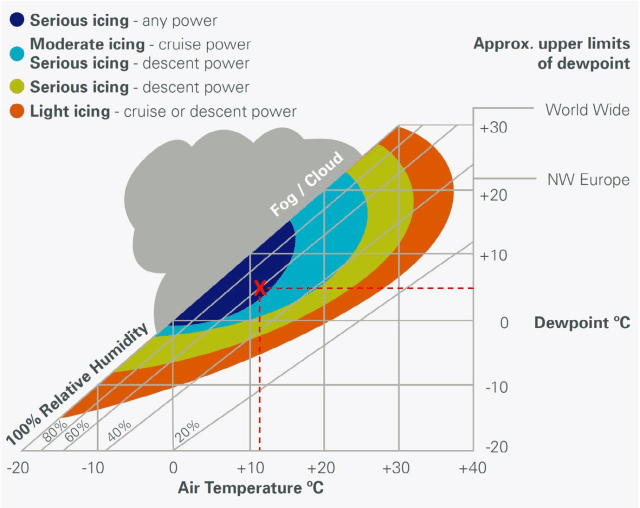
The weather was great: light wind and good visibility with the cloud base at 3,000 feet. The temperature that day was 11°C (52°F) with a dewpoint of 5°C (41°F). Their only issue that day was that the temperature and the dewpoint were very close, which means higher humidity. This matters because the temperature inside of the carburettor is much colder, caused by the Venturi effect (when air accelerates through a narrow passage) and the fuel vaporisation. The combined effect can drop the temperature inside the carburettor by as much as 30°C. If the air is humid, the moisture in the air freezes, creating ice which blocks the engine’s air supply.
The important point is that it does not have to be freezing temperatures for there to be a risk of icing in the carburettor. To counter this, hot air from around the exhaust is redirected into the carburettor to keep the temperature up. The downside is that the hotter, less dense air means a reduction of engine power. Also, the air coming from the exhaust is unfiltered, which can introduce dirt and debris into the engine. In humid conditions like the day of the accident, the CAA advises pilots to use carb heat at any power setting where there’s a risk of icing. For example, at cruise power, the throttle is more open and the reduction of engine power is more of an issue. At descent power, the throttle valve is more closed, narrowing the passage further and intensifying the Venturi effect. As a result, it is common to always apply carb heat while descending to land.
Of course, the pilot and the CFI would have known this. Both said that they recalled using carb heat during the practice forced landings.
About 40 minutes later, they called Prestwick ATC to say they were ready to rejoin the circuit.
British Airways does A320 base training at Prestwick (FlyerTalk), specifically for new cadet pilots doing their first type rating. It’s only a requirement for brand new pilots; pilots transferring from another fleet are rated in the sim.
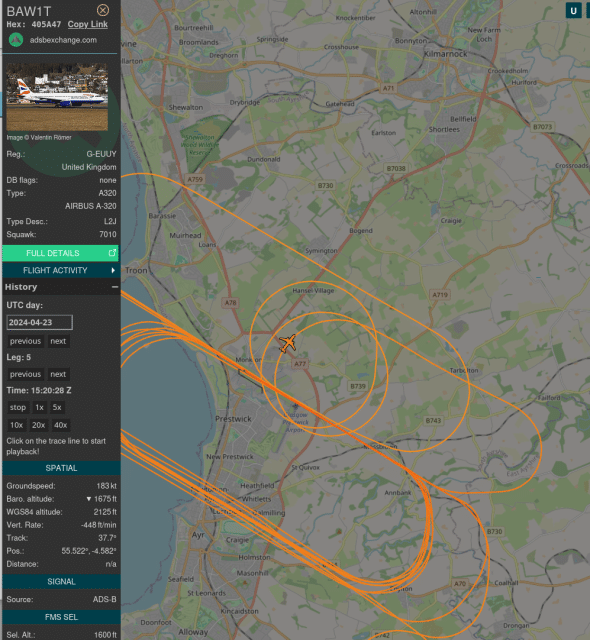
When the Piper called to rejoin, a British Airways A320 was in the left-hand circuit. The controller cleared the Piper to join left base for Runway 30.
The Piper approached and landed on the runway, stopping for approximately 90 seconds in order to increase the spacing between it and the Airbus A320 in the circuit. Then it took off again and joined the right hand circuit on the north side of the airport.
Unfortunately the two aircraft still didn’t have enough separation. The controller asked the Piper to “enter an orbit”, that is, to fly a holding pattern, staying out of the way of the Airbus 320 making an approach to runway 30. They flew three circles over the course of 3.5 minutes.
The controller then cleared them to join right base and report back when on final approach. The pilot acknowledged the call.
During that third orbit, knowing they were cleared to return to the runway, the pilot had descended to 800 feet above mean sea level. He turned out of the circle onto the base leg.
However, the engine was losing power, fast.
The CFI didn’t see the pilot react to the fact that their engine power was very low. They were at 800 feet; too close to the ground to start explaining. The CFI called “I have control” and took over flying, starting by pitching the aircraft for best gliding performance. They did not have flaps extended. According to the PA-28 Pilot’s Operating Handbook (POH) the best glide speed is 76 knots, allowing them to glide about 1.6 nautical miles for every thousand feet of altitude (descending at 800 feet per minute).
They were travelling 85 knots and less than two nautical miles from the runway. He thought they might just make it.
The controller watched the Piper roll out of the orbit towards right base, as expected. He then turned to look at the Airbus A320 in the left-hand circuit while he spoke to that crew. Then he turned back.
The Piper was gone.
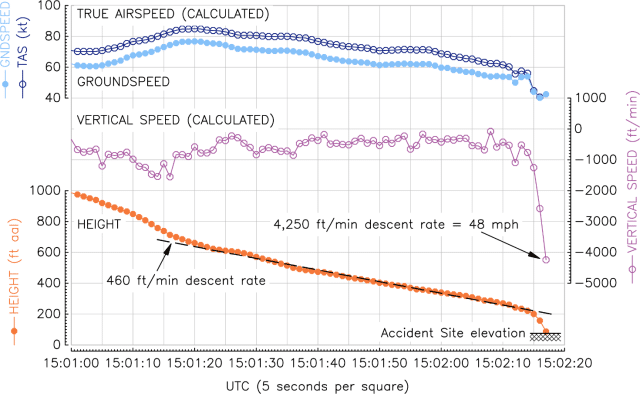
The CFI remained focused on the airfield. He didn’t notice or didn’t consider the fields to his right, which were easily in range. He could see runway 21 and the Search and Rescue hangar ahead. They descended at around 460 feet per minute, a controlled glide.
As they continued to descend in the glide, he realised that the airfield was “moving up the windscreen”. They were not going to make it.
The CFI quickly told the pilot to change the fuel tank selection while he searched for somewhere else to land. To the right, his side, all he could see was trees; they were too low to make it to the safe landing area.
There was a patch of open ground to the left. It would have to do.
He considered a Mayday call but the ground was coming up fast. It was better to focus on the rough landing. He turned left and aligned himself with the patch of land.
The Piper’s airspeed had dropped over the past sixty seconds from 85 knots to below 60.
He saw trees on his approach path, moving up in his sightline. He wasn’t sure they were going to clear them. He raised the nose, hoping for a tiny bit more lift. For a moment, it looked like they might clear the trees.
The Piper’s airspeed was already below 60. As the CFI raised the nose, the aircraft began to buffet, a physical vibration. This is the aircraft’s last-minute warning that it’s about to stop flying.
The left wing dipped. It struck the top of a 15-metre/50-foot tree. This threw the aircraft into a roll and leftward yaw. The Piper’s descent rate spiked to 4,250 feet per minute. That’s 48 mph/77km/h straight down.
Meanwhile, the pilot’s recollection of what happened is… not quite the same. He remembers that final orbit and completing the downwind checks. One of these items is the carb heat, which he believed was already on. He exited the orbit when he felt the engine rpm drop. The instrument showed around 500 rpm. He remembered that the CFI said something but he didn’t know what. He saw trees ahead, with an area of green beyond. The CFI pumped the throttle but the engine did not recover. Then he remembered the nose raising, and (incorrectly) that the aircraft was banked right. The next thing he knew, they were on the ground.
Throughout, he believed that he was the one flying the aircraft.
The sequence from exiting the orbit to crashing into the ground took just over a minute.
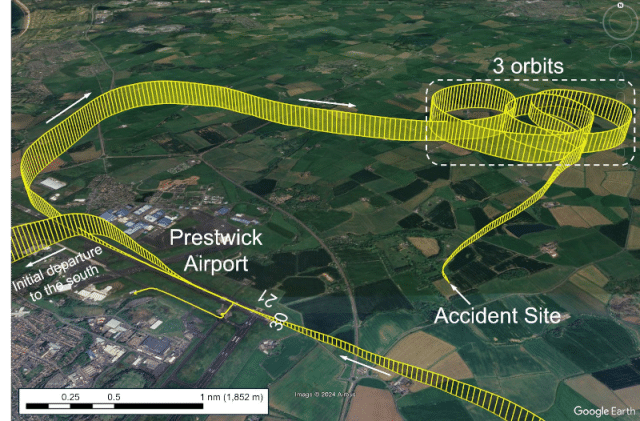
Up in the tower, the controller was still looking for them, thinking that maybe the Piper was further downwind, positioning for the approach. He called for them repeatedly, but got no response. He looked over towards runway 21, that same runway that the CFI initially hoped they would make, but the runway was empty. He asked his colleagues in the tower to watch for the missing Piper and called the Airbus A320, asking the crew to change to a right-hand circuit and see if they could see the Piper.
The Piper was about 1.5 miles away, crumpled on the ground about 45 metres from the tree. After clipping the left wing and rolling into a dive, they hit a fence post hard enough to rip the right wing off, before bouncing and falling backwards into a barbed-wire fence. Fuel soaked into the ground from both tanks. But the propeller was largely undamaged and there were no slashmarks in the ground. The engine was dead or windmilling when they crashed.
Triggered by the impact, the pilot’s mobile phone vibrated aggressively and sounded an alarm. When there was no response, the phone made an automated call to emergency services (999). On answer, the phone plays a looped recorded message that the owner of the phone has been in a severe crash, along with its latitude and longitude.
Emergency services called Prestwick ATC to tell them at the same moment as the A320 crew spotted the aircraft on the ground in a field. A coastguard helicopter based at Prestwick flew to the scene, meeting emergency services there. The two pilots were recovered from the wreckage with serious injuries. They were immediately transported to the trauma unit at the local hospital.
Both have since recovered.
The Piper Archer II was written off.
The AAIB took the wreckage to their hangar in Farnborough in order to check it thoroughly. They confirmed that the fuel tank selector valve was set to LEFT and that there were no obstructions. The fuel pump switch was set to ON and the fuse was undamaged. The fuel from both tanks had drained into the ground at the crash site but the pump and fuel pipes still held fuel.
The pump still worked when they turned it on and the filter was clear of debris and water. The air intake filter was not blocked. The oil filter was free of debris. The oil looked normal.
The engine did not fail because of fuel starvation or lack of oil. There were no signs of a pre-existing fault in the engine other than the relatively minor impact damage.
- a broken high-tension lead
- a broken oil filter casting
- a dented pushrod tube and a bend in the pushrod
When they replaced those parts, the engine, magnetos and carburettor worked perfectly. They left the engine running for an hour with no issues.
While the crash destroyed the throttle, mixture and carburettor heat controls, the carburettor heat valve was recovered. It was set to cold.
The carburettor air inlet valve was found in the full cold position, indicating that carburettor heat was not selected. The valve installation is such that the valve could not have changed position when the aircraft struck the ground.
But we already guessed that.
The pilot’s plan to get legal to fly again, taking advantage of the two-year requirement of the LAPL instead of the one-year requirements of the PPL, was convoluted but sound. The pilot seemed unclear about the 90-day rule but regardless, felt it didn’t matter as he was flying with an instructor, specifically the Head of Training at the flying school. Together, they could ensure that he satisfied the requirements of the LAPL and the flying club rule.
The problem was the CFI with a suspended medical. The Head of Training who legally could not act as an instructor. The man in the right seat, who was just a passenger, making the entire flight illegal. The CFI insisted that he had warned the pilot. The pilot said that he thought he was being instructed and that he was taking notes as they flew. His implication: passengers look out the window; instructors take notes.
If the CFI knew the plan, he knew the flight was illegal the second they taxied out.
The CAA 90-day currency rule is explicit.
A pilot shall not operate an aircraft in commercial air transport or to carry
passengers:
> (1) as PIC or co-pilot unless he/she has carried out, in the preceding 90 days,
at least 3 take-offs, approaches and landings…
The CFI, who was the Head of Training at the flying school, must have known the 90-day rule (not to mention the flying club requirements) and that the pilot needed to fly with an instructor.
What was he doing, sitting as a passenger with a pilot who hadn’t flown in over a year?
From the AAIB report:
Conclusion
The engine most likely stopped because of carburettor icing and a forced landing ensued.
The aircraft struck trees during the latter stages of the approach to the forced landing and
control was lost. Both occupants survived but sustained severe injuries
The evidence shows that neither pilot initiated the engine-out checklist. The emergency procedure is to check fuel selector, fuel pump, mixture and carb heat as soon as the aircraft is pitched for best glide. Both men believed that they were the one in charge and assumed that the other would handle the emergency checks.
Throughout, we see the same issues: both men assuming that things are going to turn out OK. The accident report goes on at length about the legality of the flight. But the real issue here is the sequence of mistakes from the time of the orbit:
- The pilot didn’t turn the carb heat on during the orbits
- The passenger took control of a flight without being absolutely clear that the pilot was aware
- Apparently no one had an accurate picture of what was happening in the cockpit
- Neither pilot quickly/correctly identified a field to land in
- And finally, neither pilot glanced at or turned on the carb heat once the engine failed
The truth is, both pilots could have been completely legal and, based on their actions that day, they would still have crashed.






I’m puzzled by the Piper Archer landing, THEN waiting to make more space for the A320. When I was flying, the usual read was that landing close to a much larger airplane was most dangerous because wake turbulence was worst when an airplane was flying slowly with more flaps; ISTM there should have been enough space ahead of the Archer before it turned on final.
If the people in this crash were both full-time professionals, we’d be talking about dreadful CRM; we might even be talking about that if they were experienced amateurs. But here they’re both rusty, and I suspect the amateur in particular had no training — or even thought — about what to do if there were an emergency when there was another pilot in the other seat.
I take your point about the crash happening even if the pilots were legal given mismanagement, but I wonder the mismanagement would have been so massive if either pilot had been current enough that the flight was legal.
I’m puzzled by the existence of both “private” and “light airplane” licenses; what’s the difference? How heavy a plane can the LAPL holder fly? Can the LAPL holder not fly small-but-complex aircraft (cf the too-much-plane-for-the-pilot case of a couple of weeks ago)?
The LAPL allows* non-commercial flying of single-engine piston aircraft and touring motor gliders. Endorsements are available for variable-pitch prop, tailwheel, retractable gear, etc.
True at the time of the incident. You can no longer get a LAPL (since October 2025) and I think they’re being converted at renewal; you get an NPPL (National) instead. That is for “UK-registered aircraft inside UK airspace” and specifically aimed at various light classes, microlights and motorgliders and such, though I don’t have a full list. I believe the accident aircraft would not have been flyable on an NPPL.
RogerBW, I’m glad you answered before I did, because I had no idea it had been phased out for the NPPL. I’ll just add that my understanding that the Beech Debonaire would not be allowed under the LAPL (based on my experience with the Piper Saratoga), however, this could equally be out of date.
I endorse the notion that currency would have helped. It means that you don’t have to think about routine procedures like putting carb heat on. This helps in situations when the pilot needs their brain for other stuff, e.g. when there’s an A320 in the circuit and you need to fly orbits you wouldn’t fly otherwise. If your routine tasks require focus to get done, they can fall by the wayside.
It wouldn’t have made a difference with respect to neither of them working the emergency checklist.
I agree that the pilot’s currency would have had an impact. But the CFI? Who was still head of training? Forgetting about putting carb heat on? This is not, to my mind, a currency issue. But I concede it is better to be gracious.