15 March 2013

How Far Did She Fall? The Amazing Story of Vesna Vulović

This blog post started, as so many do, over a general conversation at the pub. We were actually talking about Felix Baumbartner, the man who jumped from the edge of space last year and made numerous records, including the highest freefall ever.

I remembered there was a woman who held the record for the longest freefall without a parachute, who fell for 33,000 feet and survived. Funnily enough, I could remember the distance but not her name or how exactly she’d managed to survive this unbelievable fall from an aircraft. We had an amusing round of guesses (“She fell into jungle canopy which broke her fall in stages?” “She landed in very soft powdery snow?”) and when I got home, I looked it up.

Her name was Vesna Vulović and she was a flight attendant on JAT Yugoslave Airlines Flight 367, en route from Stockholm to Belgrade on the 26th of January in 1972. The DC-9 broke up midflight at 33,000 feet (10,160 metres) and crashed into a wooded area in Czechoslovakia (now the Czech Republic). Amazingly, Vesna Vulović was discovered alive in the wreckage, pinned down by a food cart.

Vesna’s Fall • Damn Interesting

A German man, upon arriving at the crash site, found all of the plane’s passengers dead, save one. Vesna was lying half outside of the plane, with another crew member’s body on top of her, and a serving cart pinned against her spine. The man had been a medic in the second world war, and did what he could for her until further help arrived.

At the hospital, her parents were told that although there was still life in her body, she would not survive. Her skull was broken and hemorrhaging, both of her legs were broken, and she had three crushed vertebrae. But three days later, she awoke from her coma, and asked for a cigarette.

Vulović has no memory of the crash. She told interviewers that she was not scheduled to be on the flight that day but her schedule was mixed up with another stewardess named Vesna and she was pleased to take the chance to fly to Denmark.

The official accident report by the Czechoslovak Investigation Commission determined that a bomb on board exploded in the front baggage compartment which broke the aircraft in half.

Scan of the English Translation of the Official Report

The beginning of destruction of the aircraft was in the altitude of 10050 m, which is testified by a sudden cutting off the function of the flight recorder and the voice-recorder. The cause was explosion of an explosive, which was enveloped in an ignition charge. Composition of the explosive and ignition charge has been determined. The explosive with ignition charge was placed in a suitcase of brown-red colour, ignited by an exploder /electric/, timed probably by an alarmclockwork, on which traces of the explosives were found. Traces on the frame of a black coloured trunk of the size 45 x 70 cm testify, that inside was placed the brow-red suitcase containing the explosive with ignition charge and the timing device. All this was packed with newprint and rags.

However, no one ever took credit for what was apparently a terrorist attack. The authorities blamed a Croatian nationalist group but no arrests were ever made.

There was another odd anomaly: officials explained that Vulović survived because she was in the rear of the aircraft but she stated in interviews that she was discovered in “the middle part of the plane”. She has no recollections of the crash at all. She told reporters that the last thing she remembered before waking up in hospital was greeting passengers as they boarded the plane.

It’s actually not at all clear how she survived the fall. The investigation said it was because she was away from the blast in the back, but Vulović and eyewitnesses deny this. News reports at the time stated that the food cart pinning her into place acted as a safety belt, keeping her safely protected by the aircraft fuselage during the impact. Vulović said she was told that it might have been her low blood pressure which saved her by causing her to pass out before her heart could burst.

But here’s the oddity that caught my eye. In the first paragraph of her Wikipedia entry and every news article about her, it says that she is in the Guinness Book of Records for surviving the highest fall without a parachute.

But she isn’t. There’s no reference to Vesna Vulović at all and the category simply doesn’t exist. I soon discovered that the record was taken off the books in 2009, when a representative of Guinness World Records said, “It seems that at the time Guinness was duped by this swindle just like the rest of the media”.

The swindle?

Two investigative journalists, Peter Hornung-Andersen and Pavel Theiner, published a shocking exposé of the report, saying that the aircraft was not the victim of a terrorist attack at all but was shot down by Czechoslovakian Mig fighter jet at low level.

Vesna Vulovic’s record fall Communist propaganda, say journalists | World news | guardian.co.uk

“It is extremely probable that the aircraft was shot down by mistake by the Czechoslovak air force, and in order to cover it up the secret police conceived the record plunge,” he said.

“The Czechoslovak secret police managed to spread this wild tale throughout the world,” he added. “No doubts have ever been expressed regarding the fall. The story was so good and so beautiful that no one thought to ask any questions.” The Yugoslav secret police also helped to uphold that version of the story, he said. Black boxes were never found.

The investigation, partially based on “secret documents from the Czech civil aviation authority”, claimed that the aircraft had an emergency situation and descended unexpectedly, without radio communication. This brought the aircraft close to a sensitive military area, where it was perceived as a threat and shot down by Czech aircraft. The crash debris was spread over a small area, which they cited as further proof that the aircraft disintegrated at low level, probably around 800 meters (2,600 feet) above the ground. Eyewitnesses from a village near the crash site said they saw the aircraft intact below the clouds and some stated that they heard a second aircraft directly before the crash.

The Czech Civilian Aviation Authority referred to the report as “speculation” and stated that they would not comment on the detail.

Last year, exactly 40 years after the incident, Czech magazine Technet wrote about the incident and referred to the report as a conspiracy theory. The article cited a military expert who argued that there where 150-200 people involved in the investigation and it would be impossible to cover up such an event. Anti-aircraft missiles would have been seen on radar and furthermore, it would have been impossible, she said, to hide the evidence of the missiles in the wreckage of the crash.

Google Translate: Serial: Terrorist attack over Czechoslovakia survived only flight attendant fell from 10 km

“Everything indicates that we can reject the theory of anti-aircraft missiles to shoot down the cash system of NAD. Investigative teams conclusions are logical. Investigation could not be manipulated because it involved members of the Yugoslav Party and independent professionals.”

Vulović has said in interview that she does not believe the conspiracy theory but added that as she does not recall the crash, she can’t shed any light on the matter.

As it happens, it makes no difference to her fall: she would have reached terminal velocity after falling 450 m (1,500 feet), so whether she fell from the sky at 33,000 feet or 2,600 feet, the impact was the same. Although she may have lost her place in the Guinness Book of World Records, her free fall is still amazing.

08 March 2013

Things That Make Me Smile

Confusion

Radio Communications for Beginners: in which One One X-Ray gets slightly confused coming into Muenster/Osnabrueck, with subtitles and background laughter by Steve Paul. I have to say this is also a great example of why a controller should be able to switch into the native language to try to help a clearly confused new pilot.


Perspective

This poster has been making the rounds. I’m not sure who wrote the original but it’s spot on.


Amazing

Get a virtual seat on an helicopter flying over Kamchatka, where four volcanoes erupted at the same time. Hit fullscreen (the icon on the right of the playing video) and then use your mouse to look around as the helicopter brings you close and personal.

360 video, Plosky Tolbachik Volcano, Kamchatka, Russia, 2012


Compassion

Three people linked this story to me. I think it’s lovely.

United Airlines delays flight for man to see dying mother – CNN.com

He started crying, obviously distraught. The flight attendants brought napkins for his tears, said they would do what they could to help, and most importantly, got his connecting flight information to the captain, he told CNN.

When he got off the airport train and was running toward the gate, “I was still like maybe 20 yards away when I heard the gate agent say, ‘Mr. Drake, we’ve been expecting you,’” he said.


Sail

If I needed to explain to someone why flying is such an amazing experience, I would simply shut up and show them this video.


Touching

This is nothing to do with aviation, but if you’ve ever travelled on the London Underground, this is sure to bring a smile to your face.

The original Mind the Gap returns … | | The Importance of Being Trivial

Wonderful news from the northbound platform of the Northern Line at Embankment Tube station. London Underground have reinstated the original Mind the Gap announcement – just so that the widow of the man who said it can go and hear his voice.


What’s made you smile this week? Leave me a link in the comments!

01 March 2013

Special Bulletin: Fatal Helicopter Crash over London

The AAIB has released a special bulletin regarding their field investigation of the helicopter which crashed into a crane at St George Wharf, Vauxhall, London on the 16th of January. The accident killed the pilot and a pedestrian. Additional people on the ground suffered serious injuries.

The special bulletin does not include any analysis. They’ve published the facts which have been determined up to now in a 10-page report which is available online: Special Bulletin S1/2013 – Agusta A109E, G-CRST.

The key information is the history of the flight and the transmissions from the pilot, which allow us to put together a picture of what happened that tragic morning.

Please remember that this is a special bulletin, not a final report, and details may end up being corrected or revised. Also, be aware that AAIB reports are to prevent future accidents, not to find someone to blame.

With that said, here’s what appears to have happened that morning in London, leading to the fatal crash at 07:59.

06:30 The helicopter pilot arrived at Redhill Aerodrome for a flight to Elstree, where he planned to pick up his client and another passenger and take them to the north of England. However, the local weather was not good.

He sent a text message to the client:

Weather ok up north but freezing fog at Elstree and Luton not clearing between 8 – 10am I’ve got same at Redhill keep you posted

He followed up with a text message to the Operator:

Freezing fog all london airports ok up north have text [client] clearing between 8 – 10

07:06 The pilot phoned another pilot (referred to in the report as Witness A) to say that the weather at Redhill was clear and he was going to collect his passenger from Elstree. He said that there was fog at Elstree but he was going to fly overhead to see for himself.

07:18 The client called the pilot to discuss the weather. The pilot said that he thought the weather might clear earlier than forecast. The client agreed to drive to Elstree and call the pilot from there.

07:29 The pilot sent a text to the client:

I’m coming anyway will land in a field if I have to

07:31 The client called the pilot to suggest that the pilot not take off until the client had reached Elstree and observed the weather there. The pilot replied that he was already starting his engines. It’s an odd turn-about of the standard pressure on a pilot that the only person putting off the flight is the client.

07:35 The helicopter, callsign Rocket 2, lifted off and departed to the north for Elstree, routing over London Heliport (near Battersea). He was cleared to transit the London Control Zone via Battersea under Special VFR clearance, not above 1,000 feet. The helicopter desciended to 1,000 feet before entering the London Control Zone.

07:42 The helicopter passed London Heliport at 1,100 feet. It crossed the River Thames and turned left towards Holland Park.

07:43 The pilot sent a text message to Witness A

Can’t see batts

07:45 Air Traffic Control amended the helicopter’s clearance to not above 2,000 feet and the helicopter climbed to 1,500 feet on track to Elstree.

07:47 The pilot sent another message to Witness A

VFR on top at 1,500 feet

07:48 The helicopter pased Elstree Aerodrome and descended to 1,000 feet. It then climbed and turn back towards central London.

Witness A sent a message back to ask if he could land and got the response:

No hole hdg back to red

07:50 The client phoned London Heliport near Battersea and was told that it was open.

07:51 Thames Radar broadcasted the London City Airport ATIS information. Visibility at London City was 700 m, with a Runway Visual Range (that is, visibility along the runway rather than from the air) of 900 m, with freezing fog and broken cloud with a base 100 feet above the airport.

The pilot requested a route back to Redhill via the London Eye, which was approved, “not above altitude 1,500 feet VFR if you can or Special VFR, QNH 1012″

VFR is visual flight rules, that is, he must be able to fly visually and not be in fog. Special VRF is a clearance which can be given in a control zone to allow exemptions from some specific flight rules.

In this instance, there is the Low Flying Rule, which states, among other things, that an aircraft flying over a congested area of a city, town or settlement shall not fly below a height of 1,000 feet above the highest fixed obstacle within a radius of 600 meters of the aircraft. However, an aircraft on a special VFR flight is exempt from the 1,000 feet rule.

Note that in the UK, a Special VFR flight should only apply to an aircraft which is clear of cloud and with the surface in sight.

07:53 The helicopter pilot climbed to 1,500 feet for the transit over London. He’s under the main approach path to Heathrow, so he has to stay low.

The controller checked visibility with the pilot. “Rocket 2, do you have VMC or would you like an IFR transit?”

The pilot responded, “I have good VMC on top here, that’s fine, Rocket 2.”

VMC on top means that he’s flying above the cloud in visual conditions. He should be in sight of the surface, but from his previous text messages about not being able to see Battersea or find a hole, he wasn’t on the inbound leg. At this point, it’s possible that he was VMC on top over broken cloud and still able to see the terrain.

The pilot messaged the client:

Over Elstree no holes I’m afraid hdg back to Redhill least we tried chat in 10

and a second message to the operator:

Can’t get in Elstree hdg back assume clear still.

The client responded at 07:55 with:

Battersea is open

The client could drive from Elstree to Battersea and get there for 10, unless the traffic is particularly bad.

07:56 The pilot contacted ATC to ask if Battersea is open. They confirm that London Heliport is open. The pilot responds with “If I could head to Battersea, that would be very useful.”

The controller replied, “I’ll just have a chat with them, see what their cloud is looking like.”

07:57 The helicopter passed the London eye and the pilot contacted ATC. “Rocket 2, I can actually see Vauxhall, if I could maybe head down to H3…H4, sorry.”

H4 is a helicopter route which runs along the River Thames. He misspoke when he said H3, which is not surprising under the circumstances. A last minute diversion like this is a heavy workload. Note that if he can see the surface, then he can descend.

The ATC controller replied, “Rocket 2, you can hold on the river for the minute between Vauxhall and Westminster Bridges and I’ll call you back.”

The helicopter was flying south parallel to the river and began to descend after it passed Westminster Bridge. Quite frankly, I am not sure how a helicopter should hold over a river but this positioning seems a bit odd to me.

07:58 The controller contacted the pilot to say “Rocket 2, Battersea are just trying to find out if they can accept the diversion.” After the pilot acknowledged, the controller said, “And you can make it quite a wide hold, you can go as far as London Bridge.”

I’d have expected him to stay in a tight circle but then the controller seems happy for him to have a “wide hold” so maybe not. Helicopters confuse me.

The pilot flew along the river while descending down as low as 570 feet, then began a gentle climb again as he approached Vauxhall Bridge.

07:59:10 The ATC controller said, “Rocket 2, yeah, Battersea diversion approved. You’re clear to Battersea.”

The pilot responded, “Lovely, Thanks. Rocket 2″ The ATC controller passed on the Battersea frequency and the exchange ended.

07:59:18 At this point, the helicopter was approximately 150 m south-west of Vauxhall Bridge. The helicopter began a right turn to go back towards Battersea. He never had a chance to make the next call.

07:59:25 The helicopter struck the crane on the south side of the river 275 m from the south-west end of Vauxhall Bridge.

St George Tower

In this image from constructionchest’s Photos on SmugMug, you can see the crane and just about make out the red lighting at the top. This light is meant for visibility at night and not specifically for adverse weather conditions. It’s also possible that the building itself was visible in light fog but the crane was obscured.

The crane was a part of the construction of a new high-rise building at St George Wharf. The total height to the top edge of the crane (the tip of the “luffing jib”) was 719 feet above ground level.

On the morning of the accident, the top of the crane and the top of the building were obscured by cloud. Based on the provisional wreckage analysis by the AAIB, the helicopter collided with the crane at 682 feet above ground level.

There was a Notice to Airmen (NOTAM) relating to the crane which the pilot should have been (and probably was) aware of. The report gives a “plain language translation” of the NOTAM:

‘In the London Flight Information Region an obstacle has been erected affecting both instrument and visual traffic. Aerodrome and en route traffic is affected. The obstacle is from the surface to 800 ft amsl and is positioned within a 1 nm radius of 51°29’ N 000° 07’W. The obstacle will be in place from 1700 hrs on 7 Jan 2013 to 2359 hrs on 15 March 2013. It is a high rise jib crane (lit at night).’

You can see the area and the tower in context on this panorama of London taken last year:

BT Tower 360 Panorama of London

Face due south and you will see the tower and the crane on the left side of the screen.

The report also includes the full radar tracks for the helicopter that morning. Of particular interest is the final minutes of the flight.

Track over the Thames

You can see how the aircraft turns to descend down over the Thames and then starts a right turn back towards Battersea. The turn back took him over the river bank and into the crane.

The Special Bulletin includes full detail of the wreckage and damage done to the helicopter and to the crane. It also includes a few quotes from relevant aviation publications including:

‘Non-IFR flights in the London Control Zone are not to be operated unless helicopters can remain in a flight visibility of at least 1 km. Non-IFR helicopters must remain clear of cloud and in sight of the surface’

and

‘The pilot of an aircraft on a Special VFR flight is responsible for ensuring that his flight conditions enable him to remain clear of cloud, determine his flight path with reference to the surface and keep clear of obstructions.’

So what happens now?

The AAIB will conduct a detailed inspection of recovered wreckage and helicopter maintenance documents, and an analysis of weather conditions. The investigation will also examine the conduct of this flight, regulation of flights over London, planning guidance and regulations relevant to development around aerodromes, and the lighting of obstacles.

I expect we’ll see more analysis of the weather and the heavy workload that the pilot was under (diverting, changing frequencies and turning) at the moment of the crash. A critical question will be whether his turn radius took him into the cloud. I won’t be surprised to see a fuss made over the text messages, there were a total of ten sent/received while he was in transit. However, the last text message was received by the pilot (and not marked as read) four minutes before the accident, so it does not appear to be related to the actual crash.

22 February 2013

Controlled Flight into Terrain

Crossair Flight 3597 was an AVRO 146-RJ100, a regional airliner manufactured in the UK by British Aerospace. This aircraft type is popular at small, city-based airports because it is very quiet.

Flight 3597 was a scheduled flight from Berlin-Tegel in Germany to Zurich in Switzerland. On the 24th of November in 2001, 28 passengers, 3 flight attendants and 2 flight crew were on board. The passengers included a German family with two small children, pop singer Melanie Thornton and three members of the band Passion Fruit with their manager.

23 November

05:00 The commander of Flight CRX 3597 starts his flying day at the Horizon Swiss Flight Academy, meeting a student pilot at Zurich for a training flight. After the training flight, he flies four scheduled flights for Crossair, round trips to Tirana and Milan-Malpensa.

11:50 The first officer of Flight CRX 3597 makes four scheduled flights for Crossair: round trips to Budapest and Dusseldorf.

20:31 The commander leaves Zurich airfield after a total duty time of 15 hours and 31 minutes.

22:05 The first officer leaves Zurich after a flight duty time of 10 hours and 15 minutes. He comments to his spouse that the working day had been very stressful and that he felt exhausted.

24 November

07:30 The commander starts his flying day at the flying school. The IFR training flights finish at 13:30.

16:20 The first officer starts his flying day at 16:20.

17:20 Crossair Flight scheduled departure for Berlin-Tegel is delayed. The flight eventually departs at 17:54 and arrives at Berlin-Tegel at 19:25.

20:01 Flight CRX 3597 departs Berlin-Tegel airport on time for its scheduled flight to Zurich. The commander is the Pilot Flying (PF) and the first officer is in a support role: monitoring and handling radio communications. The flight towards Zurich is uneventful.

20:40 Aircraft is cleared to descend to flight level 240. The commander gives the approach briefing, expecting an instrument approach on the ILS to runway 14.

20:43:44 The first officer draws the commander’s attention to their speed, which was “going into the red.” The commander reduces speed and leaves the first officer to handle the navigation set up.

Commander: “Denn, äh, s’NAV setting isch up to you. Final NAV setting wär zwei Mal d’ILS” Then, er, the NAV setting is up to you. Final NAV setting should be twice the ILS.

The pilots are speaking English for all radio work and Swiss-German interspersed with English aviation phrases to each other. There’s no evidence that there was ever any comprehension issues although the transcript makes for interesting (by which I mean somewhat bizarre) reading.

20:47:56 The crew change frequency to Zurich Arrival East Sector and report that they’ve received the recorded airport information referenced as KILO. The recorded information confirms the Captain’s prediction of an instrument approach to runway 14.

The controller doesn’t mention that the recorded information has updated from KILO to LIMA to MIKE, which means that the the flight crew are working from old information. The controller does inform the flight crew that, contrary to the recorded message, they should expect a standard VOR/DME approach for runway 28.

The flight crew were expecting a precision approach to Runway 14 which involves following a pre-defined glideslope defined by the radio-navigation signals of the Instrument Landing System (ILS).

Runway 28 doesn’t have an ILS so now they have to plan a new and more complicated approach.

Commander: “Oh sh**, that as well? Fine, OK.”

20:50:00 The recorded airport information receives an update to NOVEMBER, as the cloud ceiling has dropped to 5-7/8 (broken clouds) at 1,500 feet above the airfield. The controller does not communicate this change to Flight CRX 3597. The flight crew have no reason to realise that their weather information is out of date.

20:51:56 The commander gives a new approach briefing for the standard VOR/DME approach for runway 28.

A VOR/DME approach is a non-precision approach. Rather than simply following a glide slope, you need to track a specific radial towards or away from a VOR station. After you pass the final approach fix, you reduce your altitude at specific intervals (called step downs) which are defined for each runway approach. As you approach the airfield, you should have the runway (and surrounding terrain) in sight and be able to finish your approach visually.

As you descend, the VOR gives you positional guidance, that is, you are tracking your position laterally using the VOR. The DME tells you your distance from the runway.

The “step downs” are staggered descents based on your DME distance, ensuring that you remain at a safe altitude as you approach the runway.

As you calibrate your height to your distance, you continue your descent to the minimum decision altitude for the non-precision approach. Once you reach this altitude, you must stop your descent unless you have the runway in sight and can continue the landing visually. You can continue your approach at (but not below) the minimum decision altitude until you reach the missed approach point, which is a specific distance, by DME, from the runway. If you cannot see the runway once you have reached the missed approach point, you must break off the approach and climb away.

At Zurich, Runways 14 and 16 are equipped with a minimum safe altitude warning system (MSAW). This triggers a visual and acoustic warning in the control tower if the pre-defined minimum altitudes are infringed. Runway 28 is not equipped with this safety system.

20:58:50 Zurich Arrival clears Flight CRX 3597 for the VOR/DME approach to runway 28 and instructs the crew to reduce speed to 180 knots.

21:03:01 Zurich Arrival hands over the flight to Zurich Aerodome Control 1, Zurich Tower.

There should be four working positions at the control tower at this time, however, the supervisor reduced the crew to two and then left the tower. As the approach for Runway 28 is a VOR/DME approach done under the aircraft’s own navigation, no radar vectors are given by ATC.

The aircraft is descending through 5,000 feet above mean sea level and turning right to fly onto the final approach track of 275°. They are approximately 11 nautical miles east of Zurich. During the right turn, the commander mentions to the first officer that he has visual ground contact. The minimum descent altitude is 2,400 feet.

21:03:29 The flight ahead of them is the first to execute the changed approach that evening into runway 28. They inform the control tower that the weather is uncomfortably close to the minimums. This means that they were not visual with the runway until the very last minute.

This is important information for the remaining traffic, who need to be aware that visibility is poor and they may not be able to land under the current circumstances. The current visibility doesn’t correspond with the recorded airport information and quite frankly, does not appear to good enough for non-precision approaches into runway 28.

Flight CRX 3597 is the next in line for landing.

21:04:36 They descend to 4,000 feet above mean sea level. The aircraft is travelling at 160 knots with a descent rate of 1,000 feet per minute, which later increased to 1,200 feet per minute. This is not in line with the step downs: the flight is deviating from the approach path it should be taking.

This rate of descent continued until just before the collision.

21:05:21 Flight CRX 3597 reports to ADC Tower 1 as established.

The flight crew complete the final checks.

The air traffic controller stated that he noticed on radar that the plane was at approximately 3,600 feet when the aircraft was still six nautical miles out. That is to say, it is too low for the DME distance and not following the step-downs. It is not “established”. As the aircraft is under its own navigation, the controller doesn’t keep an eye on the aircraft’s altitude.

21:05:55 The commander claims that he has visual ground contact.

At that altitude, in that visibility, it is not possible that the commander could see the airfield. He only has sporadic contact with the hilly terrain that they were directly over. His statement is, at best, overly optimistic.

It is the first officer’s role to call when the approach lights or runway are clearly in sight. Nothing is in sight. The first officer should have argued but simply said, “Yes.”

They continued the descent.

Commander: Someone said he saw the runway late here …approaching minimum descent altitude…here we’ve got some ground contact.

21:06:10 The aircraft passes straight through the minimum descent altitude at 2,400 feet.

Commander: -..two four (2,400), the minimum. I have ground contact. We’re continuing at the moment. It appears, we have ground contact, we’re continuing on.”

The first officer quietly says “Two four” under his breath.

What exactly could they see?

These images were created with a simulator as a part of the investigation, looking at similar conditions to the incoming flight.

Runway 28 as seen from the VDP at 2,390 feet with a visibility of more than 10km

Runway 28 as above with a visibility of 5km

On that cloudy night, the flight crew are flying in visibility of around 2km. The approach lights at this distance can be detected at the earliest at 2.3 nautical miles. The flight coming in previous stated that they became visual at 2.2 nautical miles.

If Flight CRX 3597 were to attempt a final approach from the minimum descent altitude at this distance, they would need to descend at an angle of 6° towards the runway threshold, too steep for a stabilised approach.

At the point at which Flight CRX 3597 descends below minimum descent altitude, the aircraft is much further from the threshold than it should be for the glide slope: they are still 4.8 nautical miles away. There’s no way they can see anything. The commander can’t possibly have visual contact to the approach lights and the runway.

To be fair, it’s a two-person crew. It is the job of the Pilot Not Flying, the first officer, to monitor the approach and act as look out. He’s expected to call attention to deviations from procedure and watch both for the decision height and the minimum descent altitude. It is his job to call when the approach lights or runway is clearly in sight.

The first officer, in his supporting role as Pilot Not Flying, says nothing.

21:06:22 The Ground Proximity Warning System (GPWS) announces the radio altimeter reading 500 feet above ground. The flat land here is at 1,500 feet above sea level, with hills rising to 2,000 feet. The aircraft is below the minimum descent altitude and still descending. The commander vents his frustration.

Commander: “Sh**, two miles, he said, he saw the runway.”

This is a reference to the previous flight inbound to Zurich who stated that the weather for runway 28 was “pretty minimum” and that they had the runway in sight at about 2.2 nautical miles away.

Flight CRX3597 isn’t two miles out, though. The aircraft is four miles out and descending fast. The captain clearly does not have the runway in sight, despite deliberately continuing past the minimum descent altitude.

21:06:31 The commander notes that they are at 2,000 feet but appears not to be taking any note of their distance from the runway. No one is watching the DME and its likely that the commander is completely focused on looking out the window. He makes no further mention of having the runway – or anything – in sight. The main cloud base is between 2,400 and 2,700 feet. Over the hilly slope, low banks of cloud are forming between 1,800 and 2,000 feet.

21:06:32 The GPWS sounds: MINIMUMS, MIMIMUMS. They are now 300 feet above the ground. The Tower controller, without realising that they are miles away and low, clears Flight CRX 3597 to land.

First Officer: …do a go around?

At this moment, they still could have saved themselves. If the first officer had initiated a go around immediately, it might still have been possible. But instead, he asks hesitantly whether they should.

21:06:34 The commander calls for a go around and the auto-pilot is switched off, possibly as a reaction to seeing the trees in the landing lights.

The First Officer says, “Go around!” The power levers are pushed towards the take-off thrust position and the engine’s RPM increases. But it’s too late.

One second later, the Cockpit Voice Recorder records the sounds of an impact as the aircraft hit the trees.

21:06:35 The aircraft collides with treetops and bursts into flame. It travels another 50 metres before crashing into the ground. The Cockpit Voice Recorder stops recording.

A survivor who was seated in 14B described the scene: “…..suddenly a loud crashing noise could be heard and the aircraft shook violently. I immediately looked forward and saw through the open cockpit door and the cockpit windscreens that outside the aircraft a real shower of sparks was rising. Next moment there was a massive impact…”.

21:22 The first vehicles from the Zurich airport fire brigade arrive at the site. White-yellow flames burn and there are several small explosions.

Twenty-one passengers and three crew members died from their injuries at the site of the accident. Seven passengers and two cabin crew members have survived. The impact and immediate fire destroyed the cockpit, the front part of the fuselage, the central part of the fuselage and large sections of both wings.

When the BFU (the Swiss Aircraft Accident Investigation Bureau) investigated, they found a disturbing background.

There were numerous previous incidents where the commander did not follow procedure and did not use his checklists effectively. Also, they discovered that he’d struggled in the past with conversion courses to the MD-80: “it became apparently that the commander was having major problems with the MD-80′s digital guidance system.” No further performance checks or detailed examination as to the reasons for his repeated failures were undertaken.

Then, the investigation uncovered a similar incident from six years previous.

According to the statement of the copilot involved, in December 1995 the commander was carrying out an approach to Lugano airport as pilot flying, at night and under instrument flight conditions. Shortly before the Saab 340 reached the PINIK waypoint at an altitude of 7000 ft QNH, the aircraft was configured for the landing, i.e. the landing gear was lowered and a landing flap setting of 35° was selected. For the descent, the commander used the autopilot’s vertical speed mode and selected a rate of descent of 4000 ft/min.

Since rates of descent of less than 2000 ft/min are usually used for this approach, the co-pilot asked for the reason for the increased rate of descent. The commander explained that one could implement the procedure in this way. During the descent, which continued unchanged to a radar altitude of300 ft RA above the lake, the speed of the aircraft increased from 135 to more than 200 KIAS. When the aircraft changed over to horizontal flight at 300 ft RA, part of the lake shore and the mountainside could be seen. The aircraft then flew at this altitude in the direction of Lugano aerodrome until the runway finally came into view and the aircraft was able to land.

The overspeed warning and the ground proximity warning system (GPWS) had been deactivated before the descent.

The commander believed it was reasonable to descend below the minimum descent height, even at night and in instrument conditions. That successful procedure at Lugano reinforced his bad habits.

In addition, in 1999, the commander became lost during a sight-seeing trip with 30 passengers above the Savoy Alps. Eventually he realised that he’d gone past his planned flight time to Sion.

He immediately initiated a descent in the direction of an aerodrome which he had in sight. This was Aosta (I) aerodrome, which is located approximately 50 km to the south of Sion in a valley which runs along the other side of the main ridge of the Alps. No discussion on the approach took place and the most important checklist points were covered intuitively and in an undefined order. The copilot tried several times to make contact again with Sion aerodrome control, which he was unable to do because of the topographical conditions.

The commander did not react to interventions from the copilot. Several descending turns were made above Aosta aerodrome and the approach was continued without radio contact. When the aircraft was making its final approach, the passengers could see from road signs that they were in Italy. The commander then initiated a go around and flew over the St. Bernhard pass into the Rhone valley, where the landing in Sion took place.

As there was no incident, this was not reported at the time. However, there were plenty of personnel notes to indicate that there was a potential issue.

The commander was described as defensive in relation to more complex technical systems and “frequently exhibited difficulty with their operation.” A number of pilots who had flown with the commander as first officers stated that he often did not integrate the co-pilots into the operating procedures and decision-making processes.

Unfortunately, the records for the First Officer were the worst possible contrast: his personnel reports showed that although he was well-qualified and his skill level was good, four separate recruitment officers all found that he had “a tendency to subordinate himself.” He was described as lively but not aggressive and his assessments stated that he needed to develop self-confidence and personal maturity.

Earlier in the accident flight, the commander had lectured the first officer about his interpretation of the runway report, which the first officer had just deciphered “more or less completely and competently” according to the report. Thus the commander, with forty times more flying experience than the first officer, underlined his position of authority. Small wonder that the first officer didn’t dare argue.

Causes

The accident is attributable to the fact that on the final approach, in own navigation, of the standard VOR/DME approach 28 the aircraft flew controlled into a wooded range of hills (controlled flight into terrain – CFIT), because the flight crew deliberately continued the descent under instrument flight conditions below the minimum altitude for the approach without having the necessary prerequisites. The flight crew initiated the go around too late.

The investigation has determined the following causal factors in relation to the accident:

  • The commander deliberately descended below the minimum descent altitude (MDA) of the standard VOR/DME approach 28 without having the required visual contact to the approach lights or the runway
  • The copilot made no attempt to prevent the continuation of the flight below the minimum descent altitude.

As always, the cause was not quite that simple and there were a number of secondary issues flagged by the investigation which could have limited the accident to a close call rather than a fatal crash.

The following factors contributed to the accident:

  • In the approach sector of runway 28 at Zurich airport there was no system available which triggers an alarm if a minimum safe altitude is violated (minimum safe altitude warning – MSAW).
  • Over a long period of time, the responsible persons of the airline did not make correct assessments of the commander’s flying performance. Where weaknesses were perceptible, they did not take appropriate measures.
  • The commander’s ability to concentrate and take appropriate decisions as well as his ability to analyse complex processes were adversely affected by fatigue.
  • Task-sharing between the flight crew during the approach was not appropriate and did not correspond to the required procedures by the airline.
  • The range of hills which the aircraft came into contact with was not marked on the approach chart used by the flight crew.
  • The means of determining the meteorological visibility at the airport was not representative for the approach sector runway 28, because it did not correspond to the actual visibility.
  • The valid visual minimums at the time of the accident were inappropriate for a decision to use the standard VOR/DME approach 28.

The primary issue that caused this fatal accident in the end was Cockpit Management Resources. Over time, we have learned that the interaction in the cockpit is vital to the safe management of critical phases of flight. The Pilot Not Flying, often the less experienced first pilot, must be confident enough to speak up and the Pilot Flying must be willing to accept his support.

The combination was fatal: a complicated approach in minimum conditions to be executed an authoritarian commander paired with a first officer who didn’t have the strength to argue.

The decision to continue the descent into foggy ground was possibly affected by the commander’s fatigue as well as his lack of technical prowess. He appears to have hoped desperately to make visual contact rather than to reference his instruments.

Throughout the dangerous final approach, the first officer said nothing and took no recorded actions from the time when the aircraft descended past the minimum descent altitude to his final hesitant question of whether they should go around. It appears that he recognised their descent without visual references as an error and yet was not able to take action. And in the end, they — and twenty-one innocent passengers and crew — paid the price.

References

All photographs are taken directly from the accident report.


Can I tell everyone yet? YES! I can!

Wheeeee! I’ve been waiting to tell you guys about this for ages!

Ahem.

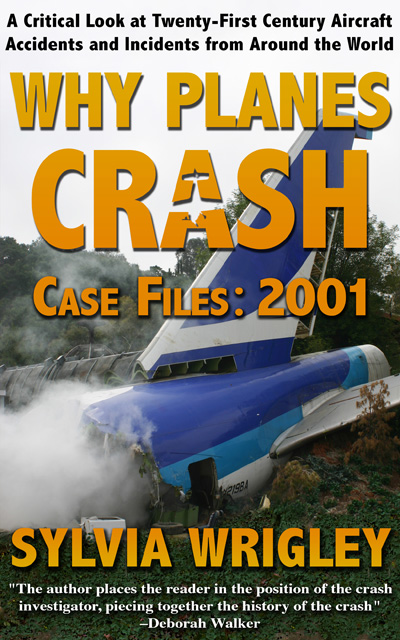
If you found this analysis interesting, please keep an eye out for my book: Why Planes Crash: 2001, due for release the first week of May.

More details soon. :)


15 February 2013

Horseplay in a Lockheed C-141 Starlifter

The Lockheed C-141 Starlifter is a strategic airlifter: a cargo aircraft specifically used to transport personnel or materials over long distances. This military aircraft has appeared in every US conflict from Vietnam to Afghanistan.

It’s a big, well-stacked, beautiful plane built for comfort, not speed. (A lot like me, actually!)

So I was excited to find that a former C-141 pilot has made an excellent website celebrating the aircraft: C141HEAVEN – All there is to know, and lots more, about the Lockheed C141 Starlifter! This wonderful resource focuses on a single aircraft but with a wide remit, including personal recollections from pilots, historical documentation, newspaper articles and videos.

If you know me, it’ll come as no surprise to know that I was fascinated by the C-141 Lifetime Mishap Summary on the site. Especially this report, which is the only official incident I have heard of which was caused by by a cigar in the cockpit.


C-141 Vance AFB 1982

Synopsis: The highly experienced crew was returning to base from a stateside airdrop mission. During some horseplay, cigar ash was introduced into a crew oxygen hose. The resulting oxygen-fed fire ignited floor coverings and filled the cockpit with dense sooty smoke. After some difficulties, the crew was able to recover the aircraft with only minor injuries.

Returning from Pope to Norton after an airdrop mission, the pilot in the left seat decided to light a cigar.

The pilot, who was in the jumpseat, complained and donned his oxygen mask. In response, the left seater covertly disconnected the jumpseater’s mask from the oxygen regulator hose, with the intent of putting smoke into the hose. Unfortunately, lit cigar ash accidentally entered the oxygen regulator hose before the hose was reconnected.

The jumpseater smelled the smoke and selected “Emergency” on the oxygen regulator. When that didn’t help, he removed the mask to clear the smoke. When he disconnected the mask from the regulator hose, a “2-foot” sheet of fire leapt from the hose. It ignited an oxygen-fed fire that spread to the flooring.

To put out the fire, the left-seat pilot shut off the crew oxygen system. At about the same time, the engineer while switching to “MAX” airflow, inadvertently hit the bleed duct overheat test switch, shutting off the engine bleed valves and disabling the air-conditioning packs. The crew started a descent but soon became hypoxic.

The crew oxygen system was again turned on. The fire reignited with a fireball large enough to melt components on the Flight Engineer’s panel.

The crew eventually extinguished the fire, reset the bleed valves, and recovered to the nearest military base. Members of the crew suffered only minor injuries (but major embarrassment).


I recommend having a browse around the full website: C141HEAVEN. In one incredibly touching blog post, he tells how he managed to return the ID tags to the wife of a pilot who crashed in 1975, after the Parks Service had failed to find the family. The website is still being updated and is a fitting testament to an exceptional aircraft.

08 February 2013

Instruments and Visuals

Flying with non-pilots always brings up interesting questions. Tony isn’t all that interested in planes; however he was quick to notice after only a few flights that there was some important difference between my licence and Cliff’s. He’s right: Cliff is instrument rated and I am not, I can only fly in visual conditions.

Cliff’s gone through additional training to fly using instruments for reference. I have a simple PPL which means that I require visual contact with the horizon and the ground in order to fly safely. Imagine driving your car with all the windows blacked out, so you could only drive with reference to the dashboard gauges (for example the speedometer and compass) and a GPS. It could work, but it wouldn’t be easy and there’d be a pretty big risk of an accident. That’s a pretty simplistic analogy but it comes down to this: Cliff has gone through extensive training so he doesn’t have to look out the window except on take-off and landing. If I can’t see out the window, I have to land.

Most of my blog posts about accidents involve instrument rated pilots. That’s not because instrument rated pilots are less safe. It’s simply that they offer more for discussion and learning.

So many fatal PPL accidents start with non-instrument rated pilots flying into instrument conditions that it’s depressing. In 2003, 69% of fatal weather-related accidents were the result of pilots without instrument ratings flying into instrument conditions. Spatial disorientation occurs when you can’t see out the window. 91% of spatial disorientation accidents between 1994 and 2013 were fatal. It is one of the biggest killers of General Aviation pilots. And the lesson to be learned is simple: do not fly into cloud or low visibility conditions unless you have your instrument rating.

The practical benefit of having an instrument rating is straight-forward: Cliff can fly in marginal or bad weather. I am limited to sunny days.

That’s the main aspect that I expected Tony to notice after a few flights across Europe. If the weather is not clear, I grumble a bit and then explain that Cliff will be flying instead of me, once again. It turns out that Tony’s picked up on a lot more than just that.

He says that it’s obvious who is going to fly the plane a few days before the flight. Our flight planning processes are very different.

Cliff sits down with a laptop and loads up Flitestar, looking at the airways. IFR planning always strikes me as a bit of a dot-to-dot game, where you are looking for the best route to get to your location. I could plan my VFR flights using the same software if I wanted to.

But I don’t feel like I get a strong enough understanding of my route doing that. I have big laminated maps with 1:500,000 views of Europe. I plot on the map, drawing red lines and planning a route so far around airspace that Cliff scowls in frustration when he sees my maps. He’ll always plot the straight-through route and presume he’ll be given permission to cross. After years of VFR in Spain, I presume they’ll tell me to go away and make me go miles out of my way.

My flight planning is a much longer process but it takes the stress away during the flight, which is critical for a VFR flight when you need to be able to react quickly. This process forces me to focus on the route and the surrounding area while I’m on the ground. That means I have much better spatial awareness when I’m in the air than I would if I let the software simply offer me a proposed route from A to B.

I also have a full list of radio frequencies that I expect to occur en route so I know who to talk to as I go. On an IFR flight, you are constantly told who to talk to. It’s pretty common to be handed off VFR as well, especially in the UK. Still, I’ve had my share of controllers end our friendship with “Free call next station” with not even a hint as to who I should speak to next.

If I already know the frequencies on my route this all becomes trivial. It also means I can key in the stations from my flight planning in advance. This way, if a controller tells me where to go next, I am not scribbling down numbers and then entering them every time. Mostly, I’m just verifying that the frequency I’ve been given matches the frequency I’ve already keyed into the radio.

“Sylvia can’t fly through cloud” is the other aspect that Tony has picked up on. Cliff plans flights at 10,000 feet so the first thing he generally does is take us straight through the clouds to get to his sweet spot in the sky. This gives us max speed and fuel efficiency and of course, he isn’t worried about getting trapped above the clouds. Meanwhile, I see a single fluffy cloud on the horizon and start talking about what I’m going to do to avoid it.

Tony’s also noticed that I tend to chug along between 4,000 and 5,000 feet, even in clear blue sky, despite the loss of efficiency. I always claim I have to do this so that I don’t have to worry about changing cloud above/below me as we go. But I’ll tell you honestly, it’s really because I like the better view of the countryside. Just don’t tell Cliff that, as he’s the one who pays the fuel bill.

01 February 2013

5 Things About the Dreamliner That I Didn’t Know

1) The Dreamliner’s noise reduction tech is the results of decades of NASA research

The Dreamliner has chevrons – serrated edges on the engine nacelles – in order to reduce the noise. Passengers on the plane before it was grounded say that it is quite noticeably quieter but I hadn’t understood the background.

“Evolution from ‘Tabs’ to ‘Chevron Technology’-a Review”

As evident from this paper, maturing the technology followed a long and arduous path with multiple dead-ends and parallel efforts. Seedling observations from laboratory-scale experiments eventually migrated to applications, a process that required prodding from noise regulations, inspired tests and finally a concerted NASA/ industry effort. It is emphasized that jet noise remains a major component of aircraft noise for moderate to low bypass ratio engines. Chevron technology has provided a modest relief. Unfortunately, a complete understanding of jet noise mechanisms is still not in our grasp.

The insight of fundamental experiments coupled with application of CFD allowed the development of the subject technology with tools slightly better than cut-and-try. Hope for further control and reduction of jet noise hinges on advancement of our understanding of the relevant mechanisms. This has been and will continue to be an emphasis of NASA’s noise related projects.

2) Lithium-ion batteries sound like something from a science fiction novel

Lithium-ion batteries are both a lot more complicated and a lot more interesting than I thought they were.

A primer on the science fueling the lithium-ion battery market

Lithium in its purest form – a silvery-white metallic element – is not found in lithium-ion cells. Rather, a chemical compound containing lithium (in some cases, lithium cobalt oxide) is used. The term “lithium-ion” refers to the positively charged atoms responsible for the battery’s charging and discharging. A lithium-ion battery’s metallic case contains a lithium-ion cell consisting of anodes (negative electrodes) that are commonly composed of lightweight elements, such as carbon, and cathodes (positive electrodes), a ceramic material made from the lithium cobalt oxide or other materials. The cathodes and anodes are placed onto individual copper or aluminum foils, separated by a porous piece of film, and submerged in an organic solvent known as an electrolyte. As the battery charges, the electrolyte aids the lithium ions (charged atoms created by the lithium salt in the electrolyte) that move through the film from the cathode to the anode. The direction of the ions is reversed during discharge, creating a flow of an electrical current. The batteries produce a higher voltage and can be recharged for hundreds of cycles, making these devices an increasingly popular power source.

3) If the battery is not the issue, then that’s bad news

The Japanese transport ministry official has stated that they have found no technical problem with the batteries in their investigation. That’s an even bigger problem for Boeing.

BBC News – Dreamliner: No fault found with Boeing 787 battery

Keith Hayward, head of research at the Royal Aeronautical Society, said that if the issue is no longer about replacing a faulty battery, it raised the prospect of Boeing having to do a major re-design.

“I think people had their fingers crossed that it was a battery fault… it looks more systemic and serious to me. I suspect it could be difficult to identify the cause,” he said.

He added that aviation regulators will have to put the 787 through another airworthiness certification process, which itself could become a complicated and lengthy process depending on the final cause of the problem.

4) Boeing’s flight test program included being struck by lightning

The unexpected event neatly helped to show that the conductive material added to the composite fuselage was doing its job.

Boeing 787 Withstands Lightning Strike | Autopia | Wired.com

The 787 flight test team gathered the unexpected data last month after one of the Dreamliner test aircaft was struck by lightning. Unlike traditional aluminum aircraft where the entire aircraft is conductive, on a composite airplane the charge from a lightning strike would find its way to the conductive parts such as wiring or hinges. In order to avoid the risk of the charge damaging these kinds of parts, Boeing had to add conductive material to the composites in order to provide a pathway for lightning strikes.

The added weight to protect the airplane from lightning strikes ended up being more than Boeing anticipated. The material was one of the factors that pushed the Dreamliner past its target weight earlier in the development process.

5) The outsourcing strategy being blamed now actually started with McDonnell Douglas

According to the New Yorker, the cuture change after the merger is why the development of the Dreamliner was outsourced all over the world.

James Surowiecki: The Trouble with Boeing’s 787 : The New Yorker

To understand why, you need to go back to 1997, when Boeing merged with McDonnell Douglas. Technically, Boeing bought McDonnell Douglas. But, as Richard Aboulafia, a noted industry analyst with the Teal Group, told me, “McDonnell Douglas in effect acquired Boeing with Boeing’s money.” McDonnell Douglas executives became key players in the new company, and the McDonnell Douglas culture, averse to risk and obsessed with cost-cutting, weakened Boeing’s historical commitment to making big investments in new products. Aboulafia says, “After the merger, there was a real battle over the future of the company, between the engineers and the finance and sales guys.” The nerds may have been running the show in Silicon Valley, but at Boeing they were increasingly marginalized by the bean counters.

Despite the problems, I’m still firmly on Team Boeing. I think the Dreamliner is an amazing machine and I hope the complications get ironed out in record time.

25 January 2013

Close Calls

This week, I want to share with you a collection of close calls (each with a happy ending) collected from around the Internet.


The FAA are investigating this video of a stunt aircraft coming dangerously close to people on the ground. A commenter who claims to have been on site when the video was filmed says that the stunt was planned, briefed and completely safe and that the camera angle makes the aircraft look closer than it is. All I can say is that the person holding the camera didn’t seem briefed, she seemed to be scared out of her wits.


Smoke in the cockpit « Contract pilot tales

I’d been warned.

I was a lowly flight instructor in the days after Sept 11, 2001. Flying jobs were next to impossible to find so I was “biding my time” as a flight instructor in Merritt Island, Florida. My flight that fateful day was to do a flight-review with an 80-something year old lady. She was a retired US Navy officer and I’d been told she had a bit of a strong character. Her doctor had told her she shouldn’t be flying any more but she decided to come to our flight school to prove otherwise. I’d never flown with her before but other flight instructors urged me not to sign her logbook ( for a flight review ) if I wasn’t comfortable.

Read the whole story on Contract pilot tales


This video of an engine fire after lightning strike is eerie to watch.

A Turkish Airlines flight suffered an engine fire due to lightning strike during its descend to I.zmir Adnan Menderes Airport (LTBJ)

Turkish Airlines flight TK-2348, an Airbus A321-231 registration TC-JRI, landed at LTBJ safely at 22:05 UTC
Passengers exited the plane normally. There were no injuries and no impact on airport operations.


Pilot ejects from fighter plane moments before crash

With his £20 million fighter plane hurtling towards the ground, Captain Brian Bews had little time to think. The 36-year-old pilot was forced to choose between battling to save the plane, or bailing to save his life. He chose the latter, launching himself out of the cockpit with the ejector seat and parachuting down to earth – miraculously landing unharmed, as his plane exploded in a mass of flames and black smoke.

These spectacular pictures show just how close Capt Bews, who has clocked 1,400 hours of flying time, came to death.

This happened a few years ago but I hadn’t seen the photograghs before. Captain Bews made a full recovery from his injuries.


I found this interesting collection of photos and story was posted onto Reddit.

Lear 35 wing strike – Imgur

So, I had an interesting day at work.

There was an 18 knot cross wind when the plane landed at 1am. Pilot said that he stalled a wing, and his wing struck the ground. As soon as he hit, he said he hit full power as quick as he could and pulled up, and looped around for another shot at landing. 2nd times the charm. Pilot did not inform tower of wing strike, just said he missed and looped around for another try. There was FOD all over the runway obviously. Real shady of the PIC to not inform anyone. I was called out at 2am to put the plane in the hangar

Click through to see the photographs of the damage and read the full story. The pilots departed with the fuel leak, hoping to make it from Canada to Mexico. I guess as it hasn’t been in the news yet, they must have made it…


EAA News – Chambliss Reportedly OK After Crash in El Salvador

“I was watching him the whole way. The plane crashed into small trees and flipped over. The airplane was badly damaged, but Kirby extracted himself and walked to a clearing. I had immediately called for the rescue helicopter and they were there very quickly. A testament to the readiness of the El Salvadorian military. Kirby is fine with superficial scrapes and bruises.”

The video is in Spanish but gives a good view of the wreckage and the removal of the (remains of the) plane from the crash site.


Meanwhile, I’m still hoping for a happy ending for the Boeing 787 Dreamliner. Any word yet?

18 January 2013

The Helicopter and the Crane

London helicopter crash pilot ‘distracted by radio’ – London – News – London Evening Standard

Mr Barnes, 50, from Berkshire, died when the AgustaWestland 109 he was piloting crashed into a crane at the side of The Tower at St George Wharf at 8am on Wednesday, just yards from Vauxhall Station.

His helicopter plunged to the ground 700ft below, killing Matthew Wood, 39, from Sutton, south London as he walked to work.

Mr Barnes had been flying from Redhill in Surrey to Elstree, Hertfordshire, but he asked to be diverted to Battersea heliport because of bad weather.

A couple of points I think are worth making:

  1. The crane was not new to that location and the crane operator had reported the location. It has been listed in the NOTAMS for months. The crane may have been a factor but it is not at all clear that it was the cause.
  2. The pilot was highly experienced and regularly flew in and out of London.
  3. The pilot was changing frequency in a normal fashion. The fact that he was “out of contact” is not, in itself, an issue, other than that it coincides with the time of the accident.
  4. It is unclear why the pilot infringed the NOTAM and collided with the crane. Any one giving a reason at this stage is guessing.
  5. There are a lot of cranes (and high buildings) in London. There are thousands of helicopters flying over London every month. Looking at CAA data for helicopter operations within the London Heathrow and London City control zones, there are 170,000 movements listed since 2007. Over the same time period, the number of fatal incidents is one. This one.

It’s a terrible tragedy and the type of accident that really should never happen. But as of now, there are many factors that could come into play. The helicopter could have had a critical failure before flying into the crane. The pilot could have been incapacited. We just don’t know.

Hopefully, we will have answers soon. The AAIB have begun their investigation. Personally, I’m waiting on their report before declaring that Something Must Be Done.

11 January 2013

Top Accidents and Stories in 2012

Every year, I post 52 pieces of content on the blog. Most of them are written by me, although I enjoy having guest posts too, and every subject is chosen by me. The categories align closely to what I’m interested in at any given moment but I also spend a lot of time thinking about what people will enjoy most. I worry that too many personal essays will seem egotistical and that too many accident reports might get a bit heavy and that my explorations of aviation topics might be too basic. And really, I worry that I bounce around too much rather than picking a focus for this blog and sticking to it.

Every year, in January, I look at the top ten posts from the previous year. And every year, I’m surprised. You guys are as eccentric as I am when it comes to what you like!

Also, the blog readership is still growing, which is exciting. To the new readers, welcome! My stats package says you mainly came from searches. Apparently, most of you were hoping to find out more about flying fear, Salisbury Hall, Marrakech, and emus.

I don’t think I helped much on those subjects. Sorry about that.

Also, fifty of you arrived after searches on “fear of flying silvia”. I suppose it’s close enough.

I usually share the top ten posts but I miscounted–stop laughing–and ended up with an extra post in my list. So, here, for your perusal, are the top ELEVEN posts from 2012:

Number Eleven: The B25 Bomber and the Empire State Building

On the 28th of July in 1945 a B25 crashed into the Empire State Building. The photographs look like something out of an old King Kong movie, with flames licking up the building. But the fire was extinguished within 40 minutes, still the only fire at such a height that was ever successfully controlled.
And if that hasn’t already got you wanting more, the accident also resulted in 19-year-old Betty Lou Oliver taking the Guinness World record for the longest survived elevator fall recorded.
So what happened?

I do enjoy the historical posts so I’m really relieved that you do too.

Number Ten: Cirrus Parachute System in action

I thought that was kind of weird, but was mostly interested in organizing my granola bars and putting my travel sunscreen into MY backpack instead of his, and figured that if anything was really going on we would calmly make an unplanned landing on some dusty runway in the Bahamas, fix whatever was going on with the oil pressure, and be on our way. Then my dad’s voice became a little more pressured, and I noticed his hands were shaking.

Everybody loves a happy ending! This incident was particularly interesting because there was video footage and a full account by the pilot’s daughter.

Number Nine: JetBlue Captain Break Down

No, there is no evidence at this time that the Captain was on drugs, was known to have a brain tumour, was a terrorist himself or was an alien from Mars. Please disregard any and all headlines of this nature. No, it is not true that “a passenger had to land the plane” – an off-duty Captain was travelling on the flight and assisted the First Officer, who was the Pilot in Command throughout.
Here’s what we know so far, primarily based on the federal affidavit released on Wednesday.

I do get rather annoyed at the popular press sometimes and this was one of those occasions.

Number Eight: Sex and Skydiving and the FAA

All of the participants were consenting adults. The flight took place in the early morning and there were no witnesses, so there was no issue of public nudity. The frustrated police stated that there was no crime but notified the FAA who agreed to investigate the pilot. The video shows Torres and Howell having sex within inches of the pilot. There is no filmed interaction between the couple and the pilot.

Another one from the news. In this case, I admit I was simply intrigued and couldn’t resist finding out a little bit more, including what the FAA thought about it all.

Number Seven: Cockpit View of a Fatal Crash

The wreckage was discovered three years later, when backpackers hiking through the woods found the crash site, including a video tape hanging from tree branches. The video was released to the FAA who who were amazed to find that it had survived both the crash and three years of exposure with only minor damage.
Using the video as primary source data, the NTSB released an accident report.

The video, taken with a camera mounted on top of the instrument panel, is chilling to watch. It still upsets me.

Number Six: Why do aircraft still have ashtrays in the lavatory?

And yet, even the most modern aircraft have ashtrays built into the toilet door. These ashtrays are accompanied by big placards which announce that it is prohibited to smoke in the lavatories under any and all circumstances – so why have the ashtrays there in the first place?

I was honestly worried that this was obvious to everyone but me!

Number Five: The Wings Fell Off

The 2008 viral video of an unregistered plane supposedly losing a wing and the brave pilot landing it safely is making the rounds again, much to my disgust and the advertiser’s excitement. The video is completely faked but seems to have done the job of getting people’s attention. To compare, you can see this real video of a radio controlled aircraft landing with one wing – ignoring everthing else, the tilting plane on the runway is what’s clearly missing from the viral video. I find it a little bit bizarre that the advertising clip is continuing to fool so many people. And once they have found out the truth, do they really go and buy clothes?

I shared a few videos of actual wings falling off, which probably isn’t the wisest thing to post for people who are finding this website because they are afraid of flying. But I think the story of the SR-71 Blackbird disintegrating around a test pilot (who survived) makes up for it.

Number Four: Half-Asleep at the Controls

The Air India Express 812 accident in May 2010 was a shocking reminder of how important cockpit management resources: the flight crew interactions and the adherence to procedures. There was nothing wrong with the plane. There was nothing wrong with the airfield. The weather was good. Everything that went wrong, went wrong in the cockpit.

I’m really very pleased to see this one in the list because quite honestly, it took me weeks to read through all the reports and make sense of exactly what happened. The result was an extremely long post and I worried that no one would bother reading it. I was wrong.

Number Three: Lanzarote Overrun: I have nothing planned

The carefully set-up approach is in a mess. The Captain repeatedly requests a faster descent. The Flight Officer knows he’s not prepared for the runway change and clearly struggles to set up the Flight Management Computer fast enough. At 10,000 feet they are 21 nautical miles from the runway and going 315 knots. They are too high and too fast. The Captain requests “a bit of speedbrake” to alleviate the issue.

Another accident analysis, this one more recent and, thank goodness, not as complicated. Fatigue is again a factor.

Number Two: FAA Approved?

So, the story goes that the Alaskan pilot had 2 new tires, three cases of speed tape and several rolls of cellophane delivered to the site and promptly repaired his plane so that he could fly it home.

I posted this over three years ago and the following week saw the most traffic on the website ever. This post has been in the top ten every since.

Number One: “Where’s that Guy Going?” Runway Incursion at Dublin

EI-DPT, the Ryanair Boeing 737, stopped 360 metres from G-OZBS having travelled a total of 1,455 metres from the threshold of Runway 16.
When asked by the Investigation if she had carried out an actual rejected take-off before, the Captain of EI-DPT said no. She added, “all that simulator training works.”

I certainly wouldn’t have predicted this one. I thought the incident was amazing when I first read about it. As a post though, I thought it would probably not do very well, as there was no actual accident and it all happened on the ground.

Instead, it was the most popular post of the year.

In 2013, I’ll stop second-guessing what you’ll like and just get on with it, shall I?

Happy New Year!