You are browsing the archive for: September 2009
25 September 2009

Brookman’s Park VOR (BPK)

I shouldn’t have hopped the fence.

It was shut with a big padlock and surrounded by barbed wire so I can’t exactly claim that I hadn’t noticed it.

Locked
But I’d walked such a long way – 5 miles! – just to take some photographs for my blog, it seemed such a shame to give up at the last hurdle. There was no one else there so it wasn’t like I was getting in anyone’s way. And it wasn’t like there was anyone to tell me off – just me and some cows off in the distance.

I didn’t know that they were guard cattle.

But let me start at the beginning…

Brookmans Park is a small village in Hertfordshire, population 3,475. There isn’t much exciting to say about the place: the locals are friendly, the Indian restaurant is divine, the village green is pleasant in nice weather.

However, pilots who fly around southeast England will recognise the name as home to the Brookmans Park VOR (BPK) which is used by aircraft flying in and out of the London area.

When I found out that I was going to be trapped visiting family staying locally for a few days, I immediately thought of BPK and wondered if I could actually visit a VOR and find out what they look like.

A VOR (VHF Omni-directional Radio) beacon is a navigational aid which broadcasts on a specific radio frequency in such a way that a pilot can get a bearing from the VOR to her aircraft.

Patrick Flannigan has a better explanation of this on Aviation Chatter: How VORs Really Work and you can even test it out yourself on his VOR / ADF Navigation Simulator.

If you want to know the detail, the Wikipedia article on VORs is probably the best single reference:VHF omnidirectional range

You can also read about how pilots use VOR’s on Plastic Pilot’s guide: Flying VORs For Dummies

Path to Brookman's Park VOR
It turned out that the Brookman’s Park VOR is not actually located in the village but a few miles east near Epping Green. The weather was glorious and I needed an excuse to get out of the house thought a walk would do me good, so I made my way there, walking along the country roads and enjoying the mild weather.

I used a hand-held GPS and reached the location after about 2 hours gentle strolling.

That’s when I discovered that the VOR was in a field, surrounded by a fence with two padlocked gates.

Fence around Brookman's Park VOR
It seemed so sad. I could see the field and the VOR and a herd of cattle grazing in the distance. I considered my situation for a few moments and then convinced myself that the fence was merely to keep the cattle in, surely not to keep me out. Besides, I wasn’t going to do any harm. I just wanted a closer look at the VOR.

So I clambered over the fence with my camera in hand.

Brookman's Park VOR
The ground was firm beneath my feet and the sun warmed my shoulders. A light breeze carried the scent of freshly-cut grass to me. The bird song was only interrupted by the roar of the engines overhead. If I had any chance of forgetting my purpose in coming to this lovely location, the air traffic would make sure I was reminded.

Jet Traffic into London
I was taught to avoid routing directly overhead popular VORs and VRPs when flying VFR as it is simply concentrating the traffic into a single place but I haven’t thought about in a long time. This was the first time I had a visual.

There was never any question of danger, the separation was more than enough but it did feel a bit like Grand Central Station above my head as various low planes from all directions flew straight towards the VOR.

Traffic Overhead
I admit it: I regularly plug a route into the GPS, jumping from VOR to VOR in a dot-to-dot pattern to ensure I don’t get lost. Max Trescott recently wrote about flight safety and indentifying local hotspots and standing at the VOR, I could see exactly what he meant.

This was one.

Despite the traffic, it was a pastoral scene, the golden colours of September all around me, the cattle lowing and a blackbird singing in the distance. I walked closer to the VOR.

It was much bigger than I expected. I stepped around the cow pats and peered up at the phased array antenna. BPK looked both old-fashioned and futuristic, like something I might see in a 1950s sci-fi film.

Close-up of Brookman's Park VOR
I walked up to the fencing surrounding the structure and began talking close-up photographs when I realised that the cows were getting louder.

The two clumps of cattle I’d seen off in the distance had joined forces and come to deal with the intruder.

Of course, I didn’t realise this immediately. I simply thought that they happened to be wandering my way. I took a few more photographs, thinking the juxaposition of the cattle and the VOR would make for an interesting contrast.

Curious Cattle
The cows kept on coming. Now in my defence, I’m very much a city girl. I grew up in Los Angeles where there is not a lot of wildlife to be found, unless you count pigeons.

So I still did not realise that there was an issue. I thought the cows were interesting and I was pleased for the great opportunity for some nature shots. I looked for a clean bit of grass and knelt down, taking a few more photographs before I realised …

Attack Cattle
…that they were coming after me.

I smiled nervously and gave the cows a little wave. This had no effect at all. I decided that perhaps I had outstayed my welcome. I assured them that I was on my way and that I hoped they had a pleasant afternoon.

I turned my back. Mistake. Never turn your back on a herd of guard cows.

I heard the trotting of running cattle behind me.

I spun around and they screeched to a halt, a few yards behind me, chewing in a melancholy way, pretending that they weren’t after me.

Killer Fast Running Attack Cattle
I turned to continue walking to the gate. I heard the hooves thud against the grass. I whirled towards them and they stopped again, blinking innocently.

I began walking backwards, keeping an eye on what I now knew were killer attack cattle, ready to defend the VOR against all intruders.

They stumbled forward, slowly closing the gap between us. When I felt the cool touch of shade of the trees, I knew I was close to the gate. I turned around and made a run for it.

Cattle at the Fence
I had no idea I was capable of hopping a fence in a single bound but I’m glad for it.

The cows clustered at the fence and stared at me. They didn’t make a sound but the message was clear:

AND STAY OUT
“AND STAY OUT.”

I assured the guard cattle that I had every intention of respecting fences in the future. Then I edged my way backwards until I was safe on the main road and I made my way back to civilisation.

And people tell me General Aviation is dangerous!

18 September 2009

Spirit of North Weald

The 13th of September was a Fly-In and Community Day at North Weald in Essex and I had the good fortune to be in the area.

Fun for All the Family

The airshow featured F16 Fighters of 132 Wing Royal Norwegian Air Force, who flew in from their base at Bodø, north of the Arctic Circle. They returned to the Wing’s Second World War home, to commemorate the 65th Anniversary of the “birth of today’s Norwegian Air Force” and celebrate their close bond with the local community since 1942.

13th September 2009 – Spirit of North Weald Community Day Fly-in | North Weald Airfield History

There was no landing fee for the day so the place was packed, aircraft parking went right the way down the field. Many of North Weald’s regular visitors, including aircraft from the RAF’s 72 (Reserve) Squadron flew in so there was a wealth of interesting planes to coo at. Unfortunately, N666EX was in the hanger for maintenance.

In FormationAs we arrived there were four planes on the runway, taking off one after the other. We watched the some impressive formation flying by this group of Bulldogs and a Pup. G-IPUP, G-JWCM, XX630, and a fourth plane (whose registration I missed) circled North Weald offering for plenty of photo opportunities.

According to my flyer, the Norwegians were represented by: Norwegian Air Force Chief of Air Staff, Major General Stein Erik Nodeland, Brigadier Per-egi Rygg the Commander of 132 Wing and 5 Norwegian veterans who flew from here in WWII, along with the Mayor and community representatives from the City of Bodø.

The real guests of honour were a group of Norwegian veterans who were stationed in North Weald during the second World War. They boarded the Falcon to be escorted by the two F16s for a circle of the airfield and then back home to Bodø. One of them made the comment that it was sad to think it would be the last time he would be flying from North Weald as he had many fond memories of the place.

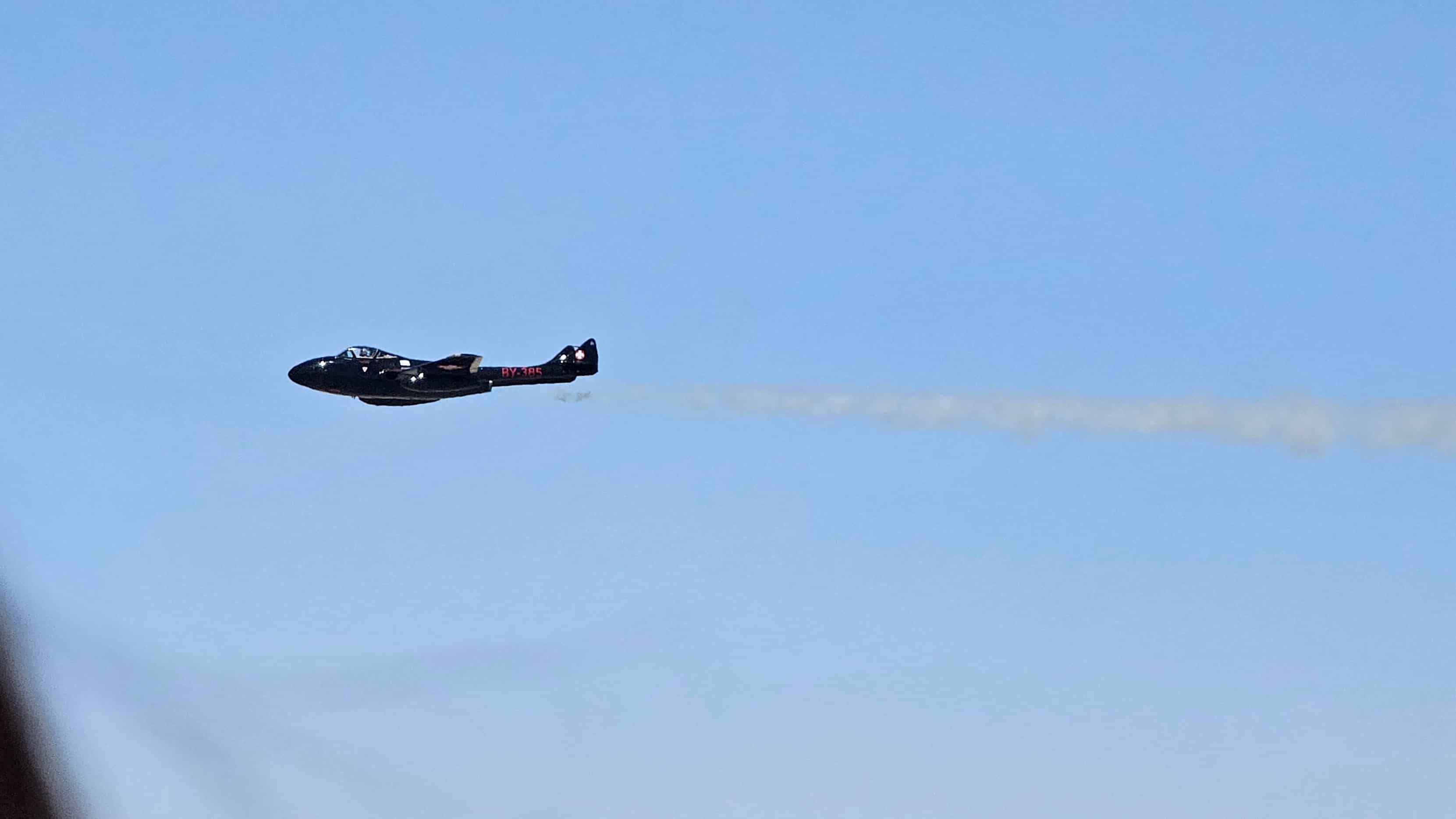
Norwegian AirforceThe Norwegian Airforce attended with two F16s, a Falcon and a de Havilland Vampire. I fell a little bit in love with the Vampire. The pilots were pretty cute, too.

F16The F-16 is a single-engined, supersonic, dog-fighting aircraft designed to be flown VFR. I like to think that I could fly one if I was given a chance to sit in the front seat. To be honest, I’d probably just sit there staring in awe if they did let me climb in. It took them quite some time to prepare the F-16s for flight. Meanwhile, we had a fly-over, Battle of Britain style.

Incoming!

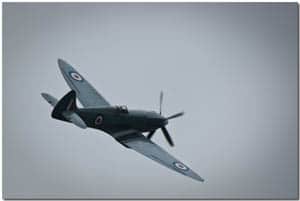
“The distinctive silhouette imparted by the wing planform helped the Spitfire to achieve legendary status during the Battle of Britain. Despite a public perception that it was the RAF fighter of the battle, the more numerous Hurricane actually shouldered a greater proportion of the burden against the Luftwaffe.”

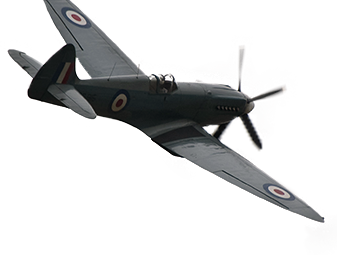
Lucky us, we had both a Hurricane and a Spitfire. Now I have to admit, I can’t tell the difference between the two. Luckily, they flew so low that I could easily see the registration and identify the planes that way.

The lower plane on the left is LF 363, Hurricane (Mk IIc) which was believed to be the last Hurricane to enter service in the RAF. LF 363 currently wears the colours of Hurricane Mk1 P3878 ‘YB-W’, the aircraft of Flying Officer Harold Bird-Wilson of No 17 Squadron during the Battle of Britain.

Goodbye, Spitfire

The grey plane is P5915, a Supermarine Spitfire. They were so close and so fast, it was difficult to train the camera on them, let alone get an in-focus shot. I have a few more misses than clear shots but I was very pleased with this one of the Spitfire as he passed straight by me before they flew off into the distance.

On the SpotMeanwhile, the engines had started on the F16s and they started rolling away.

I heard later that there was some damage to the runway. Apparently, the first F16 to take off heated up the tarmac to melting point and then the second one lifted the surface.

SpectatorsThe original briefing was was to do two fly-by’s of the airfield, flying out to Brookman’s Park VOR and back before escorting the Fan Jet Falcon back to Norway. Unfortunately, there seemed to be some issues with getting clearance from Stansted.

The F16s had to stay under 1,500 feet which is a lot lower than it sounds when 17,000 kilos of machinery are flying past!

Falcon taking the Norwegians back home

Can you imagine being an Easyjet pilot flying into Stansted as these planes thundered below you?

F16 and VampireIt’s hard to portray the speed with which the F16s hurtled past us. F-16 pilots must go through special training to deal with the high-G effects.

The US Air Force has lost 12 pilots and 16 aircraft to gravity-induced loss of consciousness (GLOC).

F-16 Fighting Falcon:

Sharp turns can induce loss of consciousness when gravity pulls blood toward the lower extremities, carrying oxygen away from the brain. After about 5 seconds of pressure, vision is progressively lost from peripheral vision to central vision. When blood flow is allowed to resume, vision is smoothly and rapidly recovered. Cerebral failure and recovery is much less graceful and predictable . After about 5 seconds of blood flow stoppage to the brain, GLOC occurs suddenly and lasts from 10 to 30 seconds (average about 13 seconds). When consciousness is regained, it is usually accompanied by brief seizure-like activity and a period of confusion,which lasts about 12 seconds. During this 12 seconds, the aviator is unable to function effectively.

Vampire

The Norwegian Airforce de Havilland Vampire took off with the F16s and the Falcon but after the initial fly-by it broke away. The Falcon, escorted by the F16s, continued to the Brookman’s Park VOR and on to Norway. The Vampire circled the airfield giving us great views of one of the most beautiful planes I’ve ever seen. It was soon joined by a second Vampire which is based in North Weald. There are very few Vampires still flying so it was a great treat to see them flying past in formation.

Representatives of NorwayI got to see the Norwegian Vampire on the ground after the display – it had a Mickey Mouse sticker on the side and a Norwegian flag lying on the dash. I wasn’t sure which of these was the pilot but the way the man in green leaned on it like he owned it, I suspected he was the one that flew it.

Flying has taken place on North Weald’s still very active airfield since 1916; with more than 50 units from seven nations (UK, USA, Norway, New Zealand, Canada, Czechoslovakia and Poland) operating from RAF North Weald prior to the station’s closure in 1964. They hope to arrange a series of fly-ins at the airfields leading up to the 2012 Olympic, each featuring a nation who had squadrons based at North Weald.

A Different Type of PlaneThere was plenty to do on the ground. Part of the field was set up as a “village green” with a bouncy castle and rides and military displays. It was very much a family event, with kids of all ages having a good time with barely a glance to the sky. I also got to take a closer look at some very details model aircraft from the North Weald model flying club. I have only ever seen them in the distance, usually thinking “is that a plane?” before watching an impossible spiral climb and realising that it’s unlikely.

All in all, it was a wonderfully pleasant day out.

I took hundreds of photographs but I managed to narrow it down to my favourites on Flickr. So if you have a moment, take a peep at the full set of photographs so that I don’t feel quite so guilty for spending all week sorting through them: Spirit of North Weald – a set on Flickr

11 September 2009

Never Ever on a Sunday

Our route for Sunday was simple: Málaga to Shoreham with a stop to refuel in Périgueux-Bassillac in France. We’ve been using Périgueux as a refuelling stop for a while now: the people are friendly and there’s never a queue for the pumps and so we get a fast turnaround. I noted that I didn’t have a Destination post for the airfield and made myself a note to write something on my return and quickly made a cheat sheet.

I have a form that I fill in for every airfield that we’re expecting to stop at. I verify the details each flight; it’s proven very useful to have the print-out on my clipboard for fast reference of all our stops in addition to my normal flight plan.

Location: Périgueux (Bassillac), France
Date: 6 August 2009
Sunset: 20:23 local

Airfield: LFBX
Website:
Phone Number:
ATC Tel: 00 33 5 53 02 79 75
ATC Fax: 00 33 5 53 02 79 78
PPR: No
Hours:
Frequencies:
Aquitaine Approach 119.275
AFIS: 118.775
Runways: 11/29 1750×30
Airfield Elevation: 328′
Circuit Height:
Fuel:
Weather Info: LFBE BergeracMeteo·Mobile | Metar LFBE by aviador
Divert: Angoulême or Bordeaux

Google Map View: Périgueux Bassillac

I only found half the details for Périgueux, they don’t have a website and the AIP is somewhat lacking in detail. However, as it was only a quick stop to refuel, I wasn’t that bothered. We knew that they had AVGAS and a very active flying club, so there wouldn’t be any problems.

Cliff flew the first leg and as we approached the airfield, he informed Aquitaine that he’d be switching to Périgueux information. Aquitaine politely pointed out that there was no one there for us to speak to.

“It’s always been manned before,” I said, nervously. Usually, Cliff rings the airfields as a politeness measure but it had been so hectic the day before, he hadn’t notified Périgueux directly. Not that it mattered as PPR wasn’t required, but it was a bit of a shock to hear that they were closed.

“Sunday in France,” muttered Cliff. “Everyone is asleep on a Sunday in France. I checked the NOTAMs, the airfield is open and fuel is available so it doesn’t much matter.”

We arrived to find the place was busy, a glider, two small planes and a model aircraft all preparing for flight in the beautiful sunny weather. I sent 15-year-old Connor to find someone to ask about fuel, thinking it would be good practice for his French studies. He found a friendly looking pilot near the club and asked him “…petrol?” with his best smile. It was a success, in that the pilot came to our plane to find someone who spoke passable French (Cliff, not me).

“Of course there is fuel,” he told us. “The pumps are automatique.”

We nodded happily as he reassured us that there would be no problem filling our plane and continuing our journey. “You just need a TOTAL card,” he said.

Wait, what?

He explained that you put the card in – only the one specific popular-in-France fuel card – and then the machine would turn on and we could dispense the fuel. And if we didn’t have a TOTAL card? Well, in that case, the machine would not turn on. He gave us a gallic shrug and wandered back to the club house.

“What will we do?” wailed Connor, convinced we’d be trapped in rural France forever.

We did not, as you may have guessed, have a TOTAL card. However, we had plenty of time and 30 gallons of fuel in each wing, 225 litres in total, so it was hardly a tragedy. Cliff needed to phone Air Traffic Control to close the flight plan anyway, so while he was speaking to them, he asked if Angoulême was open so that we could go there to refuel. Oui, Monsieur, Angoulême is open and has fuel, yes, they accept all major credit cards, not a problem at all.

Angouleme TowerWe piled back into the plane and made the short hop to Angoulême where we were told to go to the Flying Club and speak to someone there.

“Of course there is fuel,” he told us. “We run the pumps at the weekend on behalf of the airfield. You pay us and we put it on our account.”

That sounded fine until the man explained that he had no means of taking any credit cards at all. “The fuel company, they take credit cards but they are not here on a Sunday,” he explained. “I can put it onto my account and they will bill me but I can only accept cash.”

We pooled our finances together and found that we had a total of 17.63 euros which hardly seemed worth turning on the pump for.

Cliff got on the phone again and this time asked for advice as to where we might get fuel, in France on a Sunday, where we could use a credit card. La Rochelle, said the helpful man at ATC.

“Will you please contact them directly and verify that they are open, that they have fuel and that they will accept my credit card today?”

The gentleman took it with good grace and came back to us in a few minutes, confirming that La Rochelle did accept credit cards, even on a Sunday. Another 20 minutes in the air (the weather was crystal clear and the views were gorgeous, which made up for a lot) and we were at airfield number 3. Although we had to wait until Easyjet had their fuel before we could get ours, the young man was very helpful and more than happy to take our credit card in return for a few litres of AVGAS.

Who knew that France on a Sunday could be so exciting!

4 September 2009

On the Road Again

Summer is officially over: it’s time for Connor to go back to school. I hate September even more now than I did when I was a kid!

We’ll be heading off in the Saratoga on Sunday morning, taking off from Málaga (IFR as it’s the weekend) and flying 3.5 hours to in France. Just a quick break there for fuel and what my son calls “personal business” and then straight through from there to Shoreham.


View Malaga to Shoreham in a larger map

I wrote about Shoreham before but it could do with an update and maybe some photographs.

Destination: Shoreham

Shoreham Airfield

I’ll try to collect some interesting stories and photos for you while I’m away (but not TOO interesting, I hope!).